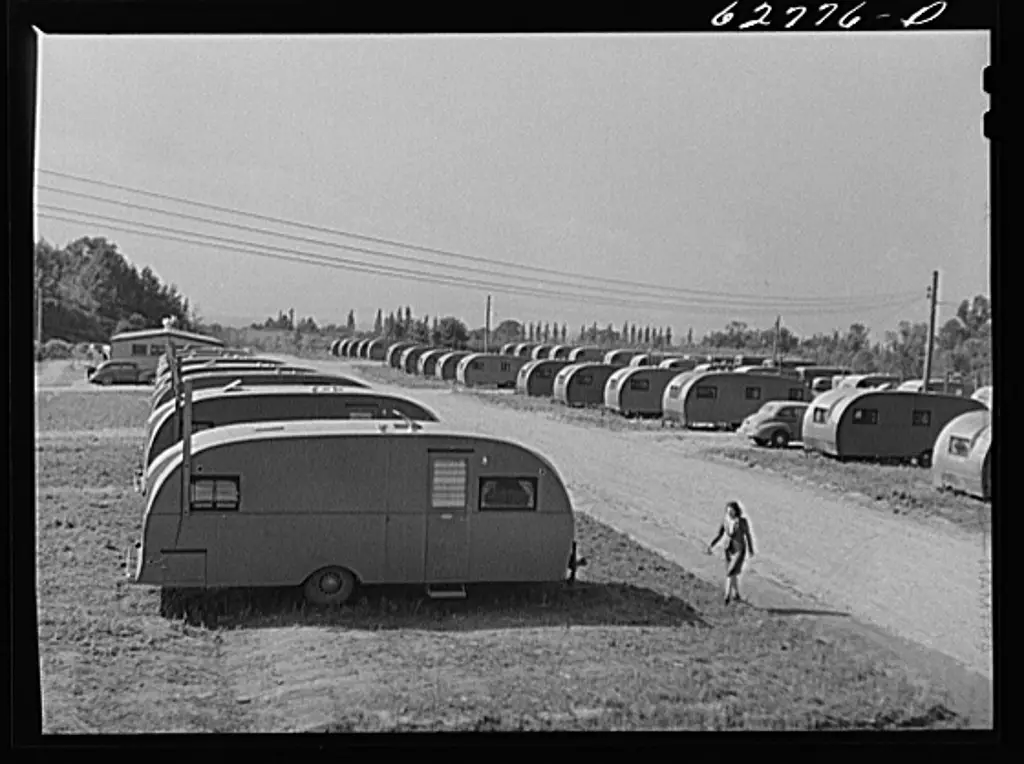
The early 1940’s was a challenging time for United States of America and trailers industry.
Our country was headed to WWII and rations were put in place in order to produce the necessities needed for the war. The mass-produced trailer was still in its infancy – factories had just begun producing trailers in 1936 so there were only a few companies producing them and they were still trying to figure out the best designs and materials to use.
Then, all of the sudden, trailers were tested on a broad scale due to WWII and unfortunately, the results didn’t fair well. The federal government ordered thousands of trailers to house factory workers and soldiers so they could help produce all the materials and products needed to fight the war. The homes weren’t built to high-quality standards because the new industry simply didn’t have the experience or materials needed to do the job right. It took 2 years before trailer construction was classified as a housing necessity so the builders had to use non-rationed materials until the classification was finally corrected. It would be like asking your kid to build a dog house without access to proper wood!
This is one of the biggest reasons trailers and mobile homes got such a bad reputation so quickly. The industry simply wasn’t prepared for the demand that WWII would put on them. The trailers had to be built in record time with a substandard material – still, the industry did it. They were able to step up and come through when it mattered most.
Thousands of soldiers, factory workers, and their families had never been around trailers before. Then they were suddenly living in these quickly (and poorly) constructed homes in a trailer park. This introduction to trailers left a lot to be desired! This situation is one of the biggest reasons trailers got such a poor reputation. Had the circumstances been different and the public been introduced to the homes in a different manner, I’m convinced the poor reputation wouldn’t have taken hold so tightly.
Trailer park living was hard living and there were pros and cons for both the federal and private parks. There was rarely enough water and trash receptacles were often overfilling in both types of parks. Mud was a big issue in the parks during the winter and spring too. However, the private parks allowed the workers to build onto their trailers, or at least modify them so they didn’t leak as much and held heat better. In some of the federal parks, wooded sidewalks were built to remedy the mud issue but you couldn’t modify or build onto the trailers at all. Private park living was considered the better since you could reinforce and modify the homes.
Related: Some Vintage Trailer Parks and Campground Images.
Below are photos from Burlington, Iowa in February 1942. This was a government park set up by the FSA.
The next set of photos was an FSA (Farm Security Administration) housing project set up outside of Erie, PA. There was a power plant that needed lots of migrant workers to keep it going during the war.
The people that lived in these trailers were heroes. While the trailers weren’t perfect they did their part to help the country overpower evil during WWII. Yes, they could have been built better but the companies did the best they could under the circumstances. They helped America do what America does best – come together in a time of need.
As always, thank you for reading Mobile and Manufactured Home Living!
This is a very condensed version of trailers during WWII. I hope to one day publish a small ebook covering the subject in depth because I find it so fascinating. Mobile homes and trailers have been a part of our country’s history for the last century. They have touched us all in one way or another. They deserve to be respected and the truth known about them!
All Images Courtesy of the National Library of Congress
Learn about mobile home additions and understand the pros, cons, and necessary steps for a…
Learn how to paint mobile home walls effectively, overcoming challenges with shiny surfaces and battens…
There're a ton of smart storage hacks to organize your camper on Pinterest and Amazon…
A small bathroom should be beautifully focused on function. Of course there are a few…
Over 100 beautiful manufactured home deck and porch designs plus free design plans and DIY…
If you own an older mobile home with a flat roof or have needed to…
This website uses cookies.