Blog

  • Mobile Home Roof Over Manual

    If you own an older mobile home with a flat roof or have needed to read our article about finding mobile home roof leaks more than once, it’s probably time for a roof replacement or mobile home roof over.

    If you need to replace your roof you have two options: self-supported mobile home roof over and not self-supported.

    This is an exhaustive 2100-word guide on self-supported mobile home roof overs. You’ll find links to other articles about roofs sprinkled throughout the page to guide you further.

    Which roof design should you use?

    Roof replacement experts need to inspect the home before they can give advice. Advice or deciding on depends on several variables. Age and size of the home being the most important but other factors are location, materials, and labor.

    A new roof over can provide a longer lifespan, better energy efficiency, and a give your home a more modern look. There’s a good chance it will increase the value of your mobile home too. Stay dry and warm are fairly important benefits of a healthy roof.

    2 Types and 4 Designs of Mobile Home Roofs


    Mobile homes are typically constructed with four prevalent roof designs: flat, bowstring, half truss, and standard sloped or pitched roofs.

    mobile home roofing shapes - illustration book 2

    Flat or bowstring roof designs were often used in manufactured home construction until the mid-1980s.

    Bowstring trusses are a dome shape. Most mobile homes will have bowstring trusses made with 2×2 or 2x3s. Structurally, they cannot withstand a lot of weight.

    Bowstring trusses are a dome shape

    Flat Roofs

    A flat mobile home roof comes from flat rafters or trusses.

    A flat mobile home roof is less expensive because fewer materials are needed.

    flat mobile home roof design

    Half Truss Roofs

    A half truss is used on double wides and means what it says, it’s only half a truss. When a double wide is married together, it forms a full truss that slopes down each side.

    double wide half roof truss roof installed in factory - Clayton Homes

    Standard slope trusses are the pitched roofs we see on modern single wides. They have a high mid-point and slope down each side.

    Pitched Roofs

    Pitched roofs have been the most common shape for both manufactured home roof design and site-built homes for over 3 decades. Standard pitch trusses are every 16″ or 24″ on center.

    mobile home with standard slope truss roof

    More expensive manufactured homes will have better framing and a shorter distance between the roof trusses.

    Related: See Common Questions about Mobile Home Roofs Here

    Can Your Mobile Home Carry the Load of a New Roof?  

    Before you can add a new roof to any home, you’ll need to ensure the home’s structure can withstand the weight of a new roof.

    Homes with flat roofs or bowstring-shaped trusses are typically not strong enough to withstand the weight of a new roof.

    A professional roofer will use special formulas to determine the best type of roof over. They’ll use the home’s framing and truss measurements regarding dead and live loads to ensure the new roof won’t be too heavy for the home’s framing to bear.

    Where the home simply cannot withstand the weight, the best option is to create a self-supporting mobile home roof over.

    Learn How to Find and Repair Leaks on Mobile Home Roofs Here

    If your home is older or made with smaller lumber, it may not bear the weight of the new roof, requiring post and beam framing that carries the weight down to the ground. This isn’t difficult, but it does add more cost.

    To give a mobile home with a flat roof better protection, more energy efficiency, and a more modern appearance, many homeowners chose a gabled roof over design, also known as pitched. These gabled roofs can be covered with asphalt shingles or metal panels – the weight doesn’t matter if the roof over has its own self-supporting frame.

    No other modification can completely change the look of a mobile home like a self-supporting roof over.

    Lean-to Design Used on Self-Supporting Roof Over design example

    Installing a self-supporting mobile home roof over is only recommended for homeowners who own the land their home sits on. There’s no sense in spending money on a self-supporting roof over if someone else owns the land or you plan on moving.

    Cost of A Mobile Home Roof Over

    Roof overs aren’t cheap but the long term heating and cooling savings can at least offset a bit of the cost.

    As with a large home improvement project, installing a new roof isn’t cheap because it isn’t easy. If you’re lucky, you can do it yourself or find a company that

    If the home’s construction cannot withstand the weight of a new roof, it will need to be designed as a self-supporting roof over, meaning its own footers will hold its weight via post and beam construction.

    A self-supporting mobile home roof over design means it has its legs or posts to stand on. The home itself will bear none of the new roof’s weight.

    The following images are all examples of self-supporting mobile home roof overs.

    Lean-to Design Used on Self-Supporting Roof Over

    Notice the posts every few feet running down the side of the home? The posts hold and distribute the weight of the new roof being built.

    Lean-to Design Used on Self-Supporting Roof Over

    After the framing was finished and the new metal installed, new siding was installed and painted blue.

    The taller roof makes this small mobile home appear much larger than it is.

    Lean-to Design Used on Self-Supporting Roof Over- after

    The posts spaced every few feet around the perimeter of the home, called perimeter footings and piers, are placed at least every 8-10 feet along the home’s perimeter to support the weight of the new roof.

    Pole Barn Design on Self-Supporting Roof Over

    This next example of a self-supporting mobile home roof over is popular because it is used on barns and sheds far more than on mobile homes.

    Your Mobile Home Energy and Repair Guide defines a roof over, or Ramada roof, as a new site-built roof that is installed above a mobile home that has its supports like a pole barn. Like this.

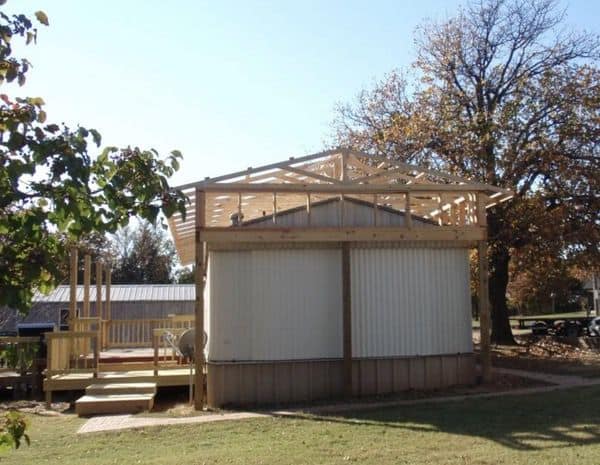
    This Is A Unique Self-Supported Mobile Home Roof Over. When Finished It Will Look Like The Pole Barn Design Below.

    Roof overs should be self-supporting like pole barns. In fact, many roof overs are just small pole barns over top the mobile home.

    Your Mobile Home Energy and Repair Guide
    self-supported mobile home roof over designs -shed barn
    This Self-Supported Mobile Home Roof Over Design Is Basically A Pole Barn Built Over A Mobile Home.

    You’ll see a self-supporting mobile home roof over built from start to finish. I found this build in a forum for Chevrolet fans (yes, I’m a Chevy fan).

    The single wide mobile home sits on Lake Eufaula in eastern Oklahoma. It has had a large deck on the front of the home for several years, but the homeowner wanted more shade and more protection for the home.

    If you want to sit outside during an Oklahoma summer, you’re gonna need shade. The homeowner knew he couldn’t attach anything to the mobile home because it can’t withstand the weight.

    Our homeowner used Google SketchUp to develop the plan for the roof over.

    building a mobile home roof over - sketch up design 2

    building a mobile home roof over from start to finish - sketchup design 1

    • Phase 1: Planning the New Mobile Home Roof Over

    Once the plan was created, he ordered $3000 worth of 6x6s and 5×5 posts and began building a structurally sound self-supporting mobile home roof over.

    • Phase 2: Posts Installed Around the Mobile Home

    The homeowner replaced old or damaged decking while installing posts.

    mobile home roof over - posts set around home

    building a mobile home roof over - step by step - installing posts around the home

    The homeowner says installing the four inner posts was the hardest job because there were already footers cemented in place.

    Integrating new posts into the existing decks was also time-consuming and required a great deal of work however, the decks are much stronger.

    • Phase 3: Installing the Railing on the Decks, Cutting the Posts to the Proper Height, and Adding the 2×8 Headers

    After the posts were set and the railings were installed, it was time to cut the posts to the proper height and notch them out to hold the headers.

    For the posts on the front and back of the home, the headers were doubled up and placed on the notched posts for proper load bearing. Here’s a closeup:

    • Phase 4: Installing the Short Wall Over the Headers

    A short wall for headers is a small section of wall built to support the beam (header) above a door or window. It helps prevent the header from bending or breaking.

    Temporary braces were installed to help keep the short wall in place until the trusses arrived.

    • Phase 5: Installing the Trusses

    Once the trusses arrived it was time to get them on the roof. Since there were only two people the homeowner used a slide and hoist system to get the trusses up safely:

    After placing the trusses on the roof, they are now ready for installation.

    The trusses have been placed as well as the purlins.

    Truss ties were installed:

    After installing the trusses, we now need to install the rafters for the deck roof.

    Phase 6: Installing Rafters Over the Decks

    rafters over the deck for self-supporting mobile home roof over
    rafters over decks on self-supporting mobile home roof over
    • Phase 7: Metal Roofing Installed

    The homeowner ordered 3800 pounds of 26 gauge metal in 12′ panels to place over the trusses and rafters of the home. Roof decking and insulation were not installed.

    Many homeowners opt to add insulation under their new metal roof. Perhaps the homeowner plans to add foam board insulation in the future? Still, with the new roof over, they will save on heating and cooling costs. The owner will also enjoy a longer life span and a whole new look for the lake home.

    • Phase 8: Ridge Cap, Side Wall, and Soffit

    finished look of the new mobile home roofover

    Popular Roofing Materials for Self-Supported Mobile Home Roof Overs

    We’ve previously discussed the 3 most popular roof over materials here: metal, shingle, and TPO. There are a couple more materials, like EPDM and standing seam metal roofing, that are used on mobile homes of all makes and models.

    Most experts can agree that the best materials for self-supporting mobile home roofs are shingles and metal.

    Shingles on Mobile Home Roof Overs

    Shingles have been the most popular roofing material in the last century, but metal has gained in popularity.

    Shingle roofs come in a few different colors and textures.

    Shingle roof overs can be installed over your original roof, as long as you have not already had a roof overdone in the past.

    The major benefit to shingled roof overs is the timeless appearance. Installing shingles is typically more costly than a TPO roof, but can improve the value of your home helping you recoup the total costs.

    Another benefit of installing a new roof on your mobile home is the insulation that goes with it.

    Corrugated Metal Mobile Home Roofovers

    There are a couple of different metal roofing systems used on mobile home roofovers. Old bowstring-shaped roofs are usually a tin of sorts that is very thin. It is easily damaged. It is recommended to replace an older mobile home roof with a metal roof product that is flat or standing seam.

    If you order from an actual metal roof producer you can sometimes get thicker metal for a lot less than the metal panels at Lowe’s or Home Depot. A lot of companies offer complete metal roofing kits for a metal mobile home roof over design.

    Standing Seam Metal Roof with Insulation is a Great Idea for Mobile Home Roofovers

    Metal roofs are extremely durable and can be installed on any slope. They are popular because the seam where two panels meet is above the water flow which greatly reduces any opportunity for water damage.

    A Chesterfield roofing company told us that metal roofs are lighter than shingles, are easier to install, and have a life expectancy of around 50 years. Metal’s durability and ease of installation make it a preferred choice for roofing professionals and mobile homeowners. Insulated metal roofs are even better.

    A thick layer of foam board insulation not only lowers heating and cooling costs, but it also reduces outside noise that’s so common in older mobile homes.

    Metal roof over can be put on top of any mobile home roof regardless of its current condition. Learn How to Hire Mobile Home Contractors Without Getting Ripped Off Here.

    Mobile Home Roof Overs That Do Not Require Support

    The following are images of mobile home roofovers that are not self-supporting, just to give you an idea of the difference.

    The first example uses pitch and gutters to its advantage. Notice how the roof overlaps the porch roof.

    In this next mobile home, the side panels above the walls were extended (much like the example above of the self-supporting roof). This is done to give the home a more prominent appearance and by raising the roof altogether it helps keep the eaves and carport out of the way.

    Related: Where to Find Mobile Home Parts and Supplies

    Can Your Home Carry the Load of a New Roof Over?  

    Before you can add a new mobile home roof over your home you’ll need to ensure the home’s structure can withstand the weight of a new roof.

    Homes with flat roofs of bowstring trusses pose a problem because they are not strong enough to withstand the weight of a new roof.

    A professional roofer will use exact measurements from the home’s construction along with framing and truss dimensions to calculate the type of roofover will work best. They must account for both dead and live loads to ensure the new roof won’t be too heavy for the home’s framing to bear.

    Where the home simply cannot withstand the weight, the best option is to create a self-supporting mobile home roof over.

    Weather Considerations for Mobile Home Roof Over Projects

    When planning a self-supported roof over for your mobile home, it’s crucial to consider the local weather conditions to ensure the longevity and effectiveness of your new roof. Here are some key weather factors to take into account:

    1. Wind Load

    Areas prone to hurricanes and tornados like Alabama require roofs designed to withstand strong gusts and extreme. Use wind-resistant materials and secure the roof with additional fastenings. In our research, we gathered some information from a roofer in Huntsville who services Northern Alabama and also learned that not only the materials for your roof need to be carefully selected with high winds in mind, but also that the structure of the roof, how often it is maintained and the overall style of the roof are all critical.

    2. Snow Load

    In regions with heavy snowfall, ensure your roof is designed to handle the weight of accumulated snow. Opt for a steeper pitch to facilitate snow runoff. Similar to high winds, the structure and style of the roof play a large role in how well the roof can tolerate harsh weather.

    3. Rainfall

    For areas with significant rainfall, ensure proper drainage systems are in place. A pitched roof with gutters and downspouts can prevent water pooling and potential leaks.

    Temperature Extremes

    Use materials that can expand and contract without damage in regions with large temperature fluctuations. Insulated roofing can help maintain interior temperatures and reduce energy costs.

    4. UV Exposure

    In sunny climates, choose UV-resistant materials to prevent degradation from prolonged sun exposure.

    By taking these weather considerations into account, you can design a roofover that provides optimal protection and durability for your mobile home.

    Conclusion

    In this article, we’ve shared several examples of both self-supported mobile home roofovers and regular mobile home roofovers that a home’s side walls can support.

    If you aren’t sure whether your home can bear the load of a new roof, have a professional roofing expert give you a free estimate. They will inspect the home’s wall, outriggers, rim joist, and roof framing to determine which mobile home roof over design best fits your needs.

    Also, always check with association guidelines if your home is in a park or other area where things like height or uniformity of the properties may be in question.

    Do you have a unique mobile home roofover design? We’d love to hear about it or see it!

    As always, thank you for reading Mobile Home Living!

  • Mobile Home Lot Rent Across the Nation

    Mobile Home Lot Rent Across the Nation

    We discuss all kinds of things on the Mobile Home Living Facebook page. Readers can ask questions and get answers in real-time from over 18,000 mobile homeowners across the nation. Recently, a reader wanted to know what other homeowners across the nation were paying for their mobile home park lot rent and what that price included. We asked our readers and received hundreds of answers from all over the nation.

    Below you’ll find the average mobile home park lot rent for states with the most mobile and manufactured homes.

    A Quick History of Mobile Home Parks

    From 1920 to 1930 travel trailers were considered a luxury item due to their cost. When the rare weary traveler decided to park beside the road to rest for the night it wasn’t a big deal. Families and local businesses living on major roadways actually encouraged travelers to stop so they sell hot food, water, and other needed wares.

    That quickly changed once mass-production made trailers more affordable and available to the average family.  By the mid-1920s those living on the major roadways in the US could expect to see 50-60 trailers every night. Unfortunately, property destruction, trash, noise, and crime became common and trailer owners were soon known for being destructive and wild.

    mobile home park rent across the nation - trailer park signs

    In order to remedy the problems created by so many travelers, townships and entrepreneurs along popular roadway created campgrounds. Wheel Estate claims there were between 3,000 to 6,000 municipal autocamps across the nation between 1920 and 1924. They go on to explain that there was a rivalry between community campgrounds:

    “..campgrounds were a source of community pride and an object of rivalry between neighboring towns. To be known as a nice place to stay reflected favorably on the whole community.’

    Campgrounds ranged in price from free to fairly expensive. The free campgrounds were often run by the townships and municipals but were eventually closed or turned into a pay by night campground because people would take advantage of the free rent and move in full-time. Time limits were also set so that no one could stay in the campground for more than 2 weeks at a time. Those rules are still enforced today in campgrounds ran by our state and federal governments.

    Hollywood Florida park - mobile home park rent across the nation18

    From Campgrounds to Trailer Parks

    The evolution of campgrounds to trailer parks was simple enough.

    Throughout the 1930’s and 40’s, trailers grew longer and wider and had everything a home had, including a fully functioning bathroom. They were better equipped for full-time living and harder to tow. Since there were way more trailers than tent travelers by the mid-1930’s, many campground owners began prohibiting tent-camping altogether and changed the name to better reflect their intentions. They saw the advantages of full-time tenancy and choosing who lived in their parks. Thus, the full-time trailer park was born.

    As with any business or product, there were different kinds of trailer parks. The lack of regulation or codes for trailers allowed for many landowners to just set up a park overnight. They offered little to no amenities but were cheap. There are records of corporations developing luxury parks with professional city planners and architects as early as the mid-1930s.

    You can read more about how the trailer park stigma began here. 

    The more expensive parks had gorgeous views, paved roads and pads, streetlights, laundry facilities, and playgrounds. The lower cost parks were located in the not-so-nice areas of town and had dirt roads that turned to mud when it rained.

    From Trailer Parks to Mobile Home Parks

    At the end of 1953, there were about 12,000 trailer parks in business around the country. Florida had around 1,500 parks and those park owners were reporting that 40% of their tenants were living in their homes full-time. It’s thought that about 1,000 new parks opened that year.

    Trailers cost between $2,800 and $6,500, depending on amenities and size. The average mobile home park lot rent in 1953 was $25 per month and that rate included utilities.

    The Trailer Coach Manufacturers Association decided to break into two different entities in 1953. The builders that would focus on larger units made for full-time living started using the term mobile home and called themselves the Mobile Home Manufacturers Association. 

    The builders that decided to stick with smaller units intended for hunting and vacationing would stick with the term trailer.

    That’s how the first name change and industry ‘transition’ occurred. The second name change would take place in 1976 when the HUD code took effect. They decided they wanted to call the homes manufactured instead of mobile. You can read more about that in my article titled No, I Will Not Stop Using the Term Mobile Home.

    Vintage Mobile Home Park Lot Rent Advertisements (1955)

    The images above show pages from a 1955 issue of Trailer Travel Magazine. We thought they were interesting and wanted to share them with you. There are no rates on many of the ads but the amenities and offerings are neat to read. Here are a few of the more interesting ads:

    Alabama: COURT STREET TRAILER PARK

    1263 S. Court Street Montgomery, Ala. A clean, modern and homelike park. Restaurant with real home cooking. Quiet location near two trading centers. Well behaved children and pets welcome.

    Arizona: LAZY-AS-CAN-B COURT

    Box 294 Sedona, AZ on beautiful Oak Creek. New, Modern, Quiet 110/220 Hookups, no meters, trailer size no object, children and pets welcome. Swim, Fish, Hike, Relax.

    California: PENROSE TRAILER PARK

    Largest trailers accommodated. Paved streets, patios, lawns, trees. Modern laundry, recreation hall. Hot and cold water at each space, natural gas. Near Lockheed.


    Connecticut: PILOTS POINT TRAILER PARK AND BEACH CLUB

    Smack on the beach. Westbrook, CT. Southern New England’s only seasonal park on the sea and sound. Brand new spaces for 50 trailers. Introductory rates $100.00 and up for the season. Light, power, and sewage. We reserve the right to refuse admittance of mobile homes that are not in well-kept condition. Exclusive membership. No transients.

    Florida: LINGER LONGER RETIREMENT TRAILER PARK

    Tarpon Springs, FL. 50 spots, some spaces 36 x 50 ft. Toilet connections, Recreation lodge, music lounge, and a mammoth fireplace. Cement patio lots $15.00 per month. Without patio is $12.00 per month. Special 10-year lease if desired. Year ’round occupancy. Pull in pick your spot and we will make you comfortable. NO PETS.

    Indiana: TED’S TRAILER TOWN

    Live in our strictly modern park. Close to lake, beaches, fast bus, and train service. 220 spaces. Children and adult sections. 3 minutes to downtown Gary. 45 minutes to Chicago Loop. Trailer Sales….New and Used. Pacemaker – Great Lakes – Westwood – Ironwood. USED $25.00 down. NEW $197.00 down. “Every size, every price, for every need.”

    PS Tenant-Owned and 55+ Parks are Special

    Before we get into the current mobile home park lot rent numbers, we need to stress two things:  55+ parks and tenant-owned parks are extremely different from regular mobile home parks. They are so unique that we don’t think they should be included in this article at all.  We think they both deserve their own articles and hopefully, we can make that happen soon.

    Tenant-owned parks are in a class of their own and cannot, or should not, be compared to regular parks. Tenant-owned parks are superior in many ways and hopefully will become more common as financial institutions realize the many benefits that come from tenant-owned parks. You can learn more about them on ROC’s website here. 

    1 1

    Mobile Home Park Lot Rent Across the Country

    Feb 1961 Ad for Arizona Mobile Home Park
    This Is An Advertisement Found In A 1961 Mobile Home Magazine For Mobile Home Park Lot Rent In Az.

    Arizona

    Arizona is a popular retirement destination and that means there are a lot of mobile homes. They are a great option for retirees that want to downsize and live in a more manageable home, after all. The dry heat and gorgeous scenery is a just a plus. One of our readers stated she pays $398 per month for a single lot in Tucson. The lot rent includes an indoor pool and clubhouse but all utilities are separate.

    mobile home park rent across the nation - California trailer park from the 1950's
    You Can See The New Asphalt Pads For This New California Coast Trailer Park.

    There is a place called The Cozy Peach at Schnepf Farms that rents out 10 vintage campers (including Spartans, Westwood, and Airstreams). You can read about Arizona’s glamping scene on their website here and learn more about the camper reservations here. 

    California

    There are a ton of mobile homes and mobile home parks scattered around the gorgeous state of California.  Unfortunately, mobile home park lot rent and homes aren’t as affordable as they are in the rest of the country because of the housing shortages in several cities. Still, you get to live in California so even paying extra seems fair.

    One of our readers in Sacremento told us they pay between $612 for the lot rent and around $80 for water and sewer, gas, and trash pickup.

    Our friend in the Central Coast area pays $707 for lot rent and that includes trash, water, and lawn maintenance.

    mobile home park rent across the nation - sunset park postcard

    The Paradise Cove Mobile Home Park and the Blue Skies Mobile Home Community are two of the most iconic and well-known parks in the nation. There’s also a place called Desert Sands Vintage Trailer Park that looks like all kinds of awesome.

    Denver, Colorado - mobile home park rent across the nation12

    Delaware

    A reader told us that she pays $800 per month for her lot rent but that she is in a nice park that would be considered ‘high class’ for the area and that it includes sewer, trash, pool, and a clubhouse.

    Florida

    Florida is the home of one of the first parks in the country, Parsley Trailer Park. It offered some amazing things like ballroom dancing, full community parties, boat docks, indoor pools, and gorgeous views.

    We received 3 reports with mobile home park lot rent running around $400 ($390, $400, and $440). This includes trash pickup and lawn care. Another reader said she pays $601 per month and only gets trash pickup.

    Tenant-Owned Park in FL

    We have a reader on the Gulf Coast of FL that lives in a tenant-owned park and she pays a whopping $128 per month for the lot rent, water, sewer, trash, and lawn maintenance. The park has a pool and a clubhouse. See the difference between for-profit parks and tenant-owned?

    Parsleys trailer park-alanp_photo-flickr

    Georgia

    One of our Georgia readers said she paid $425 per month for her mobile home park lot rent and gets cable and trash pickup. Another reader reported $300 per month with trash only.

    Illinois and Indiana

    Illinois and Indiana fell in the same range and offered similar amenities. A reader in Indiana reported their mobile home lot rent to be $320 with trash pickup. Our Illinois reader reported $370 with trash pickup.

    Iowa

    Iowa had the lowest mobile home park lot rent. Our reader stated she paid $140 per month for the lot rent itself and an additional $25 for trash, sewer, and snow removal. That sounds like a great deal!

    mobile home park rent across the nation25

    Kansas

    Kansas reports in at $255 per month and that includes trash, cable, and internet. There is also a pool, clubhouse, and a storm shelter in the park. Wow, Kansas sounds like a great deal!

    Kentucky

    We received 2 reports for Kentucky and both were for $350 a month.

    Maine

    Worchester, Maine has a park with lot rent at $381 per month. This price includes cable, trash, and snow removal.

    Michigan

    Michigan reports in at $330 with no utilities or amenities included.

    mobile home park rent across the nation - vintage park

    Minnesota

    Our reader in Northern Minnesota pays $258 for just lot rent. A reader in the Minneapolis area pays $425 but that includes trash.

    Missouri

    Missouri seems to be a very affordable state for mobile home park lot rent. One reader reports paying $185 for a 100′ X 200′ foot lot with sewer and water included.

    New York

    One reader told us that she pays $400 per month in Western New York and only water is included.

    mobile home park rent across the nation . - arial view of vintage park
    Hanford Mobile Home Park

    Ohio

    One reader pays $240 a month for lot rent, trash, and snow removal.

    Oklahoma

    A mobile home park in Oklahoma City charges $316 per month for lot rent, water, and trash pickup.

    Oregon

    We were told one reader pays $554 per month in Western Oregon and that includes sewer and water.

    South Carolina

    The South Carolina coast is one of the fastest growing areas in the nation (or so I heard on the news) and property and rent prices are getting steep.

    We received two reports, one for $280 per month that included nothing and another for $550 that included a boat dock, pool, trash, and sewer.

    Texas

    Texas has 19 manufactured home factories and there are a lot of parks. A park in Belleville, TX charges $225 per month and that includes trash and water. A Greenville park charges $242 for lot rent and a pool.

    mobile home park rent across the nation - arial view of 1970's park

    Utah

    Our UT reader seems to have a decent deal going on. She pays $450 for lot rent, trash, pool, and a full-time handyman that can help her with small repairs. How cool is that?

    West Virginia

    Mobile home parks are affordable in West Virginia. For a small park with older homes you can expect to pay $250 month and that will include trash.

    Mobile Home Park Rent Across The Nation23 700x375

    Conclusion

    As you can see, living in a mobile home park lot rent varies drastically across the nation but it’s still one of the most cost-effective housing choices.

    Be sure to read the comments below, dozens of readers have shared their park’s rent and amenities from across the country.

    We’d love to know how much you pay for your mobile home park lot rent. Add it in the comments below!

    As always, thank you for reading Mobile Home Living!

  • The History of Mobile Homes

    The History of Mobile Homes

    Everything has to start from something and the mobile home history is very rich. The original mobile home dates as far back as the early 1500’s.

    Wagons Were the First Mobile Homes

    Horse-drawn carriages carried the people selling their wares from town to town. From that lifestyle came beautiful hand carved and very elaborate designs like this wagon I found on Wikipedia:

    horse drawn carriage

    Fast forward to a brand new country and new people coming to that country finding a better way of life, some succeeded, some didn’t. The first “movable” home in the US was on the Outer Banks of North Carolina. When the tide went up a team of horses would move the home to a safer location on the beach.

    How the Mobile Home Evolved

    Add the invention of the automobile in the early 1900’s and you have what, we today, consider a true mobile home. People found that in order to support their family they had to be able to move wherever the work was. The hybrid home and auto was probably some guys way of solving his biggest problem: how to move his wife and kids comfortably and without them fussing the whole drive and still be able to make a living selling his trades. It was a genius’s way of solving the problem. I found this and all the rest of the pictures to follow on Dornob.

    1900s mobile home

    I’ve researched to find more information on this hybrid but couldn’t. I’m only guessing that this was not mass produced by a company. I could be wrong.

    The next wave of mobile home inventions and designs came from pull-trailers used for camping. A man that didn’t want to camp in a tent came up with a way to pull a cart with his car. The cart’s roof was raised up once it was at the camp and they would sleep in it. Of course, progress happens and better designs follow. By the mid-1940’s the trailer that the cars could pull averaged 8 ft. wide and 20 ft. long. It could sleep several but had no bathroom. Later that decade, the length went to over 30 ft. long and bathrooms were installed. By this time the men who had fought in WWII were coming home in masses and cheap housing was a necessity. Mobile homes were a great fit for many and the industry continued to evolve and flourish.

    1940 mobile home design

    This is a fine example of the era. The designs were ever changing and improving year after year. Some mobile homes even had 2 stories. I personally would love to have one of these. They are awesome!

    1940 mobile home design

    These pictures are just 2 of the many, many different designs you could choose. They were made with every attention to detail, from a lazy susan to an apartment sized gas range. You could choose your color schemes, layout and appliances. From the single wide evolved the double wide and now today there’s even triple wide homes.

    In 1976, the US Congress passed the National Mobile Home Construction and Safety Act (42 U.S.C.). This was necessary to hold the industry to a high standard and to ensure that everything they put in the mobile home was safe. In 1980 Congress, due to pressure from the industry itself, changed the name mobile home to manufactured housing on the bill. I guess they wanted to update the image of the industry, and “manufactured home” evokes a higher class of product. There is very little difference in the two though. One is made without regard to the site the home will eventually sit on and is completely built in a factory and the other takes the site into consideration, waiting till it gets there to put the home together.

    To know the history of something is to understand it better. Now that we have glimpsed thru mobile homes history I hope you can be proud of it. Mobile Homes evolved from necessity. Man has always adapted his surroundings to him and the mobile home is a prime example.

    Thank you for reading Mobile and Manufactured Home Living.

  • Guide to Mobile Home Windows

    Replacing mobile home windows will save on energy costs and give your home a whole new look. If you want to spend your remodeling dollars wisely you cannot go wrong with new windows. You get better heating and cooling control and update the appearance of both your interior and exterior. That’s a decent bang for your buck.

    Replacing mobile home windows isn’t difficult if you don’t have to retrofit a different sized window. Unfortunately, because mobile home windows have a “non-standard” size. If you are a seasoned DIYer with moderate construction knowledge and experience replacing a window of the same size should be no problem. If you are installing a smaller or larger window the difficulty factor increases quite a bit.

    In this article, we share the types of windows found in mobile homes, how to choose the right replacement windows for your mobile home, and share a step by step guide on how to replace mobile home windows.

    Awning Window For Mobile Home
    An Awning Window

    Mobile and manufactured homes typically have 6 different types of windows: Jalousie, awning, casement, slider, double and single hung, and custom.

    Awning Windows

    Awning windows are like Jalousie windows but with 2 or 4 larger panes of glass.

    The panes open and close via a crank mechanism and torsion rod. Awning windows were popular between 1976 and 1985. Think of them as the ‘new and improved’ Jalousie window.

    Casement Windows

    Replacement casement windows come with hinges on the side, operating outward to the left or right, providing optimal ventilation from top to bottom. These units are easy to operate due to their turn crank mechanism and superior hardware. 

    Casement Window
    A Casement Window

    Moreover, you homeowners can select fixed casement windows that don’t open but guarantee lots of natural light and improved energy efficiency. Generally, casement windows with triple glazing and LoE coating may be up to 55% more energy efficient than standard windows.

    Why choose new casement windows?

    • highest energy efficiency among operable windows
    • exceptional ventilation
    • little-to-no maintenance
    • durability
    • warranty up to 25 years when buying from reliable contractors

    Double Hung Window
    Double Hung Window

    Double Hung and Single Hung: Double hung windows are now the most popular window type. Single hung are a bit cheaper.

    Jalousie Window For Mobile Home
    Jalousie Window

    Jalousie windows were installed in mobile homes built before 1976. Several panes of glass are installed horizontally and the panes are opened and closed with a torsion rod and crank. Jalousie and awning windows are not very good at stopping drafts so they should really only be used in the south.

    Slider Window In Mobile Home
    Slider Window

    Slider windows (horizontal and vertical): Slider windows were popular in mobile homes between 1986 and the late 1990s. One example of a horizontal slider window is in most mobile home bathrooms. Horizontal sliding windows are affordable and often used as replacements to the original mobile home window.

    Custom Shape Window In Mobile Home
    Custom Shape Window

    Custom windows can be any unique shape such as the half or full circular.

    Why Replace Mobile Home Windows? 

    If your home is more than 30 years old and still has the original windows you will probably want to replace them soon. While it is a large upfront investment the long-term savings on your energy costs and the updated appearance will make it worth every dime.

    Replacing windows is a smart mobile home remodeling project that will affect both the interior and exterior of your home and give you better control over your temperature and energy consumption. It’s a win, win, win!

    Wood sided manufactured home with picture window on end

    Mobile Homes Windows Come in Odd Sizes

    In most older mobile and manufactured homes, you cannot buy a standard window at Lowe’s and expect it to fit the opening in a mobile home unless you plan on retrofitting it.

    Unless retrofitting sounds like your idea of a good time, you will want to order the exact size you need from a mobile home supply store.

    Keep in mind that if you order the windows online the shipping increases the price per window significantly so try to find a local mobile home supplier first.

    Slider window in Remodeled Single Wide Mobile Home For Sale In Denver Craigslist Steve11 Copy 2
    Slider Window In A Mobile Home.

    Related: Three Popular Mobile Home Roof Over Materials

     Team effort to install the picture window on The Whim. See it here.

    Single Hung Vs Double-Hung Windows

    A single-hung window is fairly self-explaining:  In a single-hung window the bottom panel, or sash, moves vertically, while the upper sash remains stationary. When opened, the bottom sash partially obstructs the upper sash. While single-hung is cheaper than double-hung, you get the same appearance. However, you are losing R-value and insulating properties compared to double-hung windows.

    A double-hung window offers the homeowner the ability to open each sash, rather than just the bottom sash. This allows for better airflow and ventilation. The ability to open and tilt each sash makes cleaning easier, too.

    Single Hung Vs Double Hung Windows
    Single Hung Window And Double Hung Window (Source: Greatlakeswindow.com)

    Vinyl or Aluminum?

    The two most common window frame materials for mobile and manufactured homes are vinyl and aluminum. Each has its advantages and disadvantages.

    Vinyl is the most popular window frame material because it is cheap, has good energy efficiency abilities, and a long lifespan. It’s available in several colors but white is the top pick.

    An average vinyl framed window for mobile homes, measuring 14″ x 27″ with double-hung glass, was found online for around $85 without shipping costs added.

    Aluminum Windows

    Aluminum windows have been used on mobile and manufactured homes for decades. It is strong and cheap to produce and does very well at creating an airtight seal. Most will agree that aluminum windows aren’t the prettiest but they get the job done and that’s all that matters.

    Aluminum windows are cheaper than vinyl. What you lose in appearance you gain in value. A 14″ x 27″ aluminum window can be found online for around $45 without shipping. Aluminum window repair is possible but research shows the cost of repair is comparable to buying a whole new window.

    Related: 6 Mobile Home Maintenance Tips Every Owner Should Know

    Mobile Home Window Guide

    Guide to Replacing Mobile Home Windows

    Step 1: Remove the Window

    The type of window and siding on your home will determine how easy it will be to remove the old window. If the window’s frame is over the siding just unscrew the numerous screws.

    If you cannot see the frame and screws around your window you’ll need to find them. For vinyl or metal siding, you will need to remove the siding sections that surround the window.

    Step 2: Measure the Opening

    Your measurements will make or break your entire project. You need to get it right!

    Most importantly, when replacing mobile home windows, you don’t measure the window, you measure the opening after the old window has been removed. 

    Next, you’ll need to check to see if the opening is square. If it’s a bit off you can use shims to adjust the difference. If it’s off by a lot you may want to use a smaller window so you can create a square opening yourself.

    One expert recommends that the rough opening of the window sill should be square to the sill within 1/8″ across the full width.

    Step 3: Prepare for the New Window

    Old putty or caulk will need to be removed around the opening of the window so that new sealant can be used.

    When you install the new window you’ll want to use new screws. Assuming the opening is square, you’ll create a line of caulk and install the new window into the opening and then screw it in.

    Mobile homes are not uniform when it comes to exterior wall thickness. Some homes are built with 2 x 4’s and some with 2 x 3’s. The width of your home and of the old window will need to be given to your window supplier. They can give you the best advice about the sashes for your thickness. Sometimes it’s best to order windows without a sash.

    Step 4: Seal the Frame and Replace the Siding

    Finally, run a line of silicone sealant around the entire outside of the window frame. Then simply return the siding over the edges of the frame.

    I hope these steps will help to work as a guide to replace mobile home windows and giving your manufactured home a fresh look!

    As always, thank you so much for reading Mobile Home Living!

  • How to Replace a Subfloor in a Mobile Home: Step-by-Step Guide

    Chances are you’ll need to replace a subfloor in a mobile home eventually. This is especially true if your mobile home is older and you have a bathroom

    A mobile home’s bathroom subfloor is usually the first space that needs replaced. The kitchen second.

    In this in-depth article explains how to replace a subfloor in a mobile home and share some great photos and videos that show you the entire process from start to finish.

    First things first…..

    What is a Mobile Home Subfloor?

    Mobile and manufactured homes have the same construction elements as a site-built home. They’re just built differently.

    In order, ground up, a mobile home has a chassis, floor joists, a subfloor, and then the floor covering on top.

    What’s the difference between a subfloor and a floor?

    The subfloor sits between the floor covering and the floor joists. It’s the meat of the flooring sandwich for lack of a better description.

    The images above are good depictions of a mobile home subfloor. The only issue is that the image shows the subfloor as boards instead of the 4′ x 8′ sheets that they are.

    Mobile homes were constructed with particle board subfloors for many years. Manufactured homes typically have plywood subfloors. Particle board is made from sawdust and glue and became popular after WWII. It’s a great product as far as strength goes but has one fatal flaw: water can destroy it a bit quicker.

    Soft Spots and Warping

    Water and fire are the two scariest enemies for any home, whether it be manufactured or site-built. Fire is sudden and obvious, water not so much.

    A small amount of water can cause particle board to start bowing, warping, and developing soft spots. Rot quickly follows.

    If you have a soft spot or bowing in your subfloor it needs to be addressed as soon as possible. You’ll need to find and fix the cause of the problem first. Once that’s done, you’ll want to replace the damaged area so there’s no further damage.

    Most newer homes now use a higher-grade plywood or OSB because it can withstand water better.

    Read about mobile home MDF cabinets here.

    Is a Mobile Home Subfloor Replacement a DIY Project?

    Replacing a mobile home subfloor isn’t easy but it’s doable if you have a fair amount of construction experience. I give it a difficulty score of 7 out of 10.

    For bathroom and kitchen subfloor replacements you will be dealing with major components like plumbing and wiring so it’s smart to have a professional involved. However, since this is the real world and most of us can’t afford a professional, we just have to do the best we can with what we have and that’s just fine. You’ve already proven yourself capable than most by researching first.

    The most difficult parts of the job are removing the old flooring, building out the perimeter joists, and keeping everything level. We’ll deal with each part below.

    replace a subfloor in a mobile home

    Tools and Materials to Replace Subflooring a Mobile Home

    Thankfully, the material list to replace a mobile homne subfloor is fairly short.

    1. Plywood (3/4″ OR 5/8″). We recommend marine grade plywood for kitchens and baths.
    • 2 X 6 and 2 X 4 Lumber (scrap lumber will work in many situations)
    • Galvanized Screws
    • Liquid Nail Adhesive
    • Underlayment or waterproofing depends on the floor covering

    Tool List

    • Circular Saw (this is vital)
    • Hammer
    • Pry Bar
    • Knife, Blade, Scraper
    • Standard DIY toolbox should be close cause you just never know what you’re gonna see

    Step-by-Step Process to Replace Subflooring in a Mobile Home

    This is a ‘quick and dirty’ list of the basic steps needed to replace flooring in a mobile home.

    Step 1: Remove the Trim and Floor Covering

    The first step to replace subflooing in a mobile home is to remove the trim and floor covering.

    If it’s carpet you will need to remove the nail strips carefully.

    Vinyl floor (that is one solid sheet) will usually need to be cut around the perimeter of the room.

    Tile will need to be ripped up.

    Learn more about floor covering for mobile homes here.

    Water Leaks Need to Be Found and Fixed

    If a leak caused rotting or flooring warping and bowing, you must find it and repair it before moving on to the next step. Plumbing, doors and windows, and roofs are the most common places for leaks.

    With the floor covering removed you will be able to trace the leak better. Follow the damage. Most of the time it will be a window or roofing issue and the water is running down the wall.

    Bad toilet rings and damaged water supply lines are other common source of leaks in mobile homes.

    You can learn more about mobile home plumbing repair here.

    Understanding How Home Mobile Homes are Constructed

    You may need to use a Dremel tool or knife to get the sub-flooring out from underneath the walls if the sub-flooring is damaged or rotted. If it’s healthy, you’ll likely want to leave the subflooring under the walls alone.

    knowing how a home is constructed is important when replace subflooring in a mobile home
    The Subfloor And Floor Covering Are Installed Before The Walls When A Manufactured Home Is Built.

    Manufactured home builders construct homes in layers. All the flooring is laid before the walls are installed so chances are your flooring and floor covering will be under the entire wall.

    https://www.youtube.com/embed/duJE9EuFsMM

    Measure Your Subfloor Thickness

    Next, you will need to measure your subfloor. Most subfloors are either 3/4″ or 5/8″ thick.

    You will use the measurement to set your circular saw to the proper height. One of the most tedious parts of replacing subflooring in mobile homes is the removal of the original sub-flooring.

    After you set your saw, you will carefully cut only the subfloor. Use caution so you don’t cut a joist. Here’s a video showing how to use a circular saw to cut out subflooring in a mobile home:

    Cutting Out the Subfloor

    If your flooring is 3/4″  set your circular saw to that and follow the perimeter along the edge of the room. You do not want to touch the joists below.

    This is one of those tedious jobs no one likes to do!

    Cut the Subflooring Between the Joists

    Now that you’ve cut the subflooring around the edges, you will need to cut them down so you can remove them easier.

    The smaller the pieces, the easier it is to get them out of your way. If you have ensured there are no pipes or wires between the joists you can simply saw between the joists and remove each piece.

    Remember to keep the saw set to the same thickness of the flooring to keep so you do not damage the joists.

    If you can cut out an inch or so under the wall without damaging the wall you can slide the new sub-floor under the wall.

    This is the ideal method in the subflooring is rotted or weakened in any way.

    new plywood to replace subflooring in a mobile home

    Inspect and Repair Joists

    At this point, all the sub-flooring has been removed and you have a perfect opportunity to inspect the joists for any damage. If you do see damage,  you can reinforce it by adding an additional 2 x 6 to the original or removing and replacing.

    If there’s not much damage, reinforcing is probably easier. Measure the space between the joists so you can cut the lumber (2×6) to the right length so they fit in between the joists.

    Adding New Insulation is Crucial When You Replace Subflooring in a Mobile Home

    This should be a top priority. Spending an extra $30 can save you a lot more in energy costs in the future. Remember, wiring and piping should be above the insulation so that the heat from the home can get to it.

    See The Short Joists? Those Are Placed Where The New Subfloor Panels Meet.

    Laying the New Sub-Flooring Down

    Around the perimeter of the room, you will need to attach an additional 2 x 4 to the original so that you have a shelf or lip to lay the new sub-floor down, then nail and glue.

    At each seam, where one piece of plywood ends and another begins, you will need to reinforce under it.

    This means you will need to add a 2 x 4 between the original joists so you have a place to nail and glue down the plywood.

    You can see this happening in the photo above, where the small boards have been added between the long joists.

    https://www.youtube.com/embed/6Opo8ADrf_k

    Sub-flooring should be laid in the same direction as the original, usually opposite the direction of the joists.

    New Subflooring In A Mobile Home.

    Install the New Floor Covering

    Luckily, your choices are endless when it comes to floor covering for mobile homes.

    If it’s in a bathroom, it’s probably best you go with a thick vinyl that has some protection against water will help protect your floor.

    updated single wide-flooring during 3
    New Floor Covering Installed In A Single Wide.


    Enjoy Your New Floor

    Congratulations, you have a great looking floor that will last for many years!

    updated single wide-flooring after
    New Flooring In A Mobile Home.

    It is complex to replace subflooring in a mobile home but it’s a common project for homeowners of older mobile homes.

    New subflooring, along with new insulation, will help your home last longer and save heating and cooling costs.

    As always, thank you for reading Mobile Home Living!

  • Ultimate Guide to Mobile Home Additions

    Many mobile homeowners attach porches and additions onto their mobile homes incorrectly. It’s not usually a detrimental issue, thankfully, but an incorrectly installed mobile home addition can pose problems. In this article, we are going to cover mobile home additions as thoroughly as possible. We’ll cover the advantages and disadvantages of adding to your mobile home and all the basics of building an addition or porch onto your mobile home, plus a few more important things you should know.

    The Basics of Building a Mobile Home Addition

    There are a few basics you should know before you decide to build an addition onto your mobile home.

    The top priority for any homeowner considering an extension to a mobile home is to understand that the extension must not be connected to the existing structure. This implies that the extension should be constructed independently with its own footers. This ensures that the load of the new construction is evenly distributed into the ground rather than onto the original home.

    Mobile Home Additions Must Have Their Own Foundation So It Can Shift Independently of the Home

    A mobile home addition must move freely from the home itself. Porches, decks, and additions must have their own foundation or footers so the structure can shift independently of the home. The addition is simply ‘butted up’ and attached to the mobile home, and ‘sealed’ so nothing impedes the separate movement.

    In other words, an addition should have at least 4 footers, one at every corner to transfer its weight to the ground. If you only see two footers at the ‘end’ of the addition (the side opposite the home), then it’s probably wrong and should be checked by a licensed profesional.

    Additions Post
    Your addition or porch should not be attached to your manufactured home like a porch or addition is attached to a site-built home!

    To put it simply, you aren’t attaching the addition to the home at all, you are building extremely close to the home and then sealing the crack between the home and the addition to prevent air and moisture leaks.

    Footings for Mobile Home Additions

    An addition needs a completely separate foundation from the home. And, like any structure, the footers must be placed below the frost line to keep them from shifting when the moisture around the cracks in the ground freeze causing the footers to heave and bow.

    There are poured footers, cinder blocks, slabs, and piles. Footings for a mobile home addition should be determined by the depth of the frost line of your area, even if your home does not have the frost line footers so that shifting is minimal.

    Here’s a map showing the frost line depths for the US:

    frostline depth - building mobile home additions - footers

    Footers are installed below the frost line so that the addition doesn’t sink or shift.

    Frostline Footings
    If You Do Not Use Frost Line Footings Your Piers Can Shift Creating Stress On The Home And Ultimately Making It Unlevel. If It’S Especially Soft Ground The Two Sections Can Separate.

    Financing and Insurance Issues for Mobile Home Additions

    Additions to manufactured homes are not often seen as an ‘improvement’ – meaning it probably won’t increase the value of the home in most cases. It won’t change the classification of a manufactured home from personal property to real estate unless the home is permanently installed.

    A big disadvantage of building an addition on your mobile or manufactured home involves financing and insurance. It may be harder to obtain both if your home has been modified in any way. If you didn’t get the proper inspections and permits you may run into serious issues if you try to sell the home later down the road.

    Permits and Inspections

    Some state mandates override local and county regulations when it comes to manufactured homes. Research properly for your location before you begin planning a mobile home addition. With some locations, you could run into so much red tape that the project ends before it even begins.

    With all that said, mobile home additions are perfect projects for families that need a larger home but you must get permits and inspections done before, during, and after the construction process. Read about one manufactured homeowner’s experience while building an addition onto his single wide. He failed to get permits and inspections done and paid a price when he sold the home.

    Addition on 1985 Liberty Single Wide

    Sarah and Justin Wartick built an addition onto their 1985 Liberty single wide. You can see how they created the footers right up against the home and then framed the floor of it out (they were test framing the top in the first image). The second image shows the walls and roof have been framed and the floor joists being laid.

    These next two images are the interior of the addition. The image on the right showing the door with the two steps is where the mobile home and the addition are attached. Technically, this is the only place the two structures meet other than where the roof and the siding are ‘sealed’ together.

    HUD Guide on Manufactured Home Foundations and Support Structures

    There are some great online resources about mobile home foundations. This guide about manufactured home foundations and supports is invaluable. 

    For information about general construction footers, Front Porch Ideas and More has some nice illustrations that show the poured concrete and pier footings.

    Mobile Home Additions - correct frost line footings and pier
    Mobile Home Additions - correct frost line footings and pier graphic
    pouring a pier foundation - Mobile Home Additions - correct frost line footings and pier

    There are new products hitting the market to aid in DIY footings such as these square foot concrete forms.

    Mobile Home Additions - correct frost line footings and pier - proprietary systems

    Framing an Addition

    You want the mobile home addition to having framing that is equal to or better than the framing that your home has. Of course, you’ll need to follow your local code.

    Below shows a mobile home addition being framed out by SM Construction.

    framing of mobile home additions

    A great blog called Dovetail Blog shares its mobile home addition process in detail. It’s a small addition but the end results are beautiful:

    As you can see, they used poured concrete footings and extended the roofline down to the addition, keeping the pitch. The addition looks to be used as an entryway that houses the stove and is a few inches lower than the home, except for a platform that the stove sits on.

    mobile home additions - after

    Here’s the interior of the home:

     Opening Between the Home and the Addition

    You’ll have to determine the size of your opening from the home to the addition. Doorways are easier to close up should the home ever need to be moved or the addition removed.

    If you do opt for a wider opening between the home and the addition you will need to consider support issues for the opening. Wider openings, where studs would need to be removed, will likely require support beams. That’s not the smartest move for mobile home perimeter walls because those are your load-bearing walls. In other words, keep the opening small so that it’s easier to seal around the home and to keep from needing to support the perimeter wall with a beam.

    Sealing Around the Mobile Home and the Addition

    As stated previously, basic mobile home additions are not completely attached to the home. They are simply butted up to the home and then sealed all around to prevent leaks.

    There are a variety of ways to seal the connection between the home and the addition. To seal the gaps between the home and the addition you can use weatherstripping, flashing, backer rod, caulking, and lumber. A backer rod is just a fancy name for round foaming that can be used as a membrane between the 2 structures.

    There is a popular way to attach the siding of the home to the addition. Attach a 1×6 board to the home vertically so the addition will butt up against the middle of that board. You’ll attach another board with a lip to the side of the addition. Then, add weatherstripping and screw the lip of the addition to the board on the house – this brings the addition toward the home and helps seal it without overly damaging the home.

    These questions were asked in the comment section of our very informative article about building mobile home additions found here.

    Flashing and vinyl siding will cover it all up.

    Use flashing to connect the Mobile Home Addition’s Roof

    If the addition is lower than the roof on your home

    To connect the addition to the mobile home if the addition is lower than the roof on your home, you will need to use flashing to seal the gap between the home and the addition’s meeting points.

    Metal roofs

    For a metal roof, you would tuck a single length of 18″ flashing, that has been bent to the needed angle, place the flashing under the homes roof edge and over the addition roof.

    Attach to both with screws. Using 2″ neoprene flashing tape is always a good idea, and always seal the screws with weatherproof caulking (neoprene based).

    One note about the flashing, you want as long a piece as possible, but you don’t want it too long. If the flashing is too long, it can cause cracks.

    If the addition’s roof is higher than the roof on your home

    If the addition’s roof is higher than the roof on your home, you add the flashing under the lip of the roof of the addition and over the roof of the home (the opposite of above). This creates what roofing professionals call valleys and are problematic areas on any home. Special care should be made to keep water from sitting in the valley that is created.

    The graphic below is based on a graphic found on Mobile Home Repair that shows a concept for sealing a mobile home addition. The top drawing shows a cap built on the home (labeled Alum Cap) and a piece of wide weatherstripping folded over to make a bulb shape and screwed into a board on the top edge of the addition.

    Top View Of Addition Attachment

    The bottom drawing in the image above is showing the home and addition from the top, looking down. A flexible vinyl with fiberglass insulation is used to seal the sides of the addition to the home. It allows the needed movement required if your home is not set on a permanent foundation that is set below the frost line – the best method to prevent shifting of a manufactured home.

    If the 2 roofs are at the same height, you just use flashing. Screw and seal.

    When planning structural modifications or additions to a mobile home, especially those involving metal frames or support structures, understanding welding techniques becomes crucial. Mastering welding positions—such as flat, horizontal, vertical, and overhead—ensures that welds are strong, secure, and compliant with building codes. Whether you’re installing a steel foundation, reinforcing skirting, or crafting custom frames for extensions, proper welding enhances the durability and safety of your addition. A complete guide to welding positions empowers DIYers and professionals alike to work more efficiently and confidently on mobile home projects.

    Justin And Sarah’S Addition Was Built Lower Than The Home So They Have Steps Leading Down Into The New Living Room.

    Examples of Mobile Home Additions

    Below you can see a mobile home addition that passed inspection and can be found on The Inspector Blues blog.

    An Addition With A Full Roof Over On

    It is independently supported, has wired smoke detectors, an exit, sits on an 18″ grade, and is built with pressure-treated wood. It may not be great looking but it had what it needed to pass its inspections and current codes are not lax at all.

    mobile home additions - not the prettiest but it passed inspection

    Here’s a park model manufactured home getting an addition built onto it. Notice how they’ve done the roof:

    mobile home additions - park model with addition being built

    Another park model manufactured home addition and carport built by HorseFly Construction:

    single wide park model - building mobile home addition

    The next photo shows a huge addition built onto a double wide manufactured home by Addon Rooms:

    double wide - building mobile home additions

    We’ve featured a few homes with additions:

    The Directory of Mobile Home Manuals may help you find more information about your specific builder’s suggestions here.

    questions about mobile home additions - manufactured home remodel - new garage installed beside the home
    This home has gorgeous cedar siding and a one-story garage. Click here to see the interior.

    4 Common Questions about Mobile Home Additions

    Here is a great resource from HUD about manufactured home foundations that explains everything. 

    Summary

    The basic concept of mobile home additions is to keep the addition separate from the home, while still allowing a connection that is weatherproof and leak proof.

    Inspectors and building consultants are available at your local and state agencies, use them to your advantage. You want a safe, long-lasting addition that will make your homework better for you and your family.

    If you have any questions, please comment below and I’ll try my best to find you an answer. As always, thank you for reading Mobile Home Living!

  • Energy Efficiency in Your Manufactured Home

    Manufactured homes can often present unique challenges when it comes to maximizing energy efficiency due to their construction and design. However, there are plenty of strategies that can help you save money on your energy bills while also doing your part to protect the environment. Today we are sharing with you our top strategies to help you master energy efficiency in your manufactured home. From simple changes in daily habits to more involved home improvement projects, these tips will help you save money and energy while enjoying the comfort of your home.

    Conduct an Energy Audit: Assessing Your Home’s Energy Usage

    The first step to mastering energy efficiency is to thoroughly examine how energy is being consumed. Start by examining your home’s insulation. Insulation plays a vital role in maintaining a comfortable indoor temperature and reducing energy loss. Check for any gaps, leaks, or inadequate insulation in areas such as walls, ceilings, floors, and windows. Addressing insulation issues can significantly contribute to lowering energy consumption.

    Next, take a look at your heating and cooling systems. Older systems may be outdated and inefficient, consuming excessive energy. Consider upgrading to newer, energy-efficient models that meet modern standards. Additionally, ensure that air filters are clean and free of debris, as clogged filters can restrict airflow and strain the system.

    Lighting is another aspect to evaluate during the energy audit. Replace traditional incandescent bulbs with energy-efficient LED lights. LED bulbs consume significantly less energy and have a longer lifespan, reducing the frequency of replacements.
    Appliances and electronics are often major contributors to energy consumption. Take a look at the energy efficiency ratings of your appliances and consider replacing old, energy-guzzling models with newer, energy-efficient ones. Unplug electronics when not in use, as they still draw power when plugged in, contributing to unnecessary energy usage.

    Finally, don’t forget to assess your water usage. Inspect faucets, toilets, and showerheads for any leaks or inefficiencies. Install low-flow fixtures or aerators to reduce water consumption without sacrificing performance. Additionally, consider investing in energy-efficient water heating systems to further optimize your energy usage.

    energy efficiency chart

    Upgrading to Energy-Efficient Appliances

    Upgrading to energy-efficient appliances can have a huge impact on your energy consumption and ultimately help you save on your bills in your manufactured home. Traditional appliances tend to consume a lot more energy compared to their energy-efficient counterparts, which are designed to minimize energy usage without compromising performance.

    One of the most energy-consuming appliances in a home is the refrigerator. By replacing your old refrigerator with an energy-efficient model, you can potentially reduce your energy consumption by up to 40%. Energy-efficient refrigerators are designed with advanced insulation, improved compressors, and better temperature control systems, allowing them to use less energy while still keeping your food fresh and cool.

    Another appliance that can greatly contribute to energy consumption is the washing machine. Older washing machines can use large amounts of water and energy, especially during the hot water cycle. By upgrading to an energy-efficient washing machine, you can reduce both water and energy usage significantly. These newer models are equipped with features like load sensors, shorter wash cycles, and efficient water heating systems, all of which contribute to lower energy consumption.

    When considering upgrades to energy-efficient appliances, it’s essential to look for certifications such as ENERGY STAR. ENERGY STAR-certified appliances meet strict energy efficiency guidelines set by the Environmental Protection Agency (EPA) and can help you achieve significant savings on your energy bills.

    Optimizing Your Heating and Cooling

    When it comes to optimizing energy efficiency in your manufactured home, one of the key areas to focus on is your heating and cooling systems. These systems can account for a significant portion of your energy bills, so implementing strategies to efficiently control the temperature can lead to substantial savings.

    First, consider upgrading to a programmable thermostat. This modern device allows you to set specific temperature schedules throughout the day, ensuring that your heating and cooling systems are not running unnecessarily when you’re not at home or during times when less heating or cooling is required. With a programmable thermostat, you can effortlessly adjust the temperature to suit your comfort needs while also reducing energy waste.

    Regular maintenance of your heating and cooling systems is another vital aspect of optimizing energy efficiency. Be sure to clean or replace air filters on a regular basis to ensure proper airflow and prevent dust and debris from obstructing the system. Additionally, schedule annual professional inspections to identify any inefficiencies or potential issues that could be impacting the performance of your systems.

    Lastly, consider utilizing natural ventilation methods to reduce reliance on mechanical cooling. Opening windows during cooler evenings or early mornings can allow fresh air to circulate throughout your home, providing a natural cooling effect. Ceiling fans can also help distribute cool air and create a comfortable indoor environment without the need for excessive air conditioning.

    Person Adjusting A Wall Thermostat With Dollar Sign Symbol On The Display

    Maximize Daylight and Reduce Electricity Usage

    When it comes to energy efficiency in your manufactured home, one of the simplest yet highly effective strategies is utilizing natural light to its fullest potential. Not only does this approach help reduce your electricity usage, but it also creates a bright and inviting living environment.

    Maximizing the amount of daylight that enters your home can be achieved through various methods. Start by strategically placing furniture and objects away from windows to allow unobstructed light to flood in. Consider using light-colored curtains or blinds that can be easily opened during the day to let the sunlight in.

    If privacy is a concern, there are innovative window films available that allow natural light to pass through while still providing privacy. These films can be easily applied to windows and are a cost-effective way to make the most of daylight.

    Another way to enhance natural light is by incorporating reflective surfaces into your home’s interior design. Mirrors, glossy finishes, and light-colored walls can help bounce and distribute light throughout the space, making it feel brighter and more spacious.

    Additionally, consider installing skylights or light tubes in areas where natural light is limited, such as hallways or bathrooms. These features allow sunlight to penetrate deeper into your home, reducing the need for artificial lighting during the day.

    Harnessing Renewable Energy: Solar Power Options for Manufactured Homes

    Harnessing renewable energy, such as solar power, is an excellent strategy to not only save on energy bills but also reduce your carbon footprint. With advancements in technology and the increasing affordability of solar panels, exploring solar power options for your manufactured home is a wise investment.

    One of the primary benefits of solar power is its ability to generate clean and sustainable energy. By harnessing the power of the sun, you can reduce your reliance on traditional energy sources, which often contribute to greenhouse gas emissions and environmental degradation. Embracing solar power allows you to contribute to a greener future while enjoying the financial advantages it brings.

    Installing solar panels on your manufactured home offers several advantages. First, it provides you with a consistent and reliable source of electricity. As long as the sun is shining, your solar panels will continuously generate electricity, reducing your dependence on the grid. This can lead to substantial savings on your energy bills, especially during peak energy consumption periods.

    Plus, solar power systems require minimal maintenance, making them an attractive option for homeowners. Once installed, solar panels generally have a long lifespan, and their durability makes them suitable for various weather conditions. This means you can enjoy the benefits of solar power for years to come without the hassle of frequent repairs or replacements.

    Not to mention, many governments and utility companies offer incentives and rebates for homeowners who install solar power systems. These incentives can significantly reduce the upfront costs associated with solar panel installations, making them more accessible and financially viable for homeowners.

    With energy costs rising, it’s important to implement strategies that can help you save on your bills. Hopefully, with the tips we have shared today, you’ll be able to make your home more energy-efficient and reduce your energy consumption. Not only will this keep more money in your pocket, but it will also contribute to a greener environment!

    As always, thanks for reading Mobile Home Living®.

  • Understanding Mobile Home Park Lot Rents Across the Nation

    Understanding Mobile Home Park Lot Rents Across the Nation

    Readers can ask questions and get answers in real-time from over 95,000 mobile homeowners across the nation in our Mobile Home Living Facebook group. Recently, a reader wanted to know what other mobile homeowners across the nation were paying for their lots in mobile home parks and what that price included so we asked our readers. We received hundreds of answers from all over the nation. Below you’ll find the average mobile home park lot rent for states with the most mobile and manufactured homes.


    A Quick History of Mobile Home Parks

    From 1920 to 1930 travel trailers were considered a luxury item due to their cost. When the rare weary traveler decided to park beside the road to rest for the night it wasn’t a big deal. Families and local businesses living on major roadways actually encouraged travelers to stop so they sell hot food, water, and other needed wares.

    That quickly changed once mass-production made trailers more affordable and available to the average family.  By the mid-1920’s those living on the major roadways in the US could expect to see 50-60 trailers every night. Unfortunately, property destruction, trash, noise, and crime became common and trailer owners were soon known for being destructive and wild.


    In order to remedy the problems created by so many travelers, townships and entrepreneurs along popular roadway created campgrounds. Wheel Estate claims there were between 3,000 to 6,000 municipal autocamps across the nation between 1920 and 1924. They go on to explain that there was a rivalry between community campgrounds:

    “..campgrounds were a source of community pride and an object of rivalry between neighboring towns. To be known as a nice place to stay reflected favorably on the whole community.’

    Campgrounds ranged in price from free to fairly expensive. The free campgrounds were often run by the townships and municipals but were eventually closed or turned into a pay by night campground because people would take advantage of the free rent and move in full-time. Time limits were also set so that no one could stay in the campground for more than 2 weeks at a time. Those rules are still enforced today in campgrounds ran by our state and federal governments.


    Hollywood Florida park - mobile home park rent across the nation18

    From Campgrounds to Trailer Parks

    The evolution of campgrounds to trailer parks was simple enough. Throughout the 1930’s and 40’s, trailers grew longer and wider and had everything a home had, including a fully functioning bathroom. They were better equipped for full-time living and harder to tow. Since there were way more trailers than tent travelers by the mid-1930’s, many campground owners began prohibiting tent-camping altogether and changed the name to better reflect their intentions. They saw the advantages of full-time tenancy and choosing who lived in their parks. Thus, the full-time trailer park was born.

    As with any business or product, there were different kinds of trailer parks. The lack of regulation or codes for trailers allowed for many landowners to just set up a park overnight. They offered little to no amenities but were cheap. There are records of corporations developing luxury parks with professional city planners and architects as early as the mid-1930s.

    You can read more about how the trailer park stigma began here. 

    The more expensive parks had gorgeous views, paved roads and pads, streetlights, laundry facilities, and playgrounds. The lower cost parks were located in the not-so-nice areas of town and had dirt roads that turned to mud when it rained.


    From Trailer Parks to Mobile Home Parks

    1953 was a big year for mobile homes. At the end of 1953, there were about 12,000 trailer parks in business around the country. Florida had around 1,500 parks and those park owners were reporting that 40% of their tenants were living in their homes full-time. It’s thought that about 1,000 new parks opened that year.

    Trailers cost between $2,800 and $6,500, depending on amenities and size. The average park lot rent in 1953 was $25 per month and that rate included utilities.

    The Trailer Coach Manufacturers Association decided to break into two different entities in 1953. The builders that would focus on larger units made for full-time living started using the term mobile home and called themselves the Mobile Home Manufacturers Association.  The builders that decided to stick with smaller units intended for hunting and vacationing would stick with the term trailer.

    That’s how the first name change and industry ‘transition’ occurred. The second name change would take place in 1976 when the HUD code took effect. They decided they wanted to call the homes manufactured instead of mobile. You can read more about that in my article titled No, I Will Not Stop Using the Term Mobile Home.

    1955 Mobile Home Park Advertisements

    The images above show pages from a 1955 issue of Trailer Travel Magazine. We thought they were interesting and wanted to share them with you. There are no rates on many of the ads but the amenities and offerings are neat to read. Here are a few of the more interesting ads:

    mobile home park advertising from 1955 page 3

    ALABAMA: COURT STREET TRAILER PARK

    1263 S. Court Street Montgomery, Ala. A clean, modern and homelike park. Patios, shade, lawns, shuffleboards, toilet connections, clean restrooms, laundry, and restaurant with real home cooking. Quiet location near two trading centers. Well behaved children and pets welcome.


    ARIZONA: LAZY-AS-CAN-B COURT

    Box 294 Sedona, AZ on beautiful Oak Creek. New, Modern, Quiet 110/220 Hookups, no meters, trailer size no object, children and pets welcome. Swim, Fish, Hike, Relax.


    mobile home park advertising from 1955 page 8

    CALIFORNIA: PENROSE TRAILER PARK

    Largest trailers accommodated. Paved streets, patios, lawns, trees. Modern laundry, recreation hall. Hot and cold water at each space, natural gas. Near Lockheed.


    CONNECTICUT: PILOTS POINT TRAILER PARK AND BEACH CLUB

    Smack on the beach. Westbrook, CT. Southern New England’s only seasonal park on the sea and sound. Brand new spaces for 50 trailers. Introductory rates $100.00 and up for the season. Special weekly and monthly rates. City water and fire protection. Light, power, and sewage. Showers, dressing rooms, and lockers. Laundry clubhouse. Store walking distance. Surrounded by water on three sides. Two-acre boat basin, no rocks. swimming, boating, crabbing, clamming, fishing, and oystering in our private registered cultured oyster beds. Freshwater swimming pool. Winter storage for trailers. We reserve the right to refuse admittance of mobile homes that are not in well-kept condition. Exclusive membership. No transients.


    FLORIDA: LINGER LONGER RETIREMENT TRAILER PARK

    Diamond Tool Company Estates Tarpon Springs, FL

    50 spots from which to choose. Some spaces 36 x 50 ft. Toilet connections, 11 acres of natural beauty. Shade trees, waterfront, boats, fishing pier, shuffleboard, tennis courts, recreation lodge, music lounge, and a mammoth fireplace. Cool gulf breeze in the summer. Cement patio lots $15.00 per month. Without patio is $12.00 per month. Special 10-year lease if desired. Year ’round occupancy. Pull in pick your spot and we will make you comfortable. NO PETS.


    mobile home park advertising from 1955 page 10

    INDIANA: TED’S TRAILER TOWN

    Live in our strictly modern park. Close to lake, beaches, fast bus, and train service. 220 spaces. Children and adult sections. 3 minutes to downtown Gary. 45 minutes to Chicago Loop. Trailer Sales….New and Used. Pacemaker – Great Lakes – Westwood – Ironwood. USED $25.00 down. NEW $197.00 down. “Every size, every price, for every need.”


    NEW JERSEY: BRIGHTWATERS BEACH COTTAGE AND TRAILER PARK

    Day – Week – Month- Season. bathing, fishing, modern conveniences. Sewerage connections. No trailers over 36 feet.


    NORTH CAROLINA: SUNSET TRAILER PARK 

    Lake Park Boulevard, Carolina Beach, NC Vacation conveniences just one block from the business district. Boating, fishing. 1.5 blocks from the main boardwalk. All modern facilities. Children and leashed dogs welcome. Open all year.

    PS Tenant-Owned and 55+ Parks are Special

    Before we get into the current mobile home park numbers, we need to stress two things:  55+ parks and tenant-owned parks are extremely different from regular mobile home parks. They are so unique that we don’t think they should be included in this article at all.  We think they both deserve their own articles and hopefully, we can make that happen soon.

    Tenant-owned parks are in a class of their own and cannot, or should not, be compared to regular parks. Tenant-owned parks are superior in many ways and hopefully will become more common as financial institutions realize the many benefits that come from tenant-owned parks. You can learn more about them on ROC’s website here. 


    Mobile Home Parks: Lot Rents Across the Country


    Feb 1961 Ad for Arizona Mobile Home Park
    This Is An Advertisement Found In A 1961 Mobile Home Magazine For A Mobile Home Park In Az.

    ARIZONA 

    Arizona is a popular retirement destination and that means there are a lot of mobile homes. They are a great option for retirees that want to downsize and live in a more manageable home, after all. The dry heat and gorgeous scenery is a just a plus. One of our readers stated she pays $398 per month for a single lot in Tucson. The lot rent includes an indoor pool and clubhouse but all utilities are separate.

    mobile home park rent across the nation - California trailer park from the 1950's
    You Can See The New Asphalt Pads For This New California Coast Trailer Park.


    There is a place called The Cozy Peach at Schnepf Farms that rents out 10 vintage campers (including Spartans, Westwood, and Airstreams). You can read about Arizona’s glamping scene on their website here and learn more about the camper reservations here. 

    CALIFORNIA

    There are a ton of mobile homes and mobile home parks scattered around the gorgeous state of California.  Unfortunately, lots and homes aren’t as affordable as they are in the rest of the country because of the housing shortages in several cities. Still, you get to live in California so even paying extra seems fair.

    One of our readers in Sacremento told us they pay between $612 for the lot rent and around $80 for water and sewer, gas, and trash pickup.

    Our friend in the Central Coast area pays $707 for lot rent and that includes trash, water, and lawn maintenance.


    mobile home park rent across the nation - sunset park postcard


    The Paradise Cove Mobile Home Park and the Blue Skies Mobile Home Community are two of the most iconic and well-known parks in the nation. There’s also a place called Desert Sands Vintage Trailer Park that looks like all kinds of awesome.


    Denver, Colorado - mobile home park rent across the nation12

    DELAWARE

    A reader told us that she pays $800 per month for her lot rent but that she is in a nice park that would be considered ‘high class’ for the area and that it includes sewer, trash, pool, and a clubhouse.


    FLORIDA

    Florida is the home of one of the first parks in the country, Parsley Trailer Park. It offered some amazing things like ballroom dancing, full community parties, boat docks, indoor pools, and gorgeous views.

    We received 3 reports with mobile home park lot rent running around $400 ($390, $400, and $440). This includes trash pickup and lawn care. Another reader said she pays $601 per month and only gets trash pickup.

    Tenant-Owned Park in FL

    We have a reader on the Gulf Coast of FL that lives in a tenant-owned park and she pays a whopping $128 per month for the lot rent, water, sewer, trash, and lawn maintenance. The park has a pool and a clubhouse. See the difference between for-profit parks and tenant-owned?


    Parsleys trailer park-alanp_photo-flickr

    GEORGIA

    One of our Georgia readers said she paid $425 per month and gets cable and trash pickup. Another reader reported $300 per month with trash only.


    ILLINOIS and INDIANA

    Illinois and Indiana fell in the same range and offered similar amenities. A reader in Indiana reported their mobile home lot rent to be $320 with trash pickup. Our Illinois reader reported $370 with trash pickup.


    IOWA

    Iowa had the lowest mobile home park lot rent. Our reader stated she paid $140 per month for the lot rent itself and an additional $25 for trash, sewer, and snow removal. That sounds like a great deal!


    mobile home park rent across the nation25

    KANSAS

    Kansas reports in at $255 per month and that includes trash, cable, and internet. There is also a pool, clubhouse, and a storm shelter in the park. Wow, Kansas sounds like a great deal!


    KENTUCKY

    We received 2 reports for Kentucky and both were for $350 a month.


    MAINE

    Worchester, Maine has a park with lot rent at $381 per month. This price includes cable, trash, and snow removal.


    MICHIGAN 

    Michigan reports in at $330 with no utilities or amenities included.


    mobile home park rent across the nation - vintage park

    MINNESOTA

    Our reader in Northern Minnesota pays $258 for just lot rent. A reader in the Minneapolis area pays $425 but that includes trash.


    MISSOURI

    Missouri seems to be a very affordable state. One reader reports paying $185 for a 100′ X 200′ foot lot with sewer and water included.


    NEW YORK

    One reader told us that she pays $400 per month in Western New York and only water is included.


    mobile home park rent across the nation . - arial view of vintage park
    Hanford Mobile Home Park

    OHIO

    One reader pays $240 a month for lot rent, trash, and snow removal.


    OKLAHOMA

    A mobile home park in Oklahoma City charges $316 per month for lot rent, water, and trash pickup.


    OREGON

    We were told one reader pays $554 per month in Western Oregon and that includes sewer and water.


    SOUTH CAROLINA

    The South Carolina coast is one of the fastest growing areas in the nation (or so I heard on the news) and property and rent prices are getting steep.

    We received two reports, one for $280 per month that included nothing and another for $550 that included a boat dock, pool, trash, and sewer.


    TEXAS

    Texas has 19 manufactured home factories and there are a lot of parks. A park in Belleville, TX charges $225 per month and that includes trash and water. A Greenville park charges $242 for lot rent and a pool.


    mobile home park rent across the nation - arial view of 1970's park

    UTAH

    Our UT reader seems to have a decent deal going on. She pays $450 for lot rent, trash, pool, and a full-time handyman that can help her with small repairs. How cool is that?

    WEST VIRGINIA

    Mobile home parks are affordable in West Virginia. For a small park with older homes you can expect to pay $250 month and that will include trash.


    mobile home park rent across the nation23


    Conclusion

    As you can see, living in a mobile home park is one of the most cost-effective housing choices in the nation. Of course, it varies by state and by location within the state.

    We’d love to know how much you pay for your mobile home park lot rent. Add it in the comments below!

  • Unique Mobile Homes – Highrises of the Past, Present, and Future

    Unique Mobile Homes – Highrises of the Past, Present, and Future

    There were some truly unique mobile homes in the past. Some made sense. Some didn’t. Most unique mobile homes have one thing in common – they were created by dreamers trying to solve a problem and they may have worked had they not been before their time.

    The need for affordable housing is never ending. Land is sparse in populated areas so typically the most affordable option is to build up instead of out. Though manufactured homes are typically single story dwellings they could be modified to be stacked. Here are a few stacked mobile home innovations that have attempted to meet the affordable, multistory housing shortage through the years.


    The SkyeRise Terrace Concept

    The industrialist, Elmer Frey of Marshfield Homes, a well-known force of the era’s mobile home movement had a dream to build 2 unique mobile homes or high-rise structures side by side, and he was used to getting his way. Mr. Frey was paramount in getting the first ten’ wide home legal for transport on the nation’s highways and built the first 10′ wide which allowed enough room for a hallway and rooms that were completely separated from each other, as opposed to walking through one room to get to the one behind it.  He had pull in the industry and could get things done, but this was a very extravagant project.


    SkyeRise Terrace - high rise mobile home tower


    Two twin towers, each 332 feet tall and 247 feet around, would hold 16 single wide mobile homes on each floor was the plan. A total of 504 mobile homes would be housed in the 20 story structure. With shopping and parking on the first 6 floors, a restaurant on the top floor of one tower and a community center on top of the other, the residents had everything they needed within walking distance and the rent was projected to be around $150-200 a month.

    The Milwaukee Sentinel July 23, 1966:

    “If a dream of the Marshfield (Wis) industrialist becomes reality, Milwaukee will be the first metropolis to have a high rise apartment for mobile homes.”


    The SkyeRise Terrace Corporation was formed with Frey at the helm. The board of directors included well-known members like John Horan from Foremost Insurance and Edward Dickman of Pathfinder Mobile Homes. They revealed the plan at a small meeting in July 1966 and the politicians seemed to support it. A few years later SkyRise Terrace was indeed built but at a much smaller scale.


    The SkyeRise Terrace Gets Built

    Just a bit north of St. Paul there is a smaller version of the SkyeRise Terrace. The concept was built by the Frey Building Company and was only 3 sections and 3 stories for a total of 9 mobile homes.  Though it was a semi-circular design, similar to the SkyeRise Terrace project, it was nowhere near extravagant as the unique mobile home concept.

    They may have planned to complete the circle but the ‘building’ was plagued with issues from the beginning.


    Stacked Mobile Homes


    stacked mobile home highrise - SkyeRise Terrace, Vadnais Heights MN 1972
    Source: Streets Mn


    Unfortunately, the concept was considered a failure and only lasted a couple of years, in part, because the water pumps couldn’t get the water to the top floor per Dave Kenney’s article on Streets MN. Had these unique mobile homes been built a few decades later, it may have worked.

    Had these unique mobile homes been built a few decades later it may have worked.

     Related: 2 Story Mobile Homes

    Unique Mobile Homes: Tornado Towers

    A similar concept was also built in 1972 in Mankato, MN. It housed 20 mobile homes in a rectangle shape that was 4 stories tall. Several journalists called it one of the nation’s ugliest buildings.


    three story mobile home tower built


    Valley View Apartments aka Tornado Towers was a stacked mobile home tower that housed 20 mobile homes and rented for $260 a month.


    tornado towers 2 - mobile home tower built in the 1970's


    The original owner went into default by the mid-1980’s and a new owner bought the property. The new owner’s son, Nathaniel Hood, reflects on the time in his article “Shipping Container Housing is a Terrible Idea.”


    tornado tower writeup in the newspaper


    While Nathaniel was only a child when his father owned the stacked mobile home tower, he recalls that it received the name “Tornado Towers” because it was one of the only structures in the area to survive a tornado.

    However, the local newspaper states in July 1994 that the structure was nicknamed that simply because of the myth that mobile homes attract tornadoes.

    The city bought the property back so they could demolish it around the end of 1994. One of America’s ugliest buildings nothing more than a memory.


    Valley View Apartments, aka Tornado Towers - 3 story mobile home concept built in the 1970's

    Valley View Mobile Home Apartments


    ugliest building article

    Other Stacked Mobile Home Concepts

    There have been other stacked mobile home concepts in the media. It’s always been a popular concept with urban planning but the idea was way ahead of its time. Perhaps now, with the new technologies and new knowledge, it could work. You have to hand it to the dreamers though! At least they tried!

    Related: A History of American Trailer Parks


    Multi-Level Mobile Home Park Planned for FL

    This next photo shows the plans for a multi-story mobile home park to be built in Florida. Unfortunately, information about the planned structure is rare so I’m assuming that the project never made it off the ground.

    Mobile Home Tower planned in FL

    The Redneck Mansion

    redneck mansion myth


    I’ve seen this image titled ‘Redneck Mansion.’ The Hoax Slayer presented the truth about the structure in March 2008:

    “An elaborate outdoor set for the Theater het Amsterdam Bos, a Dutch theater group. The set was created by Catherina Scholten for a 2005 production of Anton Chekhov’s Ivanov. “


    toneelgroep-amsterdam-bos-ivanov

    Ready Player One Cover Art

    A stacked camper concept made it to the front cover of a popular futuristic virtual game novel called Ready Player One by Earnest Cline, about a boy living in a futuristic mobile home park and finds refuge in virtual gaming.

    ready player one cover art

    Source 

    stacked mobile home park

    Related: Mobile Homes of the Past (Infographic)

    Modern Unique Mobile Home Ideas: Felipe Campolina’s Portable Housing

    stacked mobile home concept


    Felipe Campolina designed a portable mobile home housing concept that involves a permanent highrise structure much like the SkyeRise Terrace. Telescoping units delivered via truck and set in place by an elaborate elevator system is used to allow the homes to be moved when needed.


    portable mobile home housing unit

    Luckily, there will be many more housing concepts like we’ve just seen. The sky really is the limit!

    As always, thank you for reading Mobile & Manufactured Home Living!

    Image Sources: A, B, C, D, E, F

  • Plumbing In Manufactured Homes – Fixing Common Issues

    Plumbing In Manufactured Homes – Fixing Common Issues

    Plumbing in manufactured homes is a bit different than plumbing in a site-built home but the basics are the same. This article will help you learn how manufactured home plumbing differs from a site-built house, how to find what’s wrong with your plumbing system, and how to repair the most common issues.

    Wrong Information about Manufactured Home Plumbing Isn’t Hard to Find

    One popular home improvement site erroneously states that mobile homes aren’t regulated as well as a site-built home and that their plumbing systems are made of cheaper materials than most site-built home.

    However, manufactured housing has been on the cutting edge of plumbing technology for decades. In fact, PEX was originally used in manufactured housing long before the site-built construction industry began using it.

    It’s no secret that manufactured homes have to meet stringent national regulations and be inspected before leaving the factory by certified inspectors.

    That’s just one example of the outright wrong and overly negative information you’ll find about manufactured homes across the web. This article will help you understand the how a plumbing system works in manufactured homes and how to troubleshoot common plumbing issues.


    Plumbing in Manufactured Homes Vs Site-Built Homes

    Plumbing in manufactured homes has the same basics and logistics as site-built homes. The main differences are the location of the pipes and the ‘simplification’ of the system. Location is different simply because manufactured homes are built differently. The other big difference is the lack of cleanouts and cutoff valves in the home but newer manufactured homes have those now.

    Supply Line Location 

    The most obvious difference between site-built home and manufactured home plumbing is the location of the supply lines. Supply lines are where your water comes from and in site-built homes, they are run inside the walls. In manufactured homes, they are run under the home either in the middle alongside your heating ducts or on the side, depending on the layout and location of your water heater.


    Cleanouts, Overflows and Traps

    Cleanouts, overflows and traps are not used much in manufactured homes.


    Ventilation

    Ventilation is as important as supply and drain lines in all plumbing systems so of course manufactured homes have them – they are required by law!
    Vent stacks are the small pipes sticking out of your home’s roof and they help remove all the bad fumes and gases that are created from waste away from your home. You have to have one for your plumbing to work properly.

    Cheaper Material?

    As stated above, some people believe manufactured homes have substandard piping material and that is just not true. There were as many site-built homes with those pipes as manufactured homes.

    Some manufacturers did use the plastic, polybutylene) pipe or galvanized metal pipe, which was standard at the time but it was later learned that the material had issues. We’ll talk about that in detail in a few moments.

    Cutoff Valves

    It is smart to have cut off valves at every water source (faucet, tubs, and toilet) however, if you have to repair or replace a supply line anywhere within your home, you must cut the main water supply off. There’s a lot of pressure in those lines and it needs to be reduced before you start cutting into them.

    3 Parts of Manufactured Home Plumbing Systems

    Basically, there are 3 parts that make up the whole plumbing system. Supply lines do exactly what they say they do,  supply the water. The next component is the drainage lines and they drain waste. Simple enough, huh? The last part is the ventilation lines

    Your water supply lines are the smaller pipes (3/8-1 inch) that come into the home. They are usually either copper or Pex. If your home has white, cream or a medium grey pipe for your supply lines, you will probably want to replace them as most local regulations don’t recommend them and some have banned them altogether. The water comes through 1 line and then branches at the water heater so some water can get heated, from there a hot and cold line runs parallel to the faucets, tubs, etc.

    Your larger pipes (2″-4″) will be your drain lines. Drainage lines use gravity, traps, and ventilation to ensure the optimum waste removal and keep gases and fumes from building up and releasing. Think of this as a completely closed system with positive and negative vacuum or pressure. All the parts have to work correctly to allow the system to do what it is designed for. Without the proper positive or negative pressure acting as a vacuum in the pipes the waste won’t go where it’s supposed to, it can back-flow instead.

    Drain pipes are usually made from copper or PVC.  You have to get the grade right on drainage pipes because too much of a grade (or slant) will cause as much issue as to little. A 1/4″ to 1/2″ grade per every foot is ideal.

    Ventilation Pipes

    Ventilation pipes ventilate and help the waste keep the proper pressure or vacuum – in other words, it keeps water in all the right places.  It is just as important as the supply and drain lines and you have to have ventilation in order to make it all work. Plumbing systems are much like a living thing – it has to have air and water.

    A single ventilation pipe in a manufactured home won’t help the drain pipes furthest away so they use what I’ve always just called a dry vent (they also call them auto vents, check vents, or air admittance valves). These vents allow air flow into the drains. Keep in mind that oftentimes a dry vent on a sink isn’t necessarily helping the sink it is tied into, it’s benefiting the other drains in the house. If you would like to learn more about auto vents, this article does well explaining, as does this one.


    check vent
    Source: Mobilehomerepair.com

    Remember that water is coming into your home under a lot of pressure through your supply lines. It can turn corners and go up several stories. If you have a leak in the system, imagine how much water can be lost in just a small amount of time! It really pays to be proactive and do a monthly plumbing check. Drainage leaks are sneaky little things. Water will always follow the path of least resistance so sometimes it’s hard to pinpoint where the leak is coming from.
    Here’s the simplest schematic I could find to show you:

    Roughin plumbing diagram ask the builder

    Common Plumbing Pipe Materials Used in Manufactured Homes 

    You will need to know what type of pipe and fittings are used for each sub-system. There are basically 2 types of piping used in plumbing- metal and plastic. Most plumbing in manufactured homes uses plastic. Plastic pipes include polyvinyl chloride (PVC), chlorinated polyvinyl chlorine (CPVC), PEX pipe and PolyPipe®.  Metal plumbing pipe consists of copper, stainless steel, and galvanized steel. Not all pipes are as useful or effective as others, and each type is used for a specific purpose in plumbing.


    Polybutylene Pipe

    Polybutylene was used in all types of homes, including manufactured homes, from the late 1970’s to the mid-1990’s. Several lawsuits were filed on behalf of millions of homeowners due to issues this material had. If you had any type of bleach in your water, and most city systems do, the pipe would break down and cause leaks and complete blowouts, usually within 5-10 years. You can’t buy it anymore but it’s still in more homes than it should be. It’s a medium grey color and will have PB and some numbers on the side. If you have this in your home today, you need to replace it and then go buy a lottery ticket cause you have been very lucky to have had it this long without any issues!

    If you are looking to buy an older manufactured home, do not buy it with this kind of pipe in it. Make the seller replace it or have them take the replacement cost off the price of the home (there may even be local and federal laws prohibiting the sale of a home with this type of pipe in it).

    PVC

    PVC is a type of plastic plumbing pipe primarily used to transport high pressured water. It is available in several standard sizes, ranging from ½ inch to 4 inches in diameter. PVC pipe is only made to handle cold water, as hot water will cause the pipe to warp. It is generally white in color, though a few varieties are gray.

    CPVC

    CPVC pipe that has received an extra chlorination. It comes in a distinctive yellow color, and can handle both hot and cold water. CPVC is more flexible with substantially thinner walls than PVC pipe, and has the same outer diameter as copper pipe, which increases its range of uses.

    PEX

    PEX, also known as cross-linked polyethylene pipe, was first manufactured in the 1920s, but has become more popular in recent years. It shares the same outer diameter as copper, and can be used for both hot and cold water. However, PEX pipe has a much higher heat resistance than most other plumbing pipes, and is often used in water-based heating systems. It comes in a creamy white color, as well as red and blue which is used to denote hot and cold pipes respectively.  

    I, and my husband who has been a master plumber for 18 years,  absolutely recommend you replace your water lines with PEX when the time comes to update. You can use special fittings to secure the connections by hand or rent the tool needed to connect the lines. Pex, in our humblest of opinions, is the best pipe for water supply lines and is so much easier to install than anything else.

    PolyPipe®

    PolyPipe is a thick black pipe used to transport highly pressurized water, usually to and from the home. It is used almost exclusively outdoors, and is usually buried underground to prevent freezing. PolyPipe® is extremely rigid, and is rarely used for other purposes.

    Here’s a good video about a double wide re-pipe:

    Copper

    Copper is the most common type of plumbing pipe used in the home, although it is more expensive than plastic piping. It is especially resistant to corrosion, and can withstand high temperatures. Copper pipes come in three different sizes – type M, L, and K. Type M has very thin walls, while type L is of medium thickness, and type K is the thickest of the three.

    Stainless steel

    Stainless Steel pipe is less not as commonly used as other metal pipes, as it is more expensive and harder to find. It is primarily used in marine environments because it can withstand salt water, which would erode most other metal pipes. The price makes it less desirable for other applications, or in safer areas where a copper pipe would perform just as well.

    Galvanized

    Galvanized pipe is known for rust issues and the plastic piping (polybutylene) are known to corrode and cause leaks. There’s also issue with the connections. If you find yourself plagued with leaks, go ahead and re-pipe the home, if possible.

    Galvanized pipes have been used in homes for years, typically to carry water in and out of the house. The galvanized coating prevents rusting and gives a dull gray appearance. Use of these heavy duty pipes is diminishing, as it is being replaced by PEX pipe, which is less expensive and just as durable. Galvanized pipes typically come in sizes between ½ inch and 2 inches in diameter.

    Common Plumbing Issues in Manufactured Homes

    Nasty smells and weird noises

    Notice the yellow vent lines in the schematic above? It’s the small pipe sticking out of your roof. There are wet vents and dry vents, the roof pipe is considered a wet vent. Without proper ventilation, you will encounter several issues. The worse being nasty fumes and a build-up of gases that could cause some serious issues.

    Ventilation makes your pipes remain at a neutral pressure. Without proper venting your drainage slows and the water in your P-trap goes away, which in turn releases the nasty gas/fume combination.

    If you hear weird sounds coming from your walls you most likely have a venting problem. Think of a soda bottle: when you tip it half way, the liquid smoothly flows but when you turn it completely upside down, it makes gurgling sounds and the soda pours out slowly. That’s what happens when there’s not enough ventilation or air flow. If you have ventilation issues you can fix it yourself fairly easily.

    Leaks

    Water is one of the most destructive forces on earth. It will always flow the path of least resistance. Plumbing in manufactured homes will rarely be inside a wall so you won’t need to worry too much about damage to walls, it will be the floors that get the most of the damage and then just spread from there. Most plumbing pipes run under the home and up through the floors.

    A monthly check under your home is a good idea. Your flooring is most likely made of a composite wood and that stuff loves water – it just soaks it right up and eventually bows and rots.< In the end, it will be far cheaper, and less stressful, to just run new water supply lines than trying to fight with old material and patches. Area plumbing codes will be the ultimate factor in deciding what material to use but Pex is a popular product and as long as the connections are high quality and a proper seal is made, will be your best choice for supply lines.

    Fixing Plumbing Problems in Manufactured Homes

    Leaks, clogs, low pressure, obnoxious odors and having no hot water are just a few of the issues that you may encounter. If your manufactured home is older you may have to replace the system entirely. There’s lots that can go wrong! We’ll try to cover them all in the future. 

    Leaking Faucets

    Leaking can occur in a couple of different places on a faucet. It’s probably easier to just replace the whole unit than repairing. If you are especially attached to your faucet, this article about fixing leaking faucets should help.

    Clogs in your kitchen Sink

    If there is a clog in your sink, a plunger can work well. They make a smaller plunger for the task. If you have a two-sided sink, close off one side by stuffing a rag into the drain (cut off air) and plunge the other side, then switch – keep doing it until the clog is gone.

    If you have clog issues frequently, it may be time to find the underlying issue. You can remove your p-trap, if its closed off with grease you can clean it out or replace. You may need to add a dry vent to the next closest sink.

    How to Turn Your Water Off

    You need to know where and how to turn your water off in case of an emergency, or before any repair. Being able to shut your water off quickly can be the difference in a complete disaster and a small inconvenience.  The main stop valve should be around your outside garden hose water connection (hose bib as some call it) and most are easy to get to on a manufactured home.

    If you can’t find your connection, then you need to be able to cut your water off at the source: at the main water meter (assuming you are on a city system) or in your pump house if you are on a well system. If you are on city water you will need to own a water meter key in the shape of a five-sided pentagon to remove the cover. They come in different sizes so make sure you buy the right one. You can also use a wrench and long screwdriver for a makeshift key – place a wrench on the vertical (or straight up and down) and the thread the screwdriver through the hole at the end of the wrench. The two tools will look like a T. Use the screwdriver to turn the wrench. This article about turning off your water supply is handy if you want to read more.

    plumbing in manufactured homes -
    The Red Arrow Shows The Nut You Need To Turn.

    water-meter-shutoff-valve

    Hiring a Plumber for you Manufactured Home

    If you do need to call a professional plumber, my best advice is to ask every plumber, and any construction worker for that matter, if they actually passed the licensing exam or if they were grandfathered in. If they say they were grandfathered in, get a different plumber. I’m serious. 

    Allow me to explain: Here in WV, and a couple other states I know of, they made it mandatory that anyone working on a construction site had to carry a license. They offered 3 types licenses: apprentice, journeyman, and master. However, when the law first took effect, they gave everyone a time frame to apply and the applicants automatically received the license so one had to take an exam to prove their knowledge.

    Now, several states have hundreds of ‘licensed’ master carpenters, electricians, and plumbers that aren’t as knowledgeable as they should be.

    Most importantly, ask for references and actually call and ask them how the job went.

    We’ve covered the basics of plumbing in manufactured homes: how the systems work, where everything is located, and what your choices are for pipe materials. We also covered the 5 most common mobile home plumbning issues and how to troubleshoot them.

    In Part 2 of our manufactured home plumbing series we cover  Ventilation and Drainage Issues

    Thanks so much for reading Mobile Home Living!

  • Removing Mobile Home Wall Battens 

    Removing Mobile Home Wall Battens 

    Battens are used to cover the seam where two VOG wall panels meet. By installing battens, the factory is able to build homes faster and cheaper. A key part of home improvement is Removing Mobile Home Wall Battens, which can help homeowners achieve a more polished look.

    Unlike drywall or sheetrock, VOG panels do not require taping and mudding so the edges of the panels are not tapered and the installation process is much faster. This is ideal in a fast-paced manufactured home factory. This is not ideal for homeowners that want a seamless wall.

    For many, Removing Mobile Home Wall Battens is the first step towards a more customized interior.

    Steps for Removing Mobile Home Wall Battens

    Understanding Removing Mobile Home Wall Battens is essential for homeowners looking to enhance their space.

    You can remove the battens in your mobile home. Once the battens are removed you can paint, texture, or wallpaper over the walls.

    Removing the battens is the easy part; however, Removing Mobile Home Wall Battens involves the skill to fill in the gaps that the battens were covering, ensuring the entire wall looks cohesive is the real challenge.

    Related: Removing Walls in a Mobile Home

    Using Caulk to Fill in the Seams After Removing Mobile Home Wall Battens

    Use an acrylic caulk to fill in the gap or crack between your VOG wall panels. Remember, the panels do not have tapered seams like a sheet of drywall or sheetrock so filling in the gap smoothly and evenly can be difficult.

    Here’s the process we recommend for using caulk to fill in the seams of vinyl walls in mobile homes:

    Removing the Battens from Vinyl Walls in Mobile Homes

    You’ll want to be careful when you remove the battens or strips that cover the seams between two VOG panels. A small thin pry bar that will fit under the strip

    Here is a video that shows a man removing the strips that cover the seams of two modern VOG panels used in a manufactured home:

    After Removing Mobile Home Wall Battens, it’s important to ensure a smooth finish by properly filling any gaps.

    Jenny Painted Her Mobile Home Walls.

    Prime the Wall

    Prime the wall and ensure an even coat has been applied in the gap that the batten used to cover. Let dry. Repeat if necessary.

    Fill in the Gap with Caulk and Smooth

    Choose the caulk most suitable for your walls. Use the charts below to choose the best caulk. 

    Place an even bead of caulk in the gap to fill in the crack (you’ll need to work quickly at this point).

    vinyl walls in mobile homes-caulking wall cracks and gaps

    Using a wet finger, or smooth caulking tool, run along the gap to create an even bridge of caulk between the two VOG panels.

    vinyl walls in mobile homes-spreading the caulk out - updating mobile home walls

    Use a straight-edged tool such as a credit card to smooth the caulk so that it creates an even surface across the wall. This process may require a few attempts to get enough caulk into the gap. Carefully remove any excess caulk from the wall with a wet rag.

    vinyl walls in mobile homes-using a wet rag to even caulk out

    Allow to dry and ensure there is no shrinkage (choosing the correct caulk is important to keep the caulk from shrinking). Paint, texturize, or cover the wall with wallpaper, fabric, bead-board, shiplap – just about anything can be used to update mobile home walls as long as the framing can handle the weight.

    David Jordan removed the battens and taped and mudded his mobile home walls and the results are fantastic:

    Mudding Walls To Remove Battens From Mobile Home Walls David Jordan FBG00002
    David Jordan’S Walls After Removing The Battens.

    How to Choose the Right Caulk

    The two main types of caulk are silicon and latex but there are some caulks that are a combination of both.

    The Home Depot has a handy rundown of each type of caulk below:

    Use Latex Caulk For:

    • Use to fill in gaps between crown molding and baseboards.
    • Use to seal a door frame in place and seal the subfloor at the bottom of a door frame.
    • For the inside of both doors and windows, use latex painter’s caulk.
    • Repeated exposure to water can speed up the breakdown of latex caulk over time, rendering it weak, brittle and ineffective.

    Silicon Caulk:

    • Around sinks, tubs, and showers. The silicone acts as a water and moisture repellant.
    • When installing bath fixtures to seal gaps between shower tiles, between sinks and counters, and around the base of the toilet.
    • Outdoors in areas exposed to direct sunlight or rain as the silicone helps the caulk last longer.
    • If you have an older home, sealing around the foundation to prevent air from entering where siding overlaps the foundation. You should also fill and seal all exterior areas where different materials meet, such as around windows and doors.
    • Normally used around the full perimeter of windows to help seal the window to the header, sill, jack stud and jamb.
    • Paintable silicone caulk can be used around the outside of window units to properly seal the window and the siding edge, or around the entire door unit.

    Using Drywall Tape and Compound to Remove the Battens from Vinyl Walls in Mobile Homes

    You can also use drywall compound instead of caulk, or if you want to take it even further, you can tape and mud the gap between the two panels.

    Admittedly, it is difficult to get the tape even and it will be very difficult, if not impossible, to get the seam perfect since your VOG panels do not have tapered edges like drywall or Sheetrock. Still, if you’re more comfortable with drywall compound and tape it can be used to fill in the gaps.

    vinyl walls in mobile homes-taping a wall crack - updating a mobile home wall

    You’ll still want to primer the wall and the seam between the VOG panels.  Tape and mud as you would sheetrock.

    vinyl walls in mobile homes-covering the tape with mud
    vinyl walls in mobile homes-skimming excess mud - updating mobile home walls


    Lastly, you will need to lightly sand the compound to create an even surface. Paint, texturize, or wallpaper for a finished look.

    Check out this video for more tips on how to paint those vinyl walls in your mobile home:

    Adding a Texture to Vinyl Walls in Mobile Homes

    Adding texture to your mobile home walls is a great method of updating your mobile home walls.

    Drywall compound is used most often to add texture because it’s affordable, easy to get, easy to work with, and easy to clean.

    You’ll still want to use a primer on your walls before you apply the texture to get the proper bond. Once the primer is dry you can begin adding your texture to the wall.

    vinyl walls in mobile homes-texture walls using stencil

    You can go with simple textures such as the ‘stucco’ look, the sand or orange peel, or complex textures. You can even use stencils to create raised textures:

    Adding Orange Peel Texture to your Mobile Home Walls

    One of our favorite websites, My Hearts Song, shares a step-by-step article about how they removed the strips and added an orange peel texture to their vinyl walls.

    If removing the strips is your main priority and you want to texture your walls lightly, then you’ll definitely want to check it out. Geneva, the owner, has a great question and answer section, too.

    Related: 11 Cheap DIY Wall Decor Ideas

    Covering Vinyl Walls in Mobile Homes with Wallpaper

    You can give your mobile home walls a whole new look by removing the strips (battens) and hanging wallpaper.

    If using wallpaper, you will want to make sure the paper is thick enough for your needs.

    Paintable wallpaper is easy to hang but it needs to be thick enough to withstand the wet paint and keep the paper from showing the gap made by removing the battens. Of course, you can always fill the seam in with caulk or drywall compound (see below).

    vinyl walls in mobile homes-My mobile home makeover - wallpaper over mobile home walls
    Image Source: Mymobilehomemakeover.com

    MyMobileHomeMakeover.com shares their experience wallpapering their vinyl walls. You can read the article here. The article mentions one issue they encountered when wallpapering their bathroom:

    “In a bathroom we redid, we used only the wall repair wallpaper and painted it when we were done. This worked fairly well, but in some spots you can still tell there is an empty strip below the paper.”

    Wood Paneling in Mobile Homes

    My 1978 mobile home had faux wood paneling throughout the home but it was super easy to paint thankfully.

    Two coats and I was done. However, I kept the paneling original with the lines or grooves. You don’t have to keep those, though. You can fill them in with spackle and then paint over them. Rachel Ray had a segment on her show that shows you how:

    It is not easy to hang wallpaper with intricate patterns, especially on vinyl walls in mobile homes, so try to find a solid or simple pattern that can be matched easily.

    This Old House has a great tutorial for hanging wallpaper here.

  • Are Mobile Homes Good Investments in 2026?

    The real estate market has soared over the last couple of years. Buyers face housing shortages and skyrocketing prices across the nation while sellers make huge profits selling their site-built homes and mobile homes.

    We all know mobile homes are one of the most affordable housing options in America but they can make great investments too. This article will discuss mobile home advantages and disadvantages and whether mobile homes can be a good investment.

    In our opinion, mobile and manufactured homes should absolutely be viewed as more than just an affordable housing option. They can be a great investment that can gain value (and we have proof).

    Mobile and Manufactured Homes Defined

    Mobile homes were constructed on a chassis in a factory before mid-1976.

    Manufactured homes are also built on a chassis in a factory but after June 1976.

    June 15, 1976, is significant because a federal law took effect to make factory-built homes safer and stronger.

    Around 63% of all new manufactured homes are placed on property owned by the home buyer. Meaning only around 37% of new manufactured homes are placed in parks.

    This is an important fact because a manufactured home placed on privately owned land can be permanently installed and classified as real property, just like a site-built home.

    Once a manufactured home gets classified as real property it is sold through a Realtor just like a site-built home. Studies show a permanently installed manufactured home has the same potential to gain value or appreciation, just like a site-built home.

    Related: Manufactured Home Facts Everyone Should Know

    So, Are Mobile Homes Good Investments?

    For many. YES!

    Advantages of Owning a Manufactured Home

    There are quite a few reasons mobile homes make good investments. The best advantage is their lower cost per square foot compared to site-built homes.

    • Mobile Homes are a less expensive housing alternative and can help families accomplish their dream of owning a house. Families can obtain more space for their money because mobile and manufactured homes have always cost less per square foot than stick-built homes. The average new manufactured home costs around $112,000 in October 2021 while the average site-built home costs $350,000!
    • The average American doesn’t have it so easy when it comes to retirement. Mobile homes can be a great retirement option.
    This Wind Zone Map Shows The 3 Wind Zones For Manufactured Homes.

    • Another great advantage of mobile homes is their mobility. While few manufactured homes are ever moved after being installed knowing you can move the home if ever needed can give a family great peace of mind.
    • Manufactured homes that aren’t classified as real property have an appealing tax structure compared to site-built homes.
    • If you opt to rent out your mobile home, you can provide the advantage of a mobile home warranty to your tenants. It Will Make your property attractive and save you from the hassle of dealing with repairs.

    Manufactured Homes Can Appreciate

    Lending Tree recently published an article about manufactured home appreciation. They pulled data from a U.S. Census Bureau report that proved manufactured homes gained value in almost every state and at a higher rate than site-built homes between 2014 and 2019.

    “…the median value of mobile homes increased by 39% from 2014 to 2019, 6 percentage points more than the 33% increase in the median value of single-family homes in the same period.” – Lending Tree

    Disadvantages of Mobile Homes

    It’s only fair that we cover the disadvantages of mobile and manufactured homes. Here are the top disadvantages:

    • Historically, it has been challenging to resell a mobile home, especially if it sits in a mobile home park. However, that doesn’t seem to be quite the case nowadays, especially in the current real estate market. Homes all across the nation, of every size and shape, are selling quickly and at top dollar.
    • Financing for manufactured homes is difficult. Typically, buyers will have to use a chattel loan which has higher interest rates and fewer protections than a regular mortgage. The 6-page PDF from the Urban Institute covers the challenges of obtaining manufactured home financing.

    So Are Mobile Homes a Good Investment?

    We think so and it appears that all the mobile home park investors buying up parks across the country think so too. They certainly see the potential of mobile homes so perhaps you should too.

    If chosen correctly, mobile and manufactured homes can be very profitable investments. Just be sure to do your homework and learn what to look for in a pre-owned mobile home or a new manufactured home.

    Over 20 million Americans live in mobile and manufactured homes, accounting for around 5.6 percent of the population. According to USA Today, the number is steadily increasing because mobile homes are less expensive than traditional residences so they are more attainable.

    As we’ve stated time and again, we love mobile and manufactured homes because they are affordable and attainable, giving families a chance to own a home, and owning a home is pretty awesome!

    As always, thank you for reading Mobile Home Living®!

  • How to Paint Mobile Home Walls

    Painting vinyl walls in a mobile home is time-consuming and frustrating because of the shiny surface and those blasted battens covering the seams.

    Older mobile homes usually have faux wood paneling, so they aren’t as frustrating to paint. But manufactured homes built after the early eighties tend to have walls made from panels of pressed gypsum with a glossy surface on one side. The glossy surface is usually made from paper or vinyl.

    Vinyl on gypsum (VOG) panels are used in mobile homes because it repels water, are affordable, and are super easy to install. This coating, however, makes painting vinyl walls in mobile homes difficult.

    In this article, we’ll cover the most popular options to update and paint vinyl walls in mobile homes. If your mobile home has wood paneling, you’ll want to read our guide to wood paneling in mobile homes. 

    What are VOG wall panels and why are they used in mobile homes? 

    VOG stands for Vinyl on Gypsum (or vinyl over gypsum). Gypsum is calcium sulfate dihydrate, a soft and lightweight white or gray chalk-like mineral.

    Vinyl on gypsum panels is typically  5/16″ thick with a glossy paper coating. They do not have tapered edges, so installers use battens, or strips, to cover the seams where two panels meet. These battens are notorious within the mobile home world – most homeowners dislike them immensely.

    VOG panels are used because they are lightweight, water resistant, easy to install, clean, and maintain.

    Below you can see the modern low-gloss vinyl wallboards used in a manufactured home:

    pog wallboard panels in clayton home

    Fortunately, modern manufactured home builders are beginning to use different wall materials. It may still be made with gypsum, but the top coating doesn’t have the high gloss coating or the quickly outdated patterns.

    You can learn more about gypsum panels used in manufactured housing at the Manufactured Housing Gypsum Construction Guide.

    vinyl walls in mobile homes-manufactured housing gypsum construction guide

    The Most Important Step Before you paint vinyl walls in a mobile home

    Painting is the easiest and cheapest method to update mobile home walls. A single color, as opposed to an outdated pattern, can update a room quickly.

    Painting is especially easy if you leave the battens, or strips, that cover the seams alone and paint over them.

    Here’s the same bathroom shown above after the room was painted a solid color:

    vinyl walls in mobile homes-VOG mobile home walls after priming and painting
    Image Source: Ths.gardenweb.com

    Guide to Painting Vinyl Walls in a Mobile Home 

    Painting the vinyl-coated walls in a mobile home is a bit more difficult than most realize. The glossy paper coating on the walls requires more preparation than a standard sheetrock wall.

    Fortunately, many mobile homeowners have painted their walls with great success and we’ve collected helpful advice and tips from them. Here’s the process they recommended:

    Step 1: Wash the Walls 

    Paint and primer will not stick to dirty walls.

    Smoke from cooking, dander from pets, and airborne particles from the furnace and air conditioner naturally stick to walls so you need a detergent or non-abrasive cleaner to get the walls as clean as possible.

    Every inch of the wall should be wiped with the cleaning agent, allowed to dry, and then wiped again. Repeat if necessary.

    You want the primer and paint to bond to every part of the wall.

    Step 2: Use High-Quality Primer and Paint

    The suggestion we received most was to buy the highest quality paint and primer you can afford.

    The paint industry continuously improves their recipes so chances are you will find a great primer and paint (or combination primer+paint) if you stick to the better-known brands. Ask your local home improvement store for the latest recommendation.

    Unfortunately, better paint technology means higher prices so expect to spend at least $25.00 per gallon.

    See the section below for top brand suggestions. 

    Step 3: Use High-Quality Brushes and Rollers 

    Using high-quality brushes and rollers is another popular recommendation from homeowners that have painted their mobile home walls successfully.

    High-quality brushes and rollers transfer the paint to the walls better and give a more uniform finish which is exactly what you need.

    vinyl walls in mobile homes-Priming your mobile home walls - 2 coats of Killz Primer over VOG panel walls
    Geneva at MyHeartsSong.com shares her process of priming and adding an orange peel texture to their mobile home walls. Click on the image to go to her blog.

    Step 4: Use Several Light Coats

    All painting professionals will tell you that it’s better to paint walls in several light coats instead of one or two heavy coats. This allows the paint to dry faster and the finish will be more uniform and smooth.

    Above is an image of two light coats of Kilz Primer done by Geneva at MyHeartsSong.com.

    Additional Information that Can Help

    Knowing which company manufactured your home’s VOG panels will help you determine their recommended paint and primer. Unfortunately, not all homeowners have access to that information so a little guessing is required.

    CDS, a large VOG manufacturer, recommends an oil primer with two coats of alkyd or latex semi-gloss enamel paint:

    1.  Two coats of alkyd or latex semi-gloss enamel.
    2. Oil primer with a finish coat of oil paint or flat latex.
    3. Two coats of flat oil paint.

    Other gypsum board manufacturers have released their own recommendations and tips:

    • Lower sheen paints bond better than gloss or semi-gloss paints.
    • An acrylic based primer should work well in most mobile homes.
    • Using a good quality primer helps minimize color and surface variations and provides a more uniform profile for any surface covering (source).
    • Apply a high-quality latex primer/sealer compatible with the finished product prior to decoration (source).
    • A good quality, white, latex drywall primer formulated with higher binder solids, applied undiluted, is typically specified for new gypsum board surfaces prior to the application of texture materials and latex wall paints. An alkali and moisture-resistant primer and a tinted enamel undercoat may be required under enamel paints. Consult with the finish paint manufacturer for specific recommendations (source).

    Related: Create an Awesome Gallery Wall for Less Than $50!

    Top Paint and Primer Recommendations for Vinyl Walls in Mobile Homes

    Choosing which primer and paint (or combination product) to use on your mobile home walls is probably the trickiest part of the whole job. Go to 3 different paint stores and you will hear 3 different opinions.

    Below is a list of products that have worked well on mobile home walls (they are listed in no particular order) based on bloggers and readers that have had great results when painting vinyl walls in mobile homes:

    Living Room Walls In A Mobile Home That Has Been Painted.

    Best Primers to Use on Mobile Home Walls:

    • Kilz Primer
    • Zinnser 123
    • Gliddin Gripper
    • Xium Uma
    • Valspar Bonding Primer

    Best Paint Brands for Vinyl Walls in Mobile Homes

    • Behr Premium Plus Ultra
    • Glidden Performance Edge Fill + Prime + Paint
    • Sherwin Williams
    vinyl walls in mobile homes-painting mobile home walls and using new trim to cover the seams

    Paint, Wainscoting, and New Trim

    The owners from the image above painted the walls, added wainscoting on the lower third of the wall, and replaced the factory-installed battens with 1″ trim. This gives the space a whole new look without the hassle of removing the battens.

    Related: Using Accent Walls in Your Mobile Home

    Conclusion

    Many people have painted, textured, and papered their vinyl walls in mobile homes and you can, too!

    The trick is to get the best bond possible and that’s made possible by cleaning the walls well and using a good primer.

    As always, thank you so much for reading Mobile Home Living!

  • Mobile Home Decorating Trends for 2025

    Home decor styles have been rather boring over the last few years. White subway tile, white walls, white furniture, and neutral colors from floor to ceiling have been so popular for so long that there seems to be a bit of a revolt happening in the home design world and these mobile home decorating trends for 2025 sorta prove it.

    The days of boring color pallets may be a thing of the past. 2025 seems to be the year where anything goes and families are embracing color, texture, and materials that ooze character.

    Popular home design brands like Home Beautiful and BHG aren’t holding back at all. Every page seems to be filled with gorgeous color and tasty trends that would have been, well, not-so-cool just a couple of years ago.

    Here are some of our favorite mobile home decorating trends for 2025 that can be replicated fairly easily and doesn’t have to cost a lot:

    White Beige Scandinavian Decoration Photo Collage

    Savvy Scandinavian

    Scandinavian decor has been a major home design trend for several years. Scandinavian furniture is known for its clean lines that pair well with most any decorating style.

    If space is an issue in your mobile home you’ll want to consider using furniture that serves multiple purposes. So look for convertible bed cum sofas, coffee tables with storage, or ottomans that can double up as seating options. Such pieces of furniture not only save space but are fun and functional as well.

    Cool Coastal

    Light colors can make even the smallest of rooms look larger and more open because lighter hues reflect and bounce light around. When painting the walls, consider using light shades like soft whites, pastel shades, or soft grays. These colors reflect light in such a way to create an airy atmosphere that’s perfect for the cool coastal style.

    To add extra pop, you can consider infusing color by way of accessories like cushions and dune rugs or mesa rugs that are cheap, soft-textured, easy to clean, and made sustainably to make the home look cheery and vibrant.

    Related: This is park model is one of my favorite featured homes with a cool coastal style.

    beach theme decor-park model interior
    Wicker Furniture Screams Coastal Living.

    Cottagecore

    Wikipedia defines Cottagecore as:

    Cottagecore centers on traditional, rural, or pioneer aesthetics, through clothing, interior design, and crafts. Cottagecore is related to similar aesthetic movements such as grandmacore, goblincore, gnomecore, and fairycore.

    Basically, it’s your grandmother’s house if she lived beside a pond in a thick forest and went by the name Snow White in her younger years. Think natural fibers and textures that add dimension and depth like plush braid rugs, woven baskets, soft wool blankets, and throw pillows for added comfort.

    Related: This gorgeous mobile home is a perfect example of cottagecore.

    Since cottages tend to be tucked away in the woods they’d be a perfect place to read your favorite book. Tall bookcases filled with great literature can give a spacious feel and let you display decorative items that liven up a room. You can use books, pretty dishes, or even plants to adorn the shelves for a more personal effect. Wicker baskets and knick knacks on taller bookcases help draw the eye upward, which in turn will make a room seem taller.

    Just Be You

    Add a personal touch to your mobile home with photo frames of loved ones, display travel souvenirs, or showcase those trophies or medals you worked so hard for.

    Yes, designer touches are nice and it’s fun to look at beautiful spaces online and in magazines but at the end of the day it’s your home and yours alone. If you’re anything like me you get company once in a blue moon so decorate your home for you, not your company.

    If it makes you smile do it. Life is way too short to be worrying about what anyone thinks.

    As always, thanks for reading Mobile Home Living.

  • Awesome Storage Hacks to Organize Your Camper

    There’re a ton of smart storage hacks to organize your camper on Pinterest and Amazon but it’s easy to forget tyhat price doesn’t always equal value. Dollar Tree products can absolutely work better than high-end products in some situations. And simple items like bungee cords and peg boards remain popular for a reason: they work and they’re affordable.

    The Best Storage Hacks to Organize Your Camper

    The most common sizes for travel trailers and campers are usually between 20 to 30 feet in length and 8 foot wide. Fifth-wheel campers can range from 25 to 45 feet when combined with the towing truck. It’s plenty of space for just about any purpose but larger families or long term RVers or modern-day nomads may need to get create their own awesome storage hacks to organize your camper. Here’s a few of my favorites.

    Dollar Tree Find

    To be honest, I’m really impressed with the mop and broom collection at Dollar Tree. Each piece is sold separately so everything is replaceable and washable to an extent. Tik Tok seems to agree.

    @thecraftedstudioco

    Get ready! All of my top Dollar Tree ✨BATHROOM✨ organization hacks in one video! 👉🏻 Which idea was your favorite?! 🤩📸 SHOPPING list: 🛒 Dollar Tree Broom and Mop Hanger 🛒 Dollar Tree Book Bin 🛒 Dollar Tree Turn Table 🛒 Dollar Tree Foam Hair Rollers 🛒 Dollar Tree Clear Stackable Drawers 🛒 Dollar Tree Sink Caddy 🛒 Dollar Tree Light Sensor Night Light 🛒 Dollar Tree Makeup Brush Holder 🛒 Dollar Tree Glass Jars #diy #organization #organizationideas #dollartree #bathroom #bathroomdesign #hack #homehacks #home #homedesign #diyproject #hair #tools #tutorial #hacks #lifestyle #lifehacks @Dollar Tree

    ♬ Vlog – Gaspar

    Peg boards are awesome and completely customizable. There are several designs and price points on the market so you can get as fancy as you want.

    Designate Storage Zones

    I read somewhere that the secret t organizing is being able to recognize pattern, traffic, and flow.

    Put simply, figure out what the space is best suited for first and then devise a plan that makes it as useful as possible. Keep in mind that useful doesn’t always mean that it has the most storage.

    bus conversions-big bertha storage
    A Bus Conversion With Plenty Of Storage For Toddlers.source: Pinterest

    Bungee Cords are Awesome

    If you own a camper, you probably already know about bungee cords. I like them because they are surprisingly useful and the product loyalty for a stretchy rope fascinates me.

    Fun Fact: If you are speaking about a musical note you use an H to spell chord. If you are speaking about a rope you leave the H out, spelling it cord.


    If The Jars Were Plastic This Would Be A Great Storage Hack For Campers. I’M Just Not A Fan Of Glass In Campers For Any Reason – Minimizing Risk Is The Smartest Life Hack I Know.

    A shoe rack by the door, towel holders by the shower, and tiny mason jars with matching lids screwed onto the bottom of a shelf or table are all popular camper storage hacks on Pinterest.

    storage bins in campervan

    Stools and Ottomans

    Can you believe that we used to have ottomans that didn’t have hidden compartments? Seems so silly to me now.

    Furniture pieces like ottomans, benches, and desks with built-in storage compartments are great perfect for small homes, dorms, and campers too.

    These DIY storage ottomans are a great example of multi-functional storage for campers:

    storage benches - ottomans in camper
    Source: Kristi at Must Love Camping

    Want to keep your food items in the kitchen but out of conventional space? Make your own with a hanging shelf system like the one in this next image. Just unhook whenever you need or don’t need it anymore:

    hanging storage in a camper

    These ceiling hanging storage shelfs are about $40 at camper supply stores.

    This Pop-A-Drawer Is $24.99 On Amazon (Affiliate Link).

    Securing Bicycles to a Camper

    Some bicycle hitches make me nervous when I pass them on a 4-lane going 75mph. Actually, most all bicycle racks for campers make me nervous. I don’t like seeing handle bars or even tires around a window glass likein the photos below:

    I suppose my favorite design is something like this:

    RV Bicycle Carrier Rack Camper Trailer Rear Bike Mount Rack for 1-4 Bicycles on Amazon. $99 (Affiliate Link)

    I have seen some rather creative ways to secure items like kayaks and bicycles to campers while living in an area known for its whitewater and mountain biking. If you pay thousands of dollars for a cool triathlon bike like the Quintanaroo models I see around here you’re going to want to secure it properly. They are sleek and lightweight but span several feet so securing them can be a little tricky.

    Conclusion for Storage Hacks to Organize Your Camper


    Most of these storage hacks to organize your camper involve some level of customization, whether through adding bungee cords or peg boards and are relatively easy to install and affordable but we’d love to hear your favorite camper storage hack in the comments below.

    As always, thanks for reading Mobile Home Living!

  • 7 Simple Steps to Revamp Your Small Bathroom in Scandinavian Style

    A small bathroom should be beautifully focused on function. Of course there are a few ways to achieve that. Fortunately, several popular design styles are better suited for the function over form side of design . The Scandinavian style is great at that.

    If we’ve proved anything over the last 13 years it’s that a beautiful homes need not cost a lot.

    This time we focus on a clean and cozy Scandinavian style bathroom. However, creating a fresh and inviting space doesn’t have to mean a full-scale renovation.

    With a few strategic changes, you can breathe new life into your bathroom, making it practical and beautiful.

    Revamp Your Small Bathroom in Scandinavian Style in 7 Steps

    Step 1: Take Stock and Plan

    Do you want a modern, spa-like vibe or a simple refresh? A well-thought-out assessment helps you prioritize changes and stay within budget when getting bathroom design and remodel services. Further, document your ideas and, if possible, create a mood board to visualize your desired outcome.

    Start by evaluating the layout, functionality, and overall aesthetic of your current bathroom situation. Take stock of outdated fixtures, peeling paint, and insufficient storage. Make a mental note to pay attention to where the clutter accumulates and how the lighting makes you look.

    To best describe the Nordic aesthetic, think minimalism combined with functionality with a focus on natural materials. This style emphasizes clean lines, simplicity, and an uncluttered space that promotes a sense of calm and tranquility.

    Popular colors, textures, and materials for Scandanavian design are:

    • Light woods like birch or pine
    • Neutral color palettes often dominated by whites, grays, and soft pastels
    • Cozy textiles such as wool throws or linen cushions.
    • Functional furniture with multi-purpose designs is also key—
    • Natural lements of nature through plants or natural light further reinforces this serene atmosphere characteristic of Scandinavian design.


    Step 2: Update the Paint and Wall Décor


    Revamp your bathroom instantly with a fresh coat of paint. Opt for light, airy shades like whites,
    soft greys, or pale blues to make the space feel larger and more inviting. For a dramatic touch,
    deeper tones like charcoal or navy can add sophistication, especially in larger bathrooms.


    Beyond paint, consider peel-and-stick wallpaper for an easy-to-apply accent wall that delivers
    visual interest without commitment. Further, you can introduce texture with beadboard paneling
    or decorative wall tiles for added depth. Enhance the look with well-chosen décor like framed
    artwork, floating shelves, or a stylish mirror that complements the overall theme.

    Step 3: Upgrade Fixtures and Hardware


    Modernize your bathroom by swapping outdated fixtures for sleek, contemporary designs.
    Replace faucets, showerheads, and cabinet pulls with brushed nickel, matte black, or polished
    chrome finishes to add a touch of elegance. In addition, upgrading to water-efficient options can save money and reduce your environmental impact. Small hardware updates like installing new towel bars or robe hooks provide a refreshed look without significant expense.

    Step 4: Refresh the Lighting


    Improve the ambiance by enhancing the lighting. Therefore, install layered lighting for functionality and style, combining overhead fixtures for general illumination with task lighting around mirrors. You can replace dated light fixtures with modern sconces, pendants, or recessed lighting.


    Further, dimmer switches help you adjust brightness levels to suit different moods. Use natural light to its full advantage by installing frosted windows or sheer curtains that allow sunlight while maintaining privacy.


    Step 5: Add Smart Storage Solutions


    Start by assessing where clutter accumulates, then look for storage solutions that work with
    your space rather than against it. For instance, wall-mounted cabinets or floating shelves can use vertical areas, freeing up floor space while keeping everyday items within easy reach. For smaller accessories, decorative baskets and bins offer an attractive way to stay organized while adding texture to the design.

    If floor space is limited, over-the-door racks and slim ladder shelves provide vertical storage without feeling bulky. To maintain a streamlined look, opt for multi-functional pieces like vanities with built-in drawers, which hide clutter discreetly.

    Popular Colors For Scandinavian Style


    Step 6: Enhance with Accessories and Décor


    Coordinating soft accents like towels, bath mats, and shower curtains can create a cohesive look, while pops of color or pattern add personality. Greenery, such as a potted fern or a small succulent, introduces a sense of freshness and natural beauty, which pairs well with spa-inspired themes.


    Mirrors with unique frames also reflect light, making the space brighter and more open. Further, choose accessories like soap dispensers, candles, or artwork that align with the overall aesthetic to tie everything together.


    Step 7: Focus on Your Main Surfaces


    The flooring in a bathroom often goes unnoticed, yet it has a significant impact on both the style and functionality. If the current flooring is outdated or worn out, consider replacing it with modern, water resistant options like luxury vinyl planks or ceramic tiles. Patterns such as herringbone or geometric designs can add visual interest, while neutral tones keep the look timeless and versatile.


    To ensure safety, especially in wet areas, choose slip-resistant finishes that provide both style and practicality. If replacing flooring isn’t feasible, refreshing the grout or adding a washable area rug can make a noticeable difference.


    Step 8: Don’t Overlook Functional Details


    As stated above, the Scandinavian style puts focus on function and form so keep that in mind when choosing new materials and products. Try to make every item in the bathroom work at least two jobs.

    The smallest updates make the biggest difference in a bathroom. For instance, replacing a worn shower curtain with a stylish, mildew-resistant one or upgrading to a glass shower door can instantly modernize the space. Minor changes like updating bath mats, towels, or hardware can bring a sense of newness without requiring significant effort.

    Related: Learn how to make your yellow bathtub white again.

    Don’t forget to address maintenance—re-caulking around sinks and tubs or resealing grout ensures a clean, polished appearance that enhances the overall aesthetic. Adding practical touches, like towel warmers or suction-cup organizers, further improves the room’s functionality.


    Conclusion


    Revamping your bathroom doesn’t have to be an overwhelming or expensive project. You can transform the space into a more functional and visually appealing retreat by focusing on small, impactful changes like updating the paint, enhancing storage, or improving lighting.

    Thoughtful details, from accessories to modern fixtures, bring your vision together, ensuring the bathroom reflects your style and everyday needs. Whether you’re aiming for a complete refresh or just a subtle uplift, these simple steps can help you create a bathroom that feels new, inviting, and uniquely yours.

  • The Complete Manufactured Home Porch Manual (with 100 Photos!)

    The Complete Manufactured Home Porch Manual (with 100 Photos!)

    Adding a new deck or porch onto your mobile home is a great investment. It can increase your home’s value, add visual interest and curb appeal, and give your family more living space. If you’ve been thinking about building a new manufactured home deck or porch this is def the article for you.

    We have collected over 100 photos of great mobile home deck and porch designs with lots of great tips and advice for planning and building your own.

    What’s the difference between a deck and a porch?

    The difference between a porch and a deck is just the roof. Porches have a roof, decks do not.

    The design you chose for your manufactured home porch will be a big factor toward the cost.

    If you go with a manufactured home porch that has a simple lean-to design using metal roofing you can probably build a 10′ X 10′ porch for just a few hundred dollars.

    High-pitched gable roofs will require a lot more building materials and the skilled labor needed to create intricate designs so that will cost more.

    How Much Does a Manufactured Home Porch Cost? 

    A new mobile home porch typically costs between $5,000 and $10,000 but with the right planning, it’s possible to build a porch for much less. Location is always going to be a big factor. Here in WV labor is a bit cheaper than it was in SC so keep that in mind.

    The size of the porch will be the biggest factor in cost. Of course, larger porches and decks require more building materials.

    Homeadvisor states, “The cost to build a 200-square-foot covered porch ranges from $4,600 to $22,000, or $10,500 on average. You can expect to pay $23 to $110 per square foot. The total includes flooring, steps, posts, railing, roofing and more. This includes a material cost of $11 to $70 per square foot and $12 to $40 per square foot in labor.”

    The More You Can DIY the More Money Your Can Save

    You can save money by doing many of the tasks yourself. Demolishing and removing the old porch yourself can save a lot of money.

    Picking up the rubbish after construction can save a bit of money as well.

    Even buying and delivering your own materials will save a bit on costs. Offering to be a helper during construction can also save money. It never hurts to ask.

    Site Built Vs. Manufactured Home Porch

    There is a difference between manufactured home porches and site-built home porches. However, it’s this difference that can make building a porch for a manufactured home cheaper. 

    Nothing can be built onto a manufactured home’s structure, meaning additions and porches must be built as a free-standing unit with its own footers and must move separately from the home just like you would build a mobile home addition.

    Keep your Local Code and Regulation in Mind

    Like all building projects, you’ll need to abide by the local building codes. For example, if your porch sits high off the ground it will need railings and those must usually be at least 32″ so that cost will need to be added. Steps are also highly regulated and the rise and run must be a certain measurement to meet code. Learn more about mobile home steps here.

    Free Online Porch Design Programs

    Do you want side steps or front steps? Is a pitched roof or a gable roof your favorite? Have a favorite railing design?

    Front Porch Illustrator

    The best website I’ve found for mobile home porch designs is Front Porch Ideas and More. They also have a very handy Front Porch Illustrator that can help you determine the right porch design for your home. While they do not have a manufactured home to chose from, they do have a standard ranch home that can suffice with a little imagination.

    Here’s the home without a porch:

    manufactured home porch designs-front porch illustrator ranch home

    Here is one of the many choices of porch designs (Porch R9- Pitched roof, column capitals, painted ceiling, ashlar floor, and cast bed edging):

    manufactured home porch designs-front porch illustrator with pitched roof

    Visit the Front Porch Illustrator Here. 

    AZEK Deck Designer

    Azek Building Products has a deck designer that could be useful to you. You’ll need to create an account and have Java installed but it does create a nifty 3D visualization of your desired designs with precise cut dimensions and material lists.

    Planning a New Porch for Your Mobile or Manufactured Home

    Once you’ve chosen the perfect deck or porch design for your manufactured home you’ll need to start planning the build.

    Simple deck designs can be built by experienced DIY enthusiasts. If you’re knowledgeable of basic construction methods (footers, post & beam construction techniques, and roofing concepts) and comfortable with tools it should be a fairly straight-forward process. More complex builds are probably best left to the professionals.

    You can find lots of free porch and deck designs online. Most come with complete schematics, cut dimensions, and materials list.

    Aztek Building Products Free Deck Plans

    Aztek Building Products, mentioned above, has several free deck designs on their website. Click here to view all of them. Once you click on the design you like it will open a PDF with several pages of detailed information, from schematics to material lists. Here’s an example:

    manufactured home porch designs-Parts of a Deck

    Material List

    manufactured home porch designs-deck material list example

    Decks.com Free Deck Plans

    Decks.com has hundreds of free deck plans available on their website. Click here to see them all. You’ll chose the design and then the size and enter your name and email information and they will email you a materials list. Here’s a sample of the various designs available:

    manufactured home porch designs-free deck plans at decks dot com

    What is the Right Size for a Manufactured Home Porch or Deck? 

    Once you’ve decided on the style of your new porch you’ll need to decide on the size.

    The scale is an important aspect to consider when planning a porch or deck. You’ll want it to look like it was always a part of the home and to help add dimension, a quality that is sorely lacking in most manufactured homes.

    Most professionals advise that you never go under 6 foot on either width or length for a mobile home deck or porch.

    You’ll want enough space to sit and visit with friends and family comfortably. If you plan on grilling or having a table you’ll probably need at least 8-foot.

    You’ll also need to consider railing placement since railing is rarely positioned at the very edge with traditional porch designs. Typically there will be at least a 1″ overhang and if you are using 6″ columns they will need to be positioned over the framing  – this automatically reduces your width by 7 inches minimum thus your 6′ wide porch will only have 5′ 5″ of usable space.

    Length will be based on your home’s length and personal preference more than anything. Take into consideration shelter from the rain while walking to your garage or driveway and if you want the porch to wrap around to the side of your home.

    Roofing Considerations for a New Porch

    The roof of your new porch will impact your home significantly. You’ll have to consider the rise and run of the roof and how it will be incorporated into the roof on the home. Most professionals suggest that porch roofs have a minimum 3/12 pitch, meaning the roof rises 3″ for every 1 foot of length. This provides adequate rain and snow runoff.

    Turning a Deck into a Porch – Weight Support Differences

    If you have a manufactured home deck that you want to turn into a covered porch you’ll have to consider a few things. Ideally, the best scenario would have been building the roof when you built the deck because there are footing and weight considerations to take into account.

    While it’s a great project, you’ll have to ensure that your deck can handle the added weight of the roof. Porches must support 80 lbs per square foot. Decks only need to support 55 lbs.

    Here’s what Decks.com had to say:

    The downside is that porches are more expensive than just a deck and are relatively hard to build. You also must note that decks with porches must be designed to support 80 lbs per square foot compared to 55 lbs per square foot for decks. This extra 25 lbs is required to safely support the roof and snow loads. Decks with porches need to be specially engineered to distribute more complicated loads to the frost Footings are often required on the sides of decks that use a gable porch roof. Footing sizes are larger and need to be positioned so that support posts can directly transfer roof loads through sound framing to solid foundations.

     How to Build a New Mobile Home Deck

    If you will be building your new mobile home porch or deck yourself you should do a little research to reacquaint yourself with the basic building techniques.

    Porches are an American tradition. Many of us were practically raised on a front porch. I know I sure was! Aside from being a great gathering place for family and neighbors,  porches have many other advantages – extended living space and energy savings are two of the best.

    If your home is high enough off the ground your options for roofing are broadened. You can design the roof to simply continue down from the homes roof pitch which is what they did.

    porch being built on double wide - belindajowrites com

    This photo of the building process and was found on a great little blog called Butterfly Musings.

    front porch being built onto double wide - belindajowrites com
    finished covered porch on double wide - belindajowrites com

    You can read more about this mobile home remodel here.

    This single wide has a combination porch and deck that wraps around the single wide. It’s perfect because this home happens to be right beside a beautiful river and the view is awesome!

    best-mobile-home-remodel-ever-748x400

    This next double wide manufactured home has a beautiful porch! Faux rock panels are used on the columns and it really makes a statement. This home was found on FauxPanels.com.

    porch with stone columns on manufactured home

    The single wide below is beautiful! Not only did it get new log siding but it also got a complete front porch. You can see the original home in the lower right corner – the transformation is gorgeous!  The image is from Modulog.com.

    single wide porch with log siding

    One of my favorite blogs is My Hearts Song. Geneva and her husband have completely remodeled their single wide and the end result is spectacular. She does a great job of sharing their projects with her readers and answering questions. My Heart’s Song is a must-read blog for every manufactured homeowner.

    This is their front porch construction and below is the porch beautifully decorated which is one of Geneva’s many talents. She can come to decorate my home anytime!

    single wide porch construction

    The double wide below is one of the most popular featured homes here on Mobile Home Living. It’s a great home with lots of customization, including a wrap-around porch that runs the entire length of the front of the home and the width. You can read all about the home here.

    fully covered front porch on double wide
    double wide manufactured home with wrap around porch

    Did you know that Better Homes and Gardens once featured a single wide remodel in their magazine? We featured it here on Mobile Home Living too! One of the weird things about the feature was the fact that BHG called the home a trailer house –  I just always thought that was weird (and sorta rude – why couldn’t it just be a mobile home?)

    Here’s the home in the midst of construction. The owners added double the square footage with the addition of a screened-in front porch and roof-over.

    porch being built on single wide
    single wide with completed construction on porch
    single wide porch decor

    Adding a Porch to a Manufactured Home

    Building a porch or deck onto a manufactured home is a bit easier than building onto a site-built house. Since most areas don’t allow a true attachment to a manufactured home the building aspect is just a tad bit easier – you won’t have to modify the home much. The porch and roof will simply ‘butt against’ the home instead of being attached via framing. You should definitely check your local code before building!

    The design you chose will probably impact your life and your home more than you realize. Choose wisely!

    Once you chose your porch design and size you can utilize the free plans and get complete material lists and schematics, both invaluable items to have when building anything.

    Here are 100 great mobile home deck and porch designsthat can help you decide which style best suits you.

    This porch design with a gabled roof is one of the most traditional designs in the US. It’s going to be one of the most expensive designs because of the shingled roof. 

    manufactured home porch designs-1 Modern manufactured home porch idea

    Source

    Related: If you like decorating your home in a country style this double wide is perfect for you.

    The manufactured home deck below will cost less than the gabled porch above since there is no roof.

    manufactured home porch designs-3 double wide manufactured home deck idea
    Source

    Manufactured home porches that look to be 100% part of the home, like the one below, are perfect if you want to make a factory-built home look more like a site-built home. These will be expensive. 

    manufactured home porch designs-4 double wide manufactured home covered porch idea
    Source
    manufactured home porch designs-5 park model manufactured home porch ideas
    Source
    manufactured home porch designs-6 Manufactured home porch idea
    Source

    The porch below is one of the most affordable. If you want a simple porch and you’re on a budget this design is probably the best.  

    manufactured home porch designs-7a manufactured home covered porch and deck ideas
    Source

    This is another example of the affordable metal roof lean-to design. However, making a home wheelchair accesible will significantly increase costs. My dad had to have a 12′ ramp built onto his home and it costs right at $650 in materials alone. 

    manufactured home porch designs-7b manufactured home covered porch and deck ideas

    Source

    I love this porch! It has the simple gabled roof design but is not closed in so it looks more rustic (especially with that rafter design). 

    manufactured home porch designs-8 gabled porch on manufactured home
    Source
    manufactured home porch designs-9 simple manufactured home porch
    Source

    manufactured home porch designs-10 manufactured home decking and porch ideas
    Source

    manufactured home porch designs-11 single wide manufactured home porch ideas
     Source

    manufactured home porch designs-11b single wide manufactured home porch ideas
    Source

    manufactured home porch designs-12 wrap-around porch on manufactured home
    Source

    manufactured home porch designs-13 porch, deck, and screened room ideas for mobile and manufactured homes
    Source

    manufactured home porch designs-14 porch on manufactured home
    Source: Homepro Construction

    manufactured home porch designs-15 manufactured home porch and deck ideas
    Source: Homepro Construction

    manufactured home porch designs-16 covered porch addition on manufactured home
    Source: Homepro Construction
    manufactured home porch designs-17 manufactured home decking idea
    Source
    manufactured home porch designs-18 Park Model Manufactured Home Porch Inspiration
    manufactured home porch designs-18a Park Model Manufactured Home Porch Inspiration
    manufactured home porch designs-18b Park Model Manufactured Home Porch Inspiration
    manufactured home porch designs-18c Park Model Manufactured Home Porch Inspiration
    manufactured home porch designs-18e Park Model Manufactured Home Porch Inspiration
    manufactured home porch designs-18d Park Model Manufactured Home Porch Inspiration
    Source
    manufactured home porch designs-19 trailer porch idea
    Source
    manufactured home porch designs-20 Single wide mobile home remodel with porch
    manufactured home porch designs-20a Single wide mobile home remodel with porch
    manufactured home porch designs-20b Single wide mobile home remodel with porch
    manufactured home porch designs-20c Single wide mobile home remodel with porch
    manufactured home porch designs-20d Single wide mobile home remodel with porch
    Source

    See the interior of the single wide above here.

    manufactured home porch designs-21 concept manufactured home with modern porch design
    Source

    manufactured home porch designs-22 triple wide manufactured home deck design ideas
    Source

    See Mobile Home Decorating Ideas for Every Room in the House

    manufactured home porch designs-23 double wide manufactured home deck design

    See more of this beautiful manufactured home here!

    manufactured home porch designs-24 single wide manufactured home porch design
    Source
    manufactured home porch designs-25 single wide mobile home covered porch design ideas
    Source
    manufactured home porch designs-26. covered deck on mobile home

    See more of this gorgeous mobile home here!

    manufactured home porch designs-27 single wide manufactured home covered porch design idea
    Source
    manufactured home porch designs-28 covered front porch on manufactured home
    Source
    manufactured home porch designs-29 covered front porch design ideas for manufactured homes
    Source
    manufactured home porch designs-30 Modern Deck Design for Double wide manufactured home
    manufactured home porch designs-30 Small covered porch design for double wide manufactured home
    manufactured home porch designs-30a Small covered porch design for double wide manufactured home

    See more of this awesome manufactured home remodel here!

    manufactured home porch designs-31 Deck on manufactured home
    Source
    manufactured home porch designs-32 back porch design on double wide manufactured home.jpg
    manufactured home porch designs-32a back porch design on double wide manufactured home.jpg

    See this awesome manufactured home remodel here!

    manufactured home porch designs-33 log cabin porch design on manufactured home
    Source: Cmt
    manufactured home porch designs-34 Double-wide-decking

    See more of this beautiful manufactured home here!

    manufactured home porch designs-35 single wide manufactured home deck design idea
    Source
    manufactured home porch designs-37 Covered porch design on manufactured home
    Source
    manufactured home porch designs-38c Mobile Home Remodel - front porch and decking ideas
    manufactured home porch designs-38b Mobile Home Remodel - front porch and decking ideas

    See more of this gorgeous mobile home remodel here on Mobile Home Living!

    manufactured home porch designs-39 single-wide-decking-ideas
    manufactured home porch designs-40 single wide mobile home decking design ideas

    Get lots of great manufactured home landscaping tips here!

    manufactured home porch designs-41 single wide covered porch design
    Source Unknown
    manufactured home porch designs-42 manufactured home pergola deck design
    Source
    Beach Style Single Wide Mobile Home2
    Source: Zillow
    manufactured home porch designs-43 porch design on manufactured home
    Source
    Buying A Mobile Home In Oregon Copy
    Source: Zillow
    manufactured home porch designs-44 front door steps, small porch on manufactured home
    Source
    Buying A Manufactured Home Should You Chose A Single Wide Or A Double Wide Energy Dot Gov
    Buying A Mobile Home In Virginia Small Double Wide
    Colorful Retro Mobile Home Exterior
    Sources: Zillow
    Charlotte Mh For Sale Craigslist
    Source: Unknown
    Cool Roof Decks On Mobile Home Mobile Homen Remodels Fb Gp
    Source: Zillow
    Cool Deck On Single Wide Mobile Home
    Source: Zillow
    Cool Airstream Getaways
    Source: Unknown
    Double Wide Flickr Duaneallenlaughs
    Source: Unknown
    Covered Deck With Stone Bottom On Double Wide Mobile Home
    Source: Unknown
    Farmhouse Covered Porch Decor Ashley James
    Farmhouse Porch Decor Ashley James

    See the interior of this 1997 Clayton double wide here.

    Double Wide Manufactured Home With Traditional Pitched Front Porch00002
    Source: Zillow
    Exterior Modern Double Wide 29500 Heathercliff Rd #199, Malibu, CA Copy
    Source: Zillow
    Double Wide For Sale Trowbridge Rd Goldendale W A
    Farmhouse Style Front Porch
    Source: Unknonw
    FB IMG 1464447777208
    Source: Zillow
    Fuqua DW In FL 00037

    See the rest of this gorgeous home here.

    Great Decks On Manufactured Home FB
    Source: Zillow
    Getting A Reverse Mortgage On A Manufactured Home
    Source: Zillow
    Great Mobile Home Decks Christina Sandoval Sorensen
    Source: Zillow
    IMG 2357
    Source: Unknown
    Jeff Carson 3
    Source: Unknown
    Jeff Carson 12
    Source: Unknown
    Kelly Mobile Homes
    Source: Unknown
    Manufactured Home Purchase
    Source: Unknown
    Million Dollar Mobile Home Deck With Wide Doors
    Source: Zillow
    Mobile Home Lake House With Cedar Siding And Huge Covered Porch The Whim00001
    Mobile Home Lake House With Cedar Siding And Huge Covered Porch The Whim00008

    See the entire single wide, named The Whim, here.

    Mobile Homes 0033
    Source: Zillow
    Modern Porch Design On Double Wide Manufactured Home Jim And Connie Fickel 3
    Source: Zillow
    New Siding On A Mobile Home
    Source: Zillow
    OR Single Wide For Sale Mobile Home Carport Ideas00001 Copy
    Source: Zillow
    Rebecca McCormacks Double Wide Manufactured Home With Full Front Covered Porch00003

    See the interior of this beautiful cabin style double wide here.

    21 Outer Cir Davis Ca Movoto.com00006
    Source: Zillow
    Used Mobile Home Exterior Doors For Sale Mobile Home Front Doors For Sale Mobile Home Front Porch Half Circle Steps Used Mobile Home Mobile Home Exterior Doors For Sale Near Me
    Source: Zillow
    1975 Single Wide 9316 SW Link St, Cornelius, OR 00003
    Source: Zillow
    1996 Mobil Ehome For Sale Shiloh Way, Goldendale, WA
    Source: Zillow
    1997 Colorful Single Wide 1109 300th Pl, Ocean Park, WA 02
    Source: Zillow
    1997 Double Wide 669 Modrow Rd, Kalama, WA00002
    Source: Zillow
    2001 Double Wide For Sale 5 Trowbridge Rd, Goldendale, WA00003
    Source: Zillow
    2001 Double Wide For Sale 5 Trowbridge Rd, Goldendale, WA00006
    Source: Zillow
    6468washingtonst In Yountville Ca00001
    Source: Zillow
    Cool Front Steps On Single Wide Mobile Home
    Source: Zillow
    Great Deck On Craigslist House For Sale
    Source: Zillow
    Single Wide For Sale In RI Zill00004
    Source: Zillow
    Simple Deck On End Of Single Wide Mobile Home
    Source: Zillow
    Single Wide With Flower Boxes
    Source: Zillow
    Wraparound Porch On Kit Homes1
    Source: Zillow


    Thank you so much for reading Mobile Home Living!

    This article was first published with 45 porch designs on March 29, 2015, and has been updated to include 100 manufactured home porch and deck designs along with updated information.

  • I Painted My Mobile Home Siding Black (Here’s What I Learned)

    I moved back to West Virginia last year. Back into the 1978 Homette mobile home that is the reason I started Mobile Home Living. I’ve been a beach bum for the last 10 while my daughter attended a better school but she’s on her own now and I’m an empty nester that wanted to go home where people knew my name. I have a grand vision for it someday but for now it just needs to keep me warm and dry and preferably looking as good as bossible while doing it. That’s why I decided to paint my mobile home’s siding black for a cool, unique look that didn’t cost a lot.

    Admittedly, this mobile home has seen better days. The metal siding I had spray painted almond over 11 years ago didn’t look terrible even though it had faded quite a bit. This paint project was going to remedy that and make a huge statement in the neighborhood without saying a word.

    Lucy, I’m Home!

    In my opinion, painting your mobile home’s exterior is a great place to start when you buy an older mobile home. It’s certainly the most affordable DIY project with the biggest impact and tells all the neighbors that you’re actively trying to improve the home and the neighborhood.

    Inspiration and Planning

    I chose black paint for the metal mobile home siding because I thought it may make my very rectangular single wide with a flat roof look more like a modern container home.

    It was worth a try anyway.

    Here’s what my mobile home looked like when I started:

    Seemed fitting that I paint my home black being I’m a proud coal miner’s daughter in West Virginia. Coal and trees were the main features on my moodboard:

    painting a mobile home black

    More than a year has passed since I painted my mobile home siding black and I wish I would’ve done a couple things differently. I’ve been collecting information on color theory, impact of color on energy efficiency, and other relavant topics that I’ll share. There’s a step-by-step guide about painting your mobile home black or at least darker.

    A home’s exterior color can significantly impact both the look and the home’s internal temperature. The exterior color of a mobile home is more than just an aesthetic choice; it absolutely affects temperature regulation and a home’s energy efficiency.

    Before we get into the science take a look at this gallery of awesome black mobile and manufactured homes:

    Color Science and Factory-Built Homes

    In order to talk about the impact of black paint on a mobile home we need to go over the basics of light and its reflective value.

    LRV (Light Reflective Value)

    There is a universal measurement for color called Light Reflective Value. LRV, or light reflective value, measures how much light a color can reflect on a scale from 0 to 100. Lower LRV (0-40) indicates darker colors that absorb more light. Lighter colors have higher LRVs (60-100) and reflect more light.

    Colors with low LRV, like many grays and blacks, can be tricky as they absorb surrounding colors and light. Black can absorb up to 90% of radiant energy, also called the sun’s light rays which we know as heat.

    solar gains diagram

    This molecular dance of thermal energy is good if you live in the northern hemisphere but not so good for the southern. . Since black absorbs and doesn’t reflect, that heat is stuck new form of energy. This can lead to increased interior temperatures, especially in warmer climates.

    Honestly, I didn’t care about the sun’s rays being absorbed too much. I live in southern West Virginia and have tall trees all around me. I haven’t measured to see if painting my mobile home siding black truly effected the cooling costs but I did notice that the house seemed a bit warmer in the evenings than it did before I painted it black.

    If I had to bet money on it, I’d say the black has absolutely increased my cooling costs. I can only hope it helped me save a bit on my heating in the winter.

    Black Siding and Location Factors

    The location, position, and shade should be considered if you want to paint your mobile home siding black, especially if you live in the south.

    Of course, you can paint your mobile home siding black if you live in Florida but expect to pay more to keep your home cool.

    Black paint may not reflect solar radiation, but it does reflect a cultural shift toward more expressive color palette for home design.

    Homeowners are becoming more adventurous with their design choices; Black certainly offers a way to stand out and express individuality.

    Market Trend

    There is a growing trend towards using darker colors for exteriors.

    Psychological Effect

    Black siding can lend a modern and sleek look to a mobile home, making it stand out. It pairs well with contrasting colors and vibrant landscapes. There is a growing trend towards using darker colors for exteriors, aligning with contemporary architectural designs.

    Black can evoke feelings of sophistication and elegance but may also appear foreboding if not balanced with lighter trim and landscaping.

    Considerations in Heating and Cooling

    Black paint can cause thermal expansion and contraction issues on metal siding and skirting. That’s because black absorbs more sunlight and heat than lighter colors. This increased heat absorption can significantly affect the material it’s applied to, especially metal.

    Hot Vs Cold Climates

    Black siding can significantly increase cooling needs, leading to higher energy consumption and costs. Proper insulation and air conditioning are crucial for homes in the south.

    In cooler regions, black siding can help reduce heating costs by absorbing more sunlight (in theory).

    .

    Guidelines for Painting Metal and Vinyl Siding

    New formulations for pain withstand the elements better and that increases its longevity and durability. I started painting the metal siding black with my $40 paint sprayer and $25can of Gliddeon Black from Walmart the next day.

    Read about how I spray paintied the metal mobile home siding a few years ago.

    Cleaning

    Both metal and vinyl siding need to be thoroughly cleaned to ensure paint adhesion. Power washing is recommended.

    Priming

    Applying a primer suitable for the specific siding material is crucial to enhance paint durability.

    Painting Techniques for Metal & Vinyl Siding

    Metal Siding

    Use acrylic or latex paint formulated for metal surfaces. Multiple thin coats are better than a single thick coat to avoid drips and ensure even coverage.

    Vinyl Siding

    Select paint that accommodates the expansion and contraction of vinyl. Lighter shades are usually recommended, but special formulations can allow for darker colors like black without warping.

    Read our mobile and manufactured home siding guide here.

    How I Painted Mobile Home Siding Black

    Preparation is the Secret to Painting

    • 1. Surface Cleaning: Thoroughly clean the siding to remove dirt, mildew, and old paint flakes. Use a mixture of water and mild detergent or a commercial siding cleaner.
    • 2. Repair Damages: Fill any cracks or holes with appropriate sealants, allowing them to dry and cure as per instructions.
    • 3. Priming: For bare metal or vinyl, apply a high-quality primer to ensure better adhesion of the paint and longevity of the finish.

    Choosing the Paint

    • 1. Choosing the Right Paint: Use acrylic latex paint for vinyl siding and specially formulated paints for metal that can withstand higher temperatures and resist peeling.
    • 2. Application Technique: Apply paint using a roller or paint sprayer for even coverage. Multiple thin coats are preferable to a single thick layer to prevent dripping and ensure an even finish.
    • 3. Drying and Curing: Allow each coat to dry as per manufacturer’s instructions before applying the next one. Curing times can vary, and adequate drying conditions must be maintained to avoid issues.

    Thermal Expansion and Contraction: Effects on Metal Siding and Skirting

    Black paint, especially on metal and vinyl, can cause thermal expansion and contraction issues, potentially reducing the lifespan of the siding material. This phenomenon, known as thermal shock, can lead to cracks and peeling over time.

    Painting a dark color over a light vinyl isn’t advised, especially in the South because it can cause stress and warp the vinyl.

    Heat Absorption and Expansion

    Black surfaces heat up more because black absorbs all wavelengths of light and converts them into heat. This leads to higher surface temperatures.

    As the metal heats up, it expands. Metals have a property called the coefficient of thermal expansion, which quantifies how much a material expands per degree of temperature increase.

    When the temperature drops the metal cools down and contracts. This continuous cycle of expansion and contraction puts stress on the paint and the metal itself, potentially causing the paint to crack, chip, or peel.

    Over time, the metal can undergo material fatigue due to the repeated stress. This can lead to warping or even structural damage in severe cases. Vinyl siding is especially prone to it which is why the experts advise against painting a light vinyl a dark color.

    Paint may lose adhesion to the metal surface because the continuous movement can weaken the bond between the paint and the metal.

    You can help mitigate the thermal expansion and contraction issues AND prolong the life of your mobile home’s siding by following the tips below.

    Practical Advice

    • Opt for paints that are designed to reflect more sunlight and minimize heat absorption.
    • Regularly inspect and maintain the painted surfaces to address small issues before they become more severe.
    • Ensure that the area behind the skirting and siding is well-ventilated to help dissipate heat.
    [lasso ref=”glidden-total-exterior-paint-primer-all-in-one-black-magic-black-semi-gloss-1-gallon” id=”81197″]

    Conclusion: Should You Paint a Mobile Home Black?

    My answer is yes if you live above the Mason Dixon Line and Maybe if you’re below it. They paint houses black in Greenland and Iceland for a reason. The black holds heat in the home during the cold winters.

    Fortunately, we have better ways of heating and cooling our homes but relying 100% on modern conviennces isn’t smart. Older mobile homes located in the South could use a little extra insulation to offset the heat created by black siding.

    Here’s a handy chart I made for you to help decide whether you should paint your mobile home siding black:

    Reflective Paint Technology and Enhanced Insulation

    In-depth review of existing studies on color theory, heat absorption, and energy efficiency of reflective paint technology proves promising.

    A mobile home community in Arizona tested a new reflective black paint designed to minimize heat absorption. We know the idea is sound because it’s been used to seal flat mobile home roofs for decades. You may know it as Kool Seal. Results indicated a significant reduction in internal temperatures, demonstrating the efficacy of such technologies in mitigating traditional drawbacks of black siding.1

    In Florida, a pilot project incorporating advanced insulation techniques in homes with black siding showed promising reductions in energy costs. Homes equipped with these insulation techniques maintained a stable indoor temperature despite external heat influences.2

    I think that when it comes to mobile home siding, don’t be afraid to break the mold. We’re already breaking a mold by living in a mobile home so what’s one more?

    Whether you choose a calming blue, a lively green, a bold red, a classy burgundy, or a chic gray, you’re choosing to express your unique style and personality. Might as well pick a color that speaks to you!

    As always, thank you for reading Mobile Home Living. Have you painted your mobile or manufactured home a darker color? We’d love to add it to our gallery! Contact me in the comments below.

    Sources:

  • Winter Maintenance for Campers

    Fall and winter bring unique challenges across the country. We deal with freezing temperatures, heavy rain / snow, and power outages throughout the year here in West Virginia, but the winter months are especially tough. That’s the main reason I always keep my Airstream close and ready for anything.

    Having a camper is pretty handy when you won’t have power for a while. We’ve went 10+ days without power more than once in southern West Virginia. I think 16 days is the most and that was in the 1990s and the only reason we didn’t have to worry was because my grandparents had a coal furnace in the basement and an old Winnebago in their driveway. The memories we made during that outage are some of my favorite.

    There are a ton of winterization checklists and camper maintenance articles online, but I didn’t see one about winterizing just enough so that you don’t have to go through a lot of steps to use it should the need arise. I’m not sure if there’s a word for it but I’m going to call it ‘standby winterization’ or standby maintenance for campers.

    Inspect and Seal Windows and Doors

    One of the first things to do is check your windows and doors for any drafts or gaps that could let cold air inside. These tiny openings can significantly affect your camper’s ability to heat consistently and keep the water lines from freezing.

    Replacing old or worn weatherstripping on a camper can go a long way in keeping the warmth in and the cold out. Make sure there are no cracks or damage around window and door frames, and if you find any, take the time to repair them before the temperatures drop. If you can’t find the exact weatherstripping match for your camper look at the auto and marine universal weatherstripping products. Here’s a YouTube video with some good advice:

    Roof Inspection and Gutter Cleaning


    Fall means falling leaves, which can quickly clog your gutters on your home but fallen debris can create issues with campers too. Water can pool and freeze on your camper’s roof, leading to damage. Regularly clearing your camper roof to avoid such problems. While you’re up there, inspect your roof for any issues. Repairing small issues now will save you from leaks and costly repairs later.


    Skirting and Foundation Check


    Mobile home skirting plays an essential role in protecting your home’s foundation from the harsh elements of fall and winter. But skirting is just as important for campers, especially if you plan on using your camper in the winter.

    If you’re parking the camper long-term go ahead and add skirting around the bottom of it. Here’s why:

    Inspecting the skirting for any cracks, holes, or loose panels that could allow cold air, moisture, or pests to get inside. Patch up any gaps or replace broken panels to keep everything sealed tight.


    Additionally, check the camper to make sure it’s level. Settling or shifting can happen over time, so it’s important to ensure its level and secure before the weather turns.


    Test Your Heating System

    Before the temperatures start to drop, perform heating system maintenance for campers to ensure it’s working efficiently.

    If it’s been a while since the last inspection, it might be time for a professional service. Clean or replace air filters to keep airflow smooth, and check vents to ensure they are clear of blockages like dust or debris. A well-maintained heating system not only keeps you comfortable but also helps reduce energy costs.


    Insulate Camper Water Lines


    Frozen pipes are one of the most common issues mobile homeowners faces during winter, but it’s also a problem for camper owners.

    Start by wrapping any exposed pipes with insulation to keep them from freezing when temperatures dip. Focus especially on pipes under the home or in unheated areas. If your home has heat tape installed, inspect it to ensure it’s still in good condition. Replacing faulty heat tape now will save you from the hassle of dealing with frozen or burst pipes later on.


    Check Your RV’s Windshield Wipers and Washer Fluid


    Ensuring clear visibility is important even if you never move your motorhome. You always need to see what’s going on outside.

    Start by checking your windshield wipers for any wear and tear, as old or cracked blades can streak and reduce visibility. RVs will usually need special blades. For example, my grandparents would have needed the recommended Winnebago wiper blades for the RV that got us through that blizzard I mentioned above.

    Of course, fill your windshield washer reservoir with a fluid designed to resist freezing temperatures, ensuring you can keep your windshield clear during icy or snowy weather.

    Test Your Battery


    Cold weather can severely affect your battery, often causing it to lose power when you need it the most. Before winter hits, test your batteries to ensure they are fully charged and that all connections are clean and secure. If your battery is several years old, it may be wise to replace it, as cold temperatures can reduce its performance, making it more prone to failure when you’re on the road.

    Monitor Tire Condition and Pressure

    Having the right tires is crucial when driving in fall and winter, especially in icy or snowy conditions. Your camper’s tires are just as important.

    Make sure your tires have sufficient tread depth to provide the necessary traction on slippery roads. As temperatures drop, so does tire pressure, so check and maintain proper inflation levels regularly.

    Under-inflated tires can lead to poor handling and increased wear, while properly inflated tires will improve your vehicle’s overall performance in winter weather.

    Drain and Winterize Water Lines

    When temperatures drop, your mobile home’s water lines become vulnerable to freezing, which can cause pipes to burst and lead to costly repairs.

    To prevent this, make sure to drain all exterior hoses and disconnect them from outdoor spigots.

    Any remaining water inside the hoses or spigots can freeze and expand, causing damage.

    If your camper will be vacant for any length of time during the winter, consider adding antifreeze to your water lines to further protect against freezing. Here’s a great article by

    Inspect Water Heater

    A reliable water heater is essential for getting through the cold months comfortably. Begin by testing your water heater’s efficiency—if it’s taking longer than usual to heat water or the temperature isn’t consistent, it might be time for maintenance. Adjusting the settings to a slightly lower temperature can help conserve energy while still providing adequate heat. Additionally, consider insulating the water heater itself or adding an insulation blanket to improve its efficiency. A well-insulated water heater uses less energy, keeping your bills lower while ensuring you have hot water all winter long.
    Final Safety Checks

    Test Smoke and Carbon Monoxide Detectors

    Safety should always be a top priority, especially when heating systems and enclosed spaces come into play during fall and winter. Test all smoke detectors and carbon monoxide detectors to make sure they’re working properly. If the batteries are low or haven’t been replaced in a while, switch them out now to avoid any potential issues later.

    Consider installing smoke and carbon monoxide detectors in your camper. They should be in key areas like the kitchen, bedroom, and near the heating system. Carbon monoxide is especially dangerous in the winter months, so having functional detectors can be a lifesaver.


    Stock Up on Emergency Supplies


    Winter weather can bring unexpected power outages but the better you prepare the easier it gets. I’ve lived in several places: Sarasota FL, Southport NC, Beckley WV, Lexington NC, Huntington WV, and North Myrtle Beach SC so I’ve seen some wild weather. I have a couple of things that I like to have in case something stupid happens regardless the cause. A heated blanket powered by electrical, or battery is pretty awesome in the cold.

    Electric blanket (with battery pack if possible)

    Keep an emergency kit in your home that includes essential items like blankets, bottled water, non-perishable food, flashlights, and batteries. You should also make sure you have backup fuel or a generator if your heating system relies on electricity. Planning for the unexpected will help you stay safe and comfortable in the event of a power outage or severe weather.

    Winter’s Coming – Is Your Camper Ready to Brave It?


    Fall and winter can be challenging seasons for all of us but with the right preparation, your home, your camper, and you can remain safe and comfortable through it all.

    Doing the right maintenance for campers and RVs helps you handle whatever the cold months bring. Staying on top of these tasks now will save you from bigger headaches—and expenses—later.