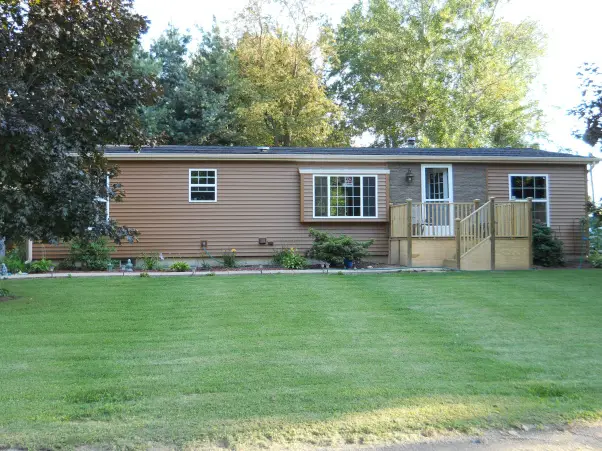
Mobile home skirting is absolutely necessary. It hides the structural elements, adds a barrier to keep pipes from freezing, protects the home from wild animals, helps retain heat in the winter, and gives the mobile home a finished look.
Mobile home skirting can help maintain an average temperature beneath the home, too. Preventing cold winds, hot summer sun, and extreme temperatures from building under the mobile home can reduce your heating and cooling costs.
Mobile Home Skirting creates great storage space for seasonal goods such as holiday decor, mowers, and weed-eaters. Every mobile home should have skirting and in most parts of the country, it is the law.
There are several different kinds of materials you can use to skirt your home. Brick, stucco, tin (metal), cinder block, T1011, plywood, hardy board, faux rock, and vinyl are just a few.
Here’s a complete guide to help you choose the best option for your mobile home skirting:
Regardless of what type of skirting you chose, you will need to figure out how much you need. Here’s how:
Add together the length and width of all 4 sides of your home. In my case, it would be 58+58+12+12 since my home is 58′ long by 12′ wide.
If you have porches or additions, make sure to add that amount to your final figure. Only include the 3 visible sides since the side attached to the home has already been included.
Here’s an example:
That end amount will be how much, in feet, you will need to purchase of the boarding, channeling, and footing for the skirting to attach to or if it’s vinyl siding, the back, top and ground tracks.
This will help you calculate how much material you will need to cover from the ground to the home.
Go to each corner of the home and measure from the ground to approximately 2″ above the bottom of the siding. Some companies say to just measure where you want your skirting to start at the bottom of the home. Adding extra to the calculation is a smart idea.
Once the 4 corners have been measured, go to the middle of the length of the home (the long sides) and measure. You’ll do this on both the front and backside of the home. Add all the measurements together and then divide by 6, the number of times you took the measurements. That’s going to be your average height in inches.
Now that you know the linear footage and average height of your home, you can figure out what type of siding you want and get a good estimate of the total cost.
The supplier will help you determine how much you need to order as different materials come in different sizes. Here’s a little break down of the types you can choose from:
Vinyl skirting is the most popular for a few reasons: it is easy to install, not hard on the wallet and very attractive. Most kits run about $600 and up for a basic sized single wide and will include all the pieces you need to completely skirt the entire home. There are 4 basic pieces needed for vinyl skirting:
Vinyl usually comes in 11’8″ panels, although they call them 12′ panels. You should buy all you need in one lot plus an extra panel or two. The dying process is not 100% accurate so there could be mismatching of the color even though you are ordering the same color.
Vinyl siding and skirting are very environmentally friendly, unfortunately, it is misunderstood by a lot of people. Most think vinyl comes from oil and the refining process, but that is incorrect. All vinyl productions start with two simple and abundant building blocks –chlorine from common salt and ethylene from natural gas. According to Building for Environmental and Economic Sustainability (BEES) software, vinyl siding out performs brick, stucco, and wood on how it affects the environment based on a combination of environmental criteria.
The disadvantages of vinyl are that it does not do well with weed eaters. There are guards you can add to remedy that though. Storms and high winds can also be an issue.
The second most popular skirting option is the Reil Rock panels. They are made of sturdy plastic, have the look of stone and come in 3 colors. They come in 5-foot sections with 3 height options: 2’6″, 3′ and 4′. Also, they are very easy to install because you simply use a U channel or J channel on the ground and screw the panel into a board attached to the home (some just attach directly to the home and some don’t even use the ground channel). There is a track you can put on top of the panel, but it’s not needed either. If your panel is just shy a couple of inches you can use the top track to cover the issue.
A 5-foot section costs about $30. While it’s more expensive than vinyl it’s sturdier and can handle a bit more.
To calculate for Reil Rock, simply convert your linear foot to inches by dividing by 12. Then use your average height calculation to get the correct panel height to buy. There is a lip on these panels that are about 2-3″ so keep that in mind.
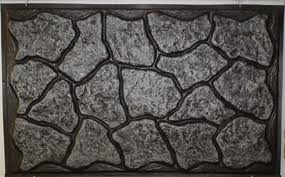
Most faux panels are made from a polyurethane and come in 46 ¼” wide × 24″ high × 1 ¼” thick panels. They look remarkably like real stone. You can frame the area to be skirted with 2×2 or 2×4′s and then screw the panels into the frame. You can also completely frame the area with plywood and screw onto that for a sturdier installation. They are light but sturdy, and they can withstand temperature fluctuations very well.
They are a bit expensive but cheaper than real stone and much easier to install. One panel runs around $100 (give or take depending on style).
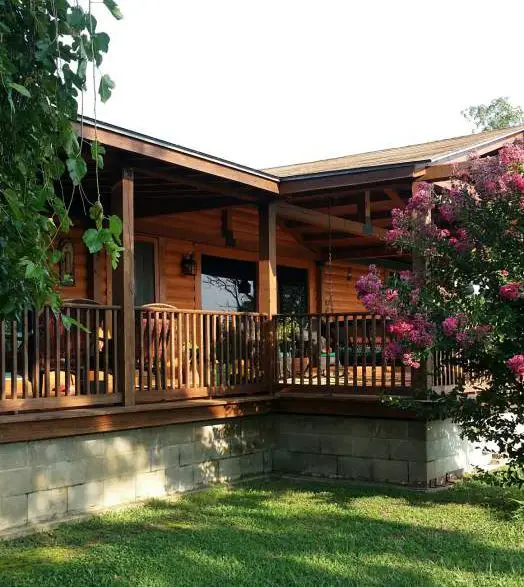
If you want absolute permanence concrete, brick, or cinder block is probably your best choice.
Adding brick or cinder block to a home is a labor-intensive ordeal, but the advantages are worth it. Being practically indestructible is it’s best advantage.
Concrete panels are easier to install but have similar indestructibility and longevity as brick and cinder block. There are companies that specialize in concrete skirting but you can purchase precast concrete panels, too.
There’s a little misunderstanding surrounding cinder block and brick skirting and ‘permanent foundations’ for mobile and manufactured homes. FHA loans require that all manufactured homes be permanently installed but that has little to do with the skirting material. A manufactured home can be permanently installed and have vinyl skirting. Permanent installation is about the ties, not the skirting.
Brick and cinder block are a bit expensive, the price will depend on the type you choose.
Metal can be steel or tin. Both are great products that are affordable. Simple installation is an added advantage. A simple 2″x4″ frame with the panels attached by screws or nails (rust free only). You can also attach the top of the panel to your home via attached board (or straight to the frame) and then dig a channel in the ground and backfill the ditch. It’s quick and easy and the dirt can’t hurt it at all.
These days the designs for metal mobile home skirting are getting more attractive, too. The old cinder block or large brick stamped pattern has been the most popular design but with a little research, you can find new patterns.
Metal mobile home skirting can be easily painted. Metal can withstand a weed eater which is always a plus.
The price for metal skirting is around $10-15 per 5-foot panel.
Foam skirting is sometimes called “Insulated Vinyl Skirting” or “Rigid Foam”. The claim is that they will reduce underside energy loss by up to 22%. You can get them in different colors and textures, like fine pebble or brick. This skirting can be used along with a kit or frame or as added insulation in front or behind other skirting solutions.
You can get complete framing solutions that act like frames but have channels to put the foams into. Most suppliers recommend this. The price of the panels is approximately $10-15 per foot. The installation kits depend on the linear foot needed. One company has an entire kit for about $650 (just for the installation kit, the panels are bought separately).
Wood has always been a well-known construction material. Using wood for skirting isn’t the best option unless it’s treated. It’s susceptible to rot and insects otherwise. Hardiboard and OSB are very sturdy. OSB is cut with the trees grain and the engineered together to make a very strong product.
Wood products that are not waterproof are going to get swelling from moisture. Price depends on what you chose and installation can be simple or complicated. Some people suggest that you use a sealer and caulk the ends of the boards before putting them up just as an added precaution against moisture. You can use planks and get the look of siding, too. Lots of potential with wood!
Regardless of what option you chose, you need to have access panels and vents in the skirting so keep that in mind.
That should get you started on mobile home skirting. Basically, if it’s used in construction you can probably use it as mobile home skirting but you need to keep insulation qualities and installation ease in mind. Skies the limit
It’s always good to try to reuse a material that’s bound for the landfill and it’s great for the budget. Look around and ask around, you never know what someone may have laying around that would work as great skirting for your mobile home.
Thanks so much for reading Mobile Home Living’s Ultimate Guide to Mobile Home Skirting!
Photo Sources
Faux Panels
Insulated Panels
Reil Rock
Learn about mobile home additions and understand the pros, cons, and necessary steps for a…
Learn how to paint mobile home walls effectively, overcoming challenges with shiny surfaces and battens…
There're a ton of smart storage hacks to organize your camper on Pinterest and Amazon…
A small bathroom should be beautifully focused on function. Of course there are a few…
Over 100 beautiful manufactured home deck and porch designs plus free design plans and DIY…
If you own an older mobile home with a flat roof or have needed to…
This website uses cookies.