Proper manufactured home installation and setup is vital to your home’s health. Simply put, there is nothing more important than having your manufactured home installed and setup correctly.
Improper installation will result in serious damage. The stress on one small part of the structure impacts the entire home. The home will age quicker and the stress causes warping and bowing. After a short time has passed, the homeowners will begin experiencing issues such as leaks and it just goes downhill from there. Unfortunately, by the time the minor issues pop up major damage has been done to the home and it can be expensive to repair or correct the problem.
Education and inspection are the two best defenses against improper manufactured home installation and setup. If a homeowner understands the installation process and is able to ask the right questions they can ensure it is done correctly.
Before you have a manufactured home installed you need to buy one. Here are a few articles that should help:
Once you know how to buy your home at a fair price you need to continue the research on installation and setup in order to protect the investment you just made.
When it comes to manufactured home installation and setup the builder’s instruction manual shall trump all others.
Think of the national HUD standards as being the base regulations. Their standards are nationwide but each state has its own (possibly) higher standards based on their average soil and climate environments. The manufacturer’s installation manual will meet all HUD standards but it is usually much more detailed and will have higher regulations so it should always be followed.
Click here see for our Directory of Mobile Home Manuals.
The manufacturer’s installation manual will provide details and specifications to meet HUD standards and is usually much more detailed so it should always be followed.
Before 2009, there were little regulations or codes set on a national level to mandate or control manufactured home installation and setup procedures. Several states provided their own guidelines but minimal standards varied and little to no checkpoints were in place. Thankfully, that’s changing a bit.
Home buyers are often put in an awkward situation when it comes to installation of their home.
Typically, the dealership will either have their own installation department or will recommend contractors. Most home buyers aren’t going to know of any installers so they will just take the recommendation and choose one with. That’s where they go wrong.
Due diligence is absolutely required when choosing the installer for your new home. You just paid thousands of dollars for a home, you need it installed properly to protect your investment.
Google search the name of your state and term ‘licensed manufactured home installer.’ The search results should include a link to your state’s HUD agency (or relevant office). Click here for a listing of Florida’s licensed installers.
You will need to check that the company you choose still has an active license (bonds and insurance are required -if they lapse the license is no longer active).
Learning the lingo and terminology used in the manufactured home installation and setup process is the first step in understanding the process and ensuring that you get your home properly set up.
A few common terms you should know (courtesy of the Florida Manufactured Home Setup Manual):
Dealer Installer – any licensed manufactured home dealer who is authorized by the department to install mobile/manufactured homes. Dealer installers are part of the dealership where you buy the home. In the US, a manufactured home builder cannot sell a home themselves, there has to be a middleman or dealer.
Licensed Installer – any person that is not a direct employee of a licensed dealer or builder that engages in mobile home installation and setup that is licensed to do so by their state’s Department of Highway Safety and Motor Vehicles.
Stabilizing Devices – any part of the anchoring or support system, such as piers, footings, ties, anchoring equipment, anchoring assemblies, or any other equipment, materials, and methods of construction that support and secure the manufactured home to the ground.
There are two main types of foundations, permanent and non-permanent.
There are several types of foundations that a manufactured home can have. The permanency of the installation, chosen appearance, and the location of the home will determine which foundation is used.
If a homeowner owns the land and has no intention of moving the home again, a permanent foundation is usually the best.
The three main categories of permanent foundations are floating slab, roll-on, and pit-set. There’s also the basement and roll-on foundations.
A floating slab foundation is a poured concrete pad with re-bar or J-bolts installed into the concrete so that the tie-downs can be attached to them instead of Helix Anchors.
The concrete floating slab foundation is usually only 6 inches thick but due to the way the concrete is formed and shaped the home can move along with the slab when the ground freezes, avoiding the possibility of cracking the foundation or damaging the home. There is a variable to the single floating slab foundation where two strips of concrete are used instead of one large slab.
Roll-on foundations are used when a homeowner wants the home to be even with the ground level. A deep foundation is dug out and reinforced walls are poured to so that the home looks as if it is sitting directly on the ground.
A pit-set foundation is similar to a floating slab except the slab is poured one or two feet below ground level and walls are poured around the perimeter of the foundation to be even or slightly higher than the ground level. This creates a completely enclosed foundation.
Basement foundations are self-explanatory. A full or half basement is built under the home. This single wide is installed over a basement foundation. You can read more about that home here and here.
For non-permanent foundations, there are two main choices, pads and footings.
A surface set pad foundation uses cinder blocks on level ground.
A pier footing foundation system consists of several re-bar reinforced concrete columns that are poured to set directly under each pier or block set of the home. These columns may or may not meet the frost-line depth for that location.
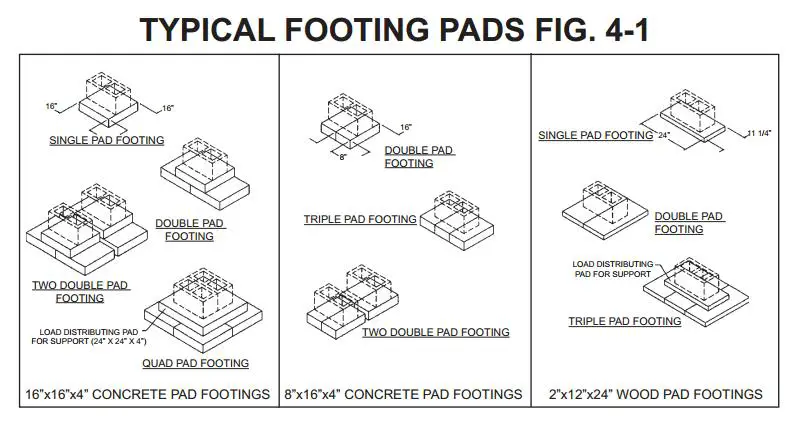
The size of the foundation is determined by the soil bearing capacity and the size of the pad. Each state will have a minimum foundation pad size and will state what material the pad can be constructed with. For instance, Florida’s smallest pad size is 16”x16” and can be made of concrete or plastic, wood is not acceptable.
The size of the foundation determines the pier spacing and the amount of weight that each pad can carry. The manufacturer’s installation manual will provide additional information for proper pad sizes. Below is a footing pad diagram from a Skyline Homes manual:
Site built homes have stem walls on the outside, directly under the exterior walls. Manufactured homes have piers positioned under the chassis.
Piers are made of steel or concrete. There are three main support areas on a manufactured home: the frame or I-beam, the center-line, and the outside perimeter.
Perimeter piers must be centered under the I-beam and at the marriage line if the home is multi-section. The spacing of the piers must be carefully calculated by the installer. The block plan discussed earlier is used to determine this spacing.
There are various rules regarding the different piers. Clearance, pier height, single vs double stacked blocks, shims, and many more guidelines must be followed. The homeowner should research to know the specific rules for the home type and the location.
A blocking plan will be included with each home installation manual. It will be similar to the one below:
The illustrations below portray the various types of piers and footings that a manufactured home can have.
Note: If a double interlocked pier is filled with concrete it can usually be used up to 80 inches in height.
Steel pier and frost line footer:
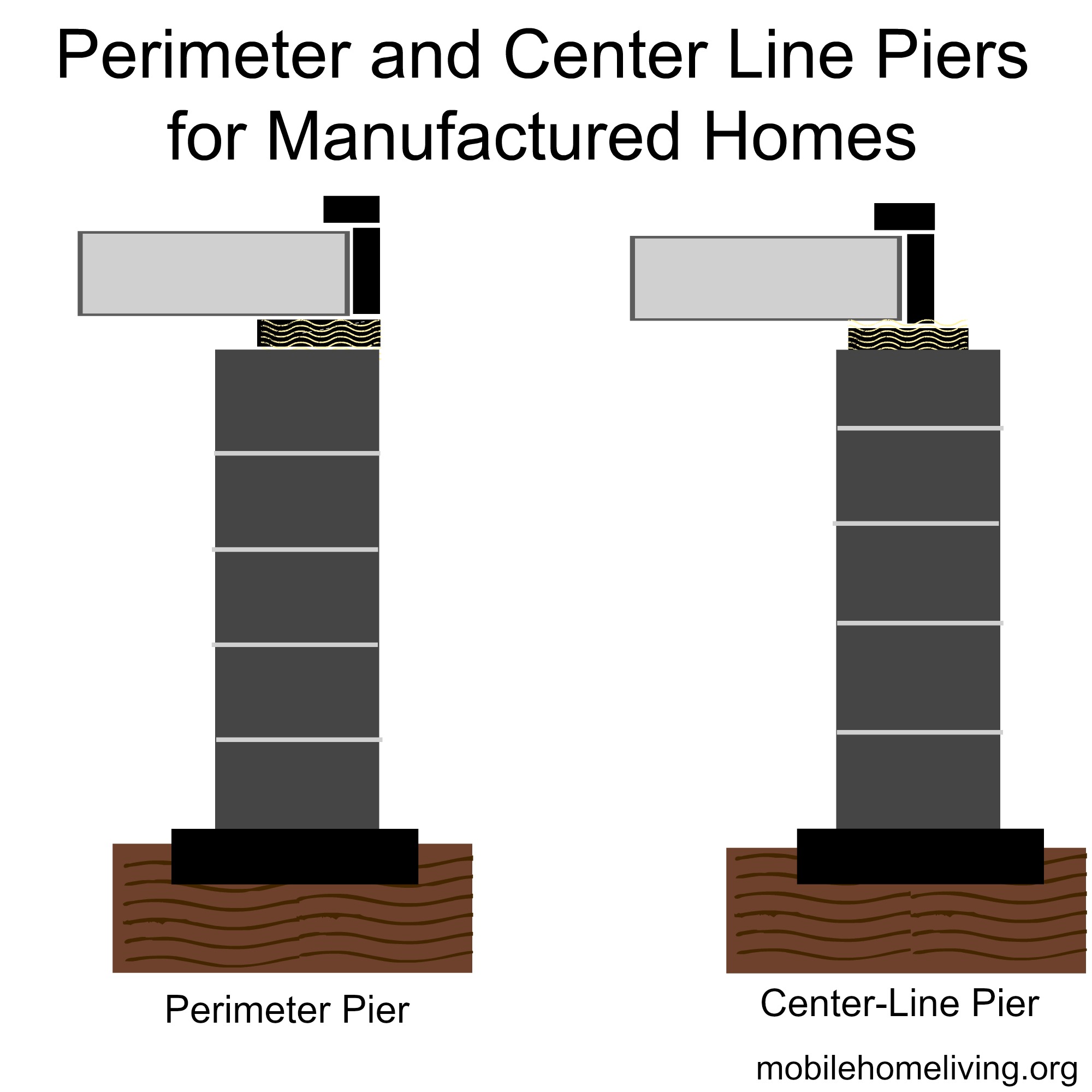
An illustration showing the difference between perimeter piers and center-line piers:
Anchors, or tie-downs, are used to anchor the home’s frame to the earth or the foundation.
Improper anchoring or tying-down a home is the main reason we see so many homes on their sides on the weather channel. It is not the home itself but the lack of tie downs or anchoring system used on the home.
If a new manufactured home is correctly tied down it can withstand over 110 mph winds.
Ground Anchor – any device approved by the DMV that is used for the purpose of securing a manufactured home to the ground in order to resist wind forces. Ground anchors are rated by working load, which is the maximum load for design purposes. The ultimate load is the working or design load multiplied by the safety factor of 1.5.
Frame Tie or Tie Down – any device or method approved by the department and used for the purpose of securing the mobile/manufactured home or park trailer to ground anchors in order to resist lateral wind forces.
Vertical Tie – any device or method approved by the department and used for the purpose of securing the mobile/manufactured home or park trailer to ground anchors in order to resist vertical or uplift forces caused by the wind.
Over-Roof Tie – any device approved by the mobile/manufactured home manufacturer or listed by the DMV to be used for the purpose of securing the manufactured home to ground anchors in order to resist wind forces. Ties may be installed over metal roofs.
The most important advice I can give you is to never sign anything until the home has been completely installed and inspected by a 3rd party that is not affiliated with the dealer or the installer.
Hiring an independent inspector will cost you a few hundred dollars but it is money well spent. Only after they have inspected everything should you sign anything.
A manufactured home must be re-leveled at regular intervals. Homes with complicated foundations or if they are high off the ground should be checked annually for the first few years to ensure that settling or shifting hasn’t occurred. Less complicated homes can probably go 18-24 months between checks. You can find a water level for around $50.
As always, thank you so much for reading Mobile and Manufactured Home Living!
Learn about mobile home additions and understand the pros, cons, and necessary steps for a…
Learn how to paint mobile home walls effectively, overcoming challenges with shiny surfaces and battens…
There're a ton of smart storage hacks to organize your camper on Pinterest and Amazon…
A small bathroom should be beautifully focused on function. Of course there are a few…
Over 100 beautiful manufactured home deck and porch designs plus free design plans and DIY…
If you own an older mobile home with a flat roof or have needed to…
This website uses cookies.