

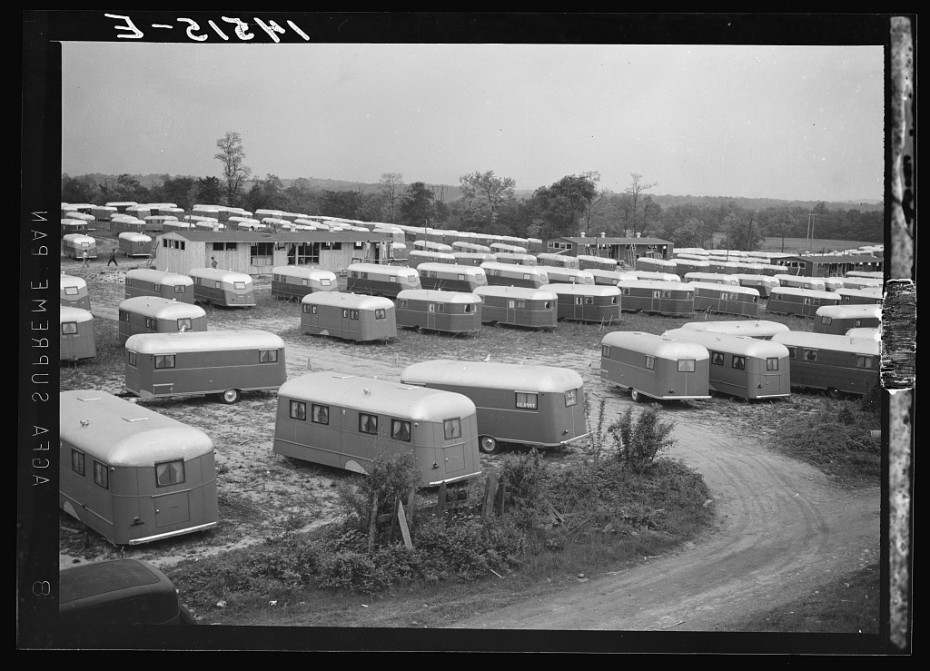

The early 1940s were a challenging time for the United States of America and the trailer industry.
Our country was headed to WWII and rations were put in place in order to produce the necessities needed for the war. The mass-produced trailer was still in its infancy – factories had just begun producing trailers in 1936 so there were only a few companies producing them and they were still trying to figure out the best designs and materials to use.
How the Mobile Home Stigma Began
Then, all of a sudden, trailers were tested on a broad scale due to WWII and unfortunately, the results didn’t fare well. The federal government ordered thousands of trailers to house factory workers and soldiers so they could help produce all the materials and products needed to fight the war. The homes weren’t built to high-quality standards because the new industry simply didn’t have the experience or materials needed to do the job right. It took 2 years before trailer construction was classified as a housing necessity so the builders had to use non-rationed materials until the classification was finally corrected. It would be like asking your kid to build a dog house without access to proper wood!
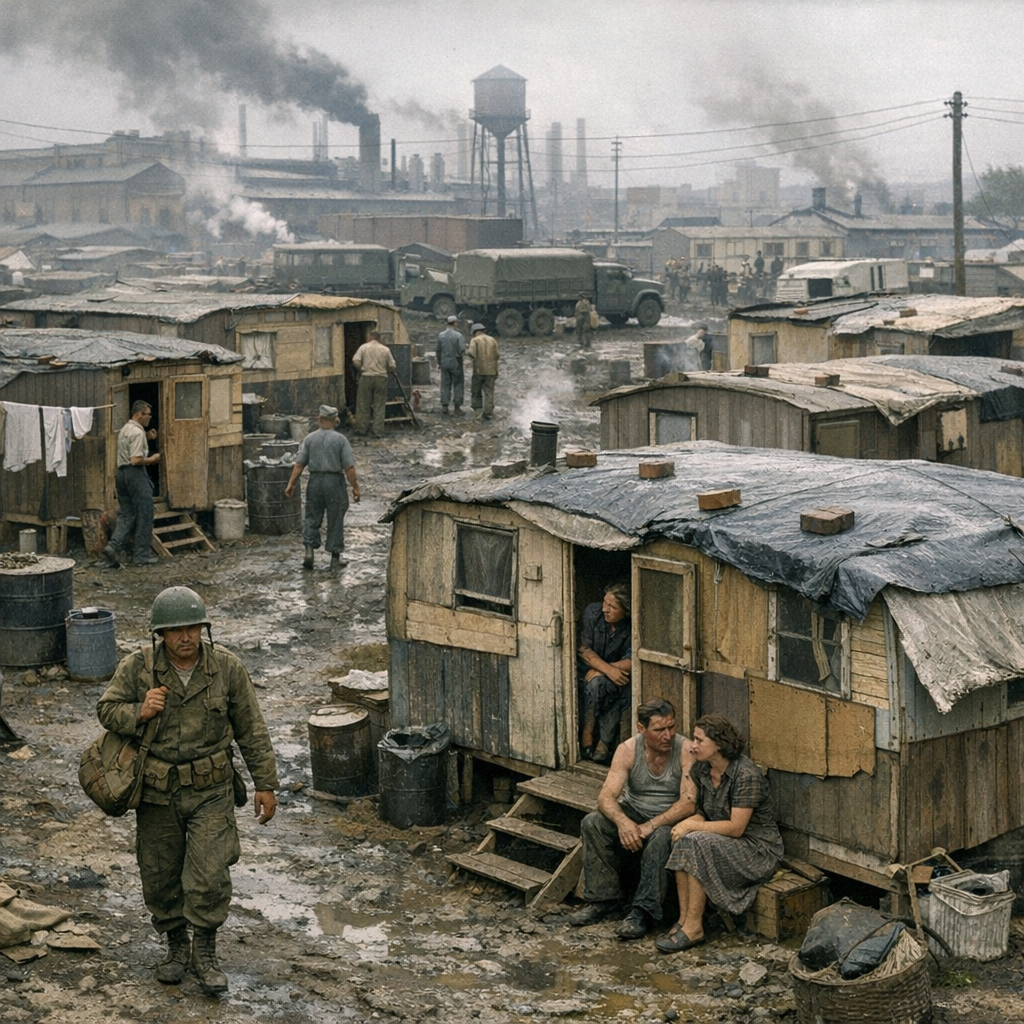
This is one of the biggest reasons trailers and mobile homes got such a bad reputation so quickly. The industry simply wasn’t prepared for the demand that WWII would put on them. The trailers had to be built in record time with a substandard material; still, the industry did it. They were able to step up and come through when it mattered most.
Thousands of soldiers, factory workers, and their families had never been around trailers before. Then they were suddenly living in these quickly (and poorly) constructed homes in a trailer park. This introduction to trailers left a lot to be desired! This situation is one of the biggest reasons trailers got such a poor reputation. Had the circumstances been different and the public been introduced to the homes in a different manner, I’m convinced the poor reputation wouldn’t have taken hold so tightly.
Trailer Park Life
Trailer park living was never easy, and those who called such places home often did so out of necessity rather than choice. Life in these parks demanded resilience, resourcefulness, and a tolerance for the challenges that came with a modest way of living. Both federal and private trailer parks offered their own advantages and disadvantages, and each type provided a unique experience shaped by differing rules, resources, and community dynamics. In both settings, one of the most persistent problems was the scarcity of reliable water. During particularly dry seasons, water pressure would drop to a frustrating trickle, forcing residents to ration what little they had. Bathing and laundry days often required creative timing, as everyone seemed to compete for what water was available. Trash disposal was another constant concern—bins were often overflowing with garbage, and the irregular pickup schedules in some parks meant that a few days of delay could lead to unpleasant odors and scattered debris carried by the wind. These small but persistent issues often reminded residents of how fragile the infrastructure could be when budgets were tight or maintenance was overlooked. The environment added its own set of burdens. In the damp months of winter and early spring, mud became a nearly inescapable fact of life. Yards turned into sticky messes, and muddy paths stretched between the trailers, making even simple walks to the mailbox a balancing act. Residents of the federal parks sometimes found temporary relief when wooden sidewalks or makeshift paths were installed to help them avoid the worst of the muck. Still, these improvements were often limited in scope, and when heavy rains came, few areas remained completely dry. The major distinction between federal and private trailer parks lay in the rules surrounding modifications. In federal parks, residents were generally prohibited from altering their units. Trailers had to remain as they were, which meant that leaks, poor insulation, and drafty corners often persisted through the changing seasons. These restrictions were meant to maintain uniformity and meet government safety standards, but for residents, they sometimes felt like a barrier to making their homes more livable. On the other hand, private parks offered more flexibility. Tenants could patch leaky roofs, add small porches, install better insulation, or even extend sections of their trailers to create modest storage rooms or small enclosed entryways. Over time, these handmade improvements made a tremendous difference in comfort and warmth, particularly during the cold months. Because of these freedoms, private park living was often considered the better option. The ability to take ownership—to mend, adapt, and personalize one’s space—gave residents a sense of stability and pride that rigid federal regulations tended to suppress. Even though private parks came with their share of maintenance problems and sometimes higher rental fees, they encouraged a certain spirit of community and self-reliance. Neighbors often helped each other with repairs, trading tools, materials, and know-how. Despite the hardships, moments of camaraderie and small triumphs over adversity gave trailer park life a rough, enduring charm that spoke to the perseverance of those who made the best of the hand they’d been dealt.
Related: Some Vintage Trailer Parks and Campground Images.
Below are photos from Burlington, Iowa in February 1942. This was a government park set up by the FSA.


The next set of photos depicted an FSA (Farm Security Administration) housing project that had been established on the outskirts of Erie, Pennsylvania. This project was one of many created during the late 1930s and early 1940s, as the federal government sought to provide stable living conditions for families displaced by the Great Depression and later for workers required in war-related industries. In this particular case, the housing complex had been constructed to accommodate the influx of laborers needed for a nearby power plant—an essential facility that supplied electricity to support wartime manufacturing and regional infrastructure. During World War II, industries across Pennsylvania expanded rapidly to meet the growing demands of the defense effort. The power plant near Erie was no exception; it operated around the clock, providing the vital energy needed to fuel factories producing steel parts, machinery, and other materials crucial to the war. To maintain continuous production, managers recruited large numbers of migrant workers from different parts of the country. Many of these individuals were farmers, displaced workers, or rural residents seeking new opportunities in industrial labor. The FSA housing project offered these workers and their families a safe, organized community where they could live while contributing to the nation’s wartime needs. Rows of modest but sturdy homes were built, complete with basic amenities such as running water, electricity, and communal spaces. Photographs from this project often captured not only the architecture of the settlement but also the human stories—children playing along gravel roads, men in work clothes returning from long shifts, and women tending small gardens or sharing meals with neighbors. These images revealed more than just the physical layout of the housing complex; they reflected the determination and adaptability of working families in the face of uncertainty. The FSA photographs served as a visual record of resilience—ordinary Americans supporting the war effort while striving to build a sense of community far from home. This Erie housing project stood as a testament to the broader social and economic transformations that reshaped the nation during one of its most challenging eras.



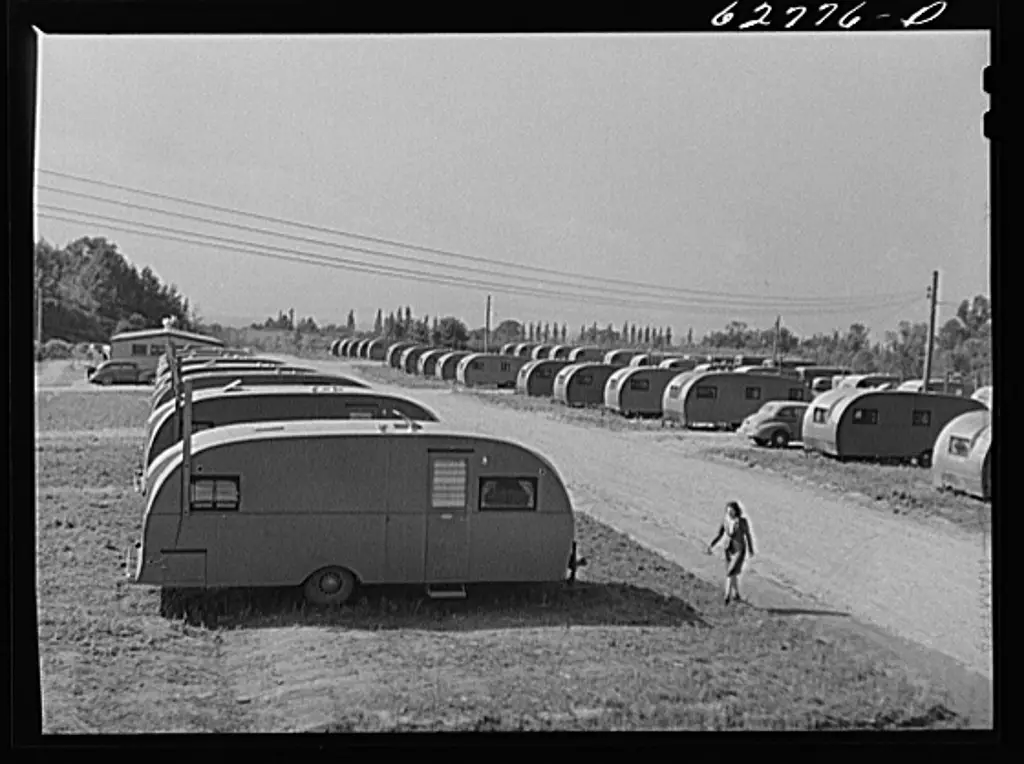


The people who lived in these trailers were true heroes in every sense of the word. Though their homes were small and the living conditions often far from ideal, their courage and determination reflected the very heart of the nation’s spirit during one of the most challenging times in history. These trailers, modest and hastily built, became symbols of resilience and sacrifice. While they lacked the comfort and durability of proper housing, they played a crucial role in supporting the war effort during World War II, serving as temporary dwellings for workers, soldiers’ families, and civilians who were all contributing to a cause far greater than themselves. The truth is, the trailers weren’t perfect—many were cramped, drafty, and constructed from limited materials due to wartime shortages. Yet, the companies that produced them worked tirelessly, facing rationing of steel, rubber, and other essential resources. They did the best they could under those difficult circumstances, driven by a shared sense of duty rather than profit. Every trailer that rolled off the assembly line was another step forward in helping America maintain its industrial strength, keep families together, and ensure that the workforce could stay close to factories and military bases where their labor was most needed. These makeshift communities became places of unity, where individuals from all walks of life came together, sharing meals, stories, and the hope of victory. They embodied what America does best—rallying together in times of crisis, finding strength in cooperation, and believing that even the smallest contributions could have a lasting impact. In those humble trailers, people found ways to create warmth, laughter, and perseverance amid uncertainty. And when history looks back on that era, it is clear that these trailer dwellers, with their quiet sacrifices and steadfast hearts, were as vital to the war effort as those who fought on the front lines. They proved that heroism doesn’t always wear a uniform—it also lives in the spirit of ordinary people who come together in extraordinary times.
As always, thank you for reading Mobile Home Living!
All Images Courtesy of the National Library of Congress
What's Your Reaction?

My husband’s family lived in one of these for part of WWII. At that time, it was the 2 parents and 2 children under the age of 4; then extended family members moved in with them for a while – 2 more parents and 2 more children. And no bathroom! You’re absolutely right about them doing their part for the good of the country!
I still can’t believe there’s still ignorant people that call MHP “trailer parks”. Luckily I haven’t run into too many but I always correct them and say, “excuse me but you can’t hitch this behind your truck and pull it. MHs can be bigger and nicer than a lot of “homes”. My husband inheirited some money 21 years ago. The market was INSANE as many remember. We decided we wanted to buy something outright because we didn’t want a mortgage. We paid 27,990 for a 1972 Carriage (I think that’s what it is called). In 6 months it tripled in value. Later the tiny house movement started. Our home today is worth over 130,000 in California. My problem are the parks. You rent the land and have to maintain/plant etc. They do no maintenance on tall trees. In a lot of parks (including my own now) I’ve seen weed filled yards, yards full of junk in the back and front, piles of junk on front porches, tenants parked in guest parking and management does nothing. Meaningless threats get mailed out and that’s it. No tow truck drives through at night to pick up cars lining the street. The only thing that has changed for the better is our clubhouse. It’s very nice now for parties. Unfortunately the new thing is to let your guest strew there paper products and plastic bottles all over the lawn and play area then make a half-hearted attempt to clean it up. The manager here now won’t hire an assistant so she whines, “I’m only one person, or what do you want me to do?” She also tells who it is if a person files a complaint against another.
Great article! I’m fascinated by this kind of stuff. :) Here’s a link to a book I found I while ago about early mobile home communities/culture in America–it might help with your research (or just be fun to read). https://babel.hathitrust.org/cgi/pt?id=mdp.39015028126707;view=1up;seq=5
Hi Jesse,
Thank you so much for sharing this with me! I love love love this kind of stuff! Thank you!
My parents lived in a trailer park city when Dad was in the Navy out in San Diego. Anybody have any information about that location – ?Bon Ami? near Chula Vista?
Very unique and interesting website, as well as article! I have had an almost lifelong passion – I’m just now 60! – for anything and everything early 40’s, during WWII, and immediately following, particularly regarding living conditions on the Homefront and how that demand was met. I have seen several of these pictures before, on another website called “Shorpy” (consult the site regarding the origin and meaning of the name, if you’re interested) but several others are new to me. Equally interesting, all of them! Personally, I think the fairly primitive living conditions that people took up, and accepted “for the duration,” spoke well for the hardy stock from which they came, just that minute easing out of a decade-long Depression, and its attendant shortages and hardships. Since they weren’t strangers to such conditions, in spite of being quite weary of them, the nation’s call to arms, to 24-hour a day production of the materiel of war, hard work, shortages and deprivation, weren’t any strangers to them really. The previous generation – parents of these workers – having been through much worse during WWI, since even though the duration of our participation was shorter than other countries, our government had much less time, technology and know-how in getting such a job done. Everything had to be done in double-quick time, and there was much less to work with! The technology involved in producing the average airplane during WWI paled badly in comparison to what was involved in the then advanced technology of the early 40’s! A great deal more advanced technology was involved, not only in the assembly of the plane, but in the pieces and parts it took to build it.
I guess my point is that we had come so far ahead between the two wars, that the short term advances that took place to produce the travel trailer/mobile home needed its own growing space and time as well. They were the most basic of shelter, just a few steps ahead of a “garage on wheels for people” when first pressed into service, and the lack of R&D by the time the War broke out and the demands placed upon them hurt them a great deal due to the initial lack of proper materials, technology and knowledge in how to build high quality units. People took what was offered, and gladly in most cases, because they were again not alone in such hardships. “Relative deprivation,” a term that came out of college sociology and stuck with me, explains why so many people were able to stand such conditions for so long. It was because each couple or family was not alone in the deprivation, they were all in it together, in large groups. It did no good – served no purpose – to whine and complain about their circumstances, because their neighbors were all in it together! Nobody else in their immediate vicinity had it any better or any worse than they did. They consulted each other for ideas on how to solve their own problems, since it was a matter of simple comparison that they all had it about the same. The focus was on how to best solve the nation’s needs for defense materiel, much less their own simpler requirements for living from day to day.
Since none of those early “mobile homes” had indoor plumbing of any kind, W is isater was fetched from the nearest outside water spigot, carried in buckets or basins, used and then discarded outside as well. Laundry water likewise, and there were also no indoor toilets or showers inside the units either. Shower houses took the place of private facilities inside each unit. Children took to them just like any other “adventure” they could dream up! I’m sure also that after the War, just about any other kind of living accommodations seemed palatial by comparison!
HI Crystal,
Thank you for that great article! I’d love to use some of those photos in a talk I’ll be giving in about a month, about how mobile homes and parks deserve more credit than many people give them. Do you know if these pics are in the public domain? If not, any idea how I can get permission to use them?
Of course, I’ll mention your website. What a great job you’re doing here!
Carol
Hi Carol!
I’m 99% positive these are public domain and probably available in the national archives. Best of luck!
Thank you for this post. I never knew this history about mobile homes.
Wonderful article, thanks Crystal.
Really enjoyed the article. I look forward to your book….
Thank you! It’s slow going but I’ll get it done eventually!
Loved reading that. Thank you!
Thanks for reading MMHL Sharon! I appreciate you!