

Removing Walls in a Mobile Home
A common misconception in the mobile home community is that walls in a mobile home cannot be removed. That is not entirely true. As long as you understand how these homes are built and how they maintain structural integrity, you can remove most interior walls. The key is knowing which walls are load-bearing or shear-bearing and which are not.
In a single wide, with recent construction methods, there are no load bearing interior walls.
The home’s stability and integrity is derived from the roof and the exterior walls. Imagine a spiderweb. Alone, one single thread does nothing for the spider but a bunch of threads together makes a strong home that catches dinner and houses the family safely. The roof and side frames of a mobile home is roughly the same concept. It’s called integrated engineering and there’s many, many ways to design that ‘web’. Some companies use screws that go through the roof studs into the wall studs, some simply staple or glue them.
It’s up to you to determine which method was used to construct your home, and unfortunately, only the manufacturer you purchased it from can provide that information. Don’t hesitate to call and ask questions. If your home’s manufacturer is no longer in business, do as much research as you can online and offline to gather the information you need, and don’t be afraid to keep asking questions.
Here’s a couple of photos to help you conceptualize the way a single wide is manufactured.
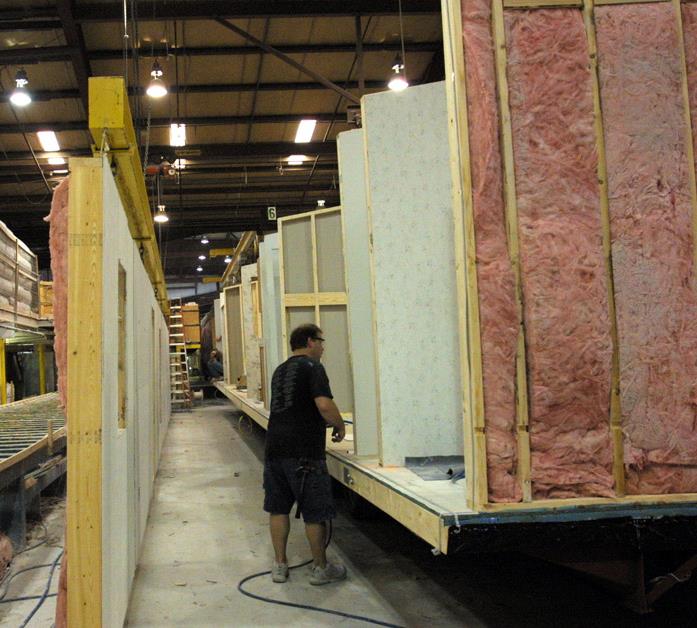
Notice how the interior walls are attached to the floor first?
Only staples, nails or glue will be used to mate the exterior wall to the interior walls. Once all exterior walls are placed the roof is laid and it all makes a perfectly strong and structurally sound home that can be pulled on the highway going 55mph!
In this next photo you can see a few interesting things:
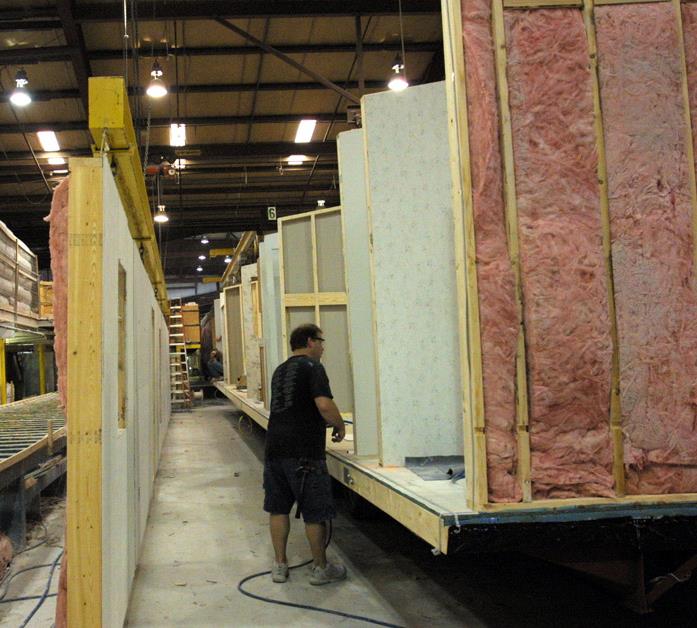
- The laminate floor is under the interior walls and tub in the bathroom.
- The wiring will be ran through the ceiling.
- This manufacturer utilizes top and bottom horizontal studs in the interior walls.
If you can learn the same kind of information about your own home you’ll be well prepared to tackle removing a wall in a mobile home.
Removing Walls in a Double Wide
A double wide is essentially 2 single wides joined together. The center line is called the marriage line and is what forms the spider web of integrity.
Each piece of a double wide has to have it’s own integrity and strength, they are simply brought together as one in the end. As long as you’re not messing with the marriage line or the exterior walls and corners, you shouldn’t have any issues when removing walls.
A Word of Caution When Removing Walls in a Mobile Home
Take proper precautions because I can’t guarantee you that every mobile home is the same. One example that you need to look for is if your ceiling changes height or goes from one height to another on the same wall. That could signify that either a shear or load bearing wall is being utilized. Each company did things just a little different and I’m painting with a broad stroke here.
If your home does have a shear or load bearing wall within its interior it’s still possible to remove the wall but you really need to know what you’re doing or your entire home could suffer some very bad consequences (collapsing is always a possibility). You can use a beam and span support system to replace the wall but this is when things start getting serious and you need to have a professional contractor and a licensed engineer on speed dial or in the room. Preferably in the room.
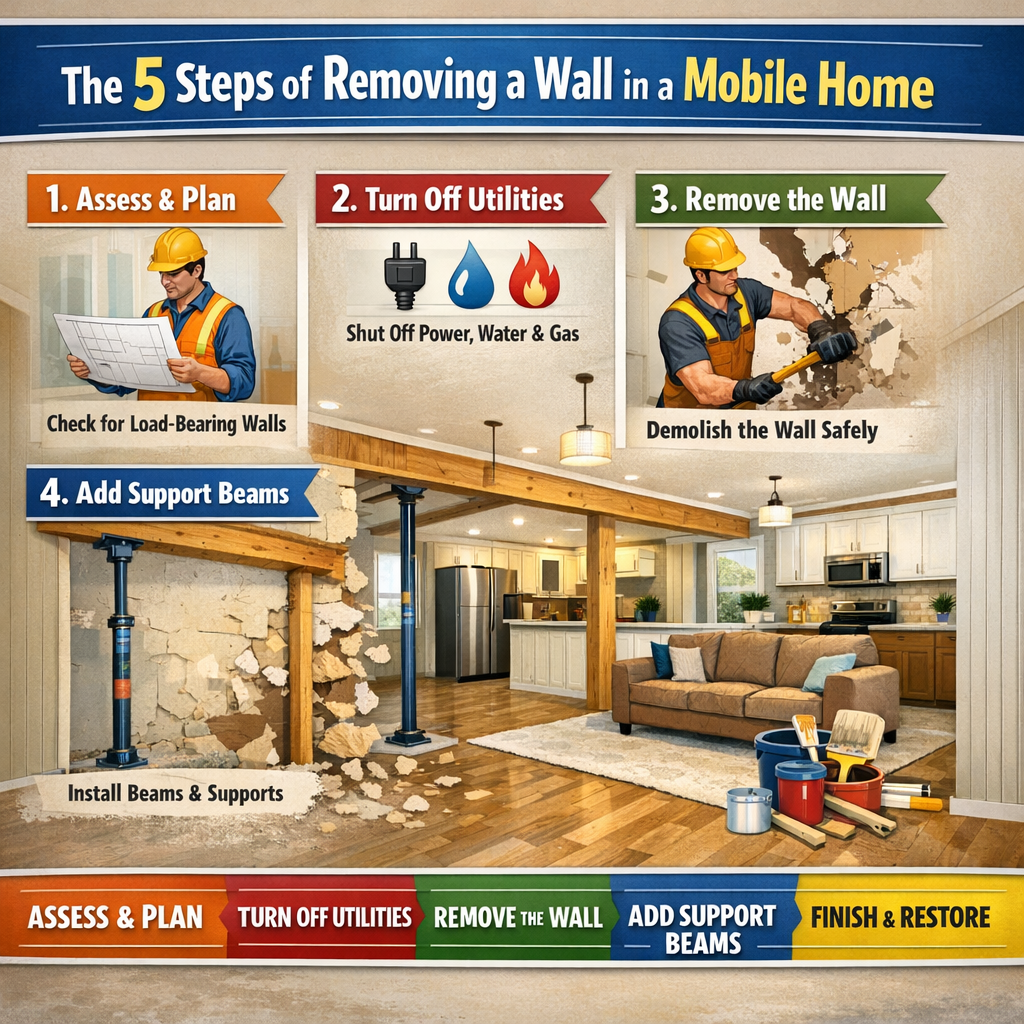
The 5 Steps of Removing a Wall in a Mobile Home
If you are removing an interior wall there is an order in which you should do it. This ensures you don’t start busting through a wall and find out that it is load/shear bearing or full of juicy wires.
- Turn off the electricity in both the room you are in and the neighboring rooms. If possible, turn the breaker off on the entire side of the home you’re working in. If you’re near a bathroom or kitchen or there’s a slight possibility that there could be a pipe anywhere close to where your working, turn the water off as well. Better safe than sorry! Some mobile homes have the electrical walls traveling through the ceiling and down into the walls, some through the exterior walls and some under them. Again, it’s up to you to the homework and research, please do it!
- Take the strips and molding off the wall. Peel back the flooring if needed. Then tear only the paneling/wall board off of one side of the wall very carefully. Start at one corner and make a small hole. Use a crow bar or hammer to gently pull the paneling away from the framing. Do not alter or harm the framing within the wall at this point. Go a little bit at a time to ensure there are no wires, pipes or load bearing frames.
- If all is clear and you only see single 2×4’s (or whatever your home is studded with) go to the other side of the wall and remove the paneling/wall board from that side.
- You’ve only just begun! Now that the wall covering is gone what do you see? Are there vertical studs attached to a top and bottom horizontal stud? Look closely and see what was used to attach the horizontal boards to the floor and ceiling; nails, staples, glue, or screws? You have to figure out how to get those studs away from the ceiling and/or floor without causing too much damage. Easy does it. Think about it first and then do the manual work. You want to do this in a way that causes the least amount of damage to the home. You don’t want to scar the ceiling at all; no holes allowed! Before you begin to cut through the studs, you need to do something with the wires or pipes if there are any. You can take each stud down one by one or the whole wall unit as one. It’s completely up to you. Personally, I try to save the wood in its original length so I can reuse it in another project. I watched one guy just cut right through the middle of the vertical studs, knock them out and then attack the horizontal stud. It worked for him :)
Now that the wall is removed, you need to figure out 3 more things:
- How are you going to fix the exterior wall that the interior wall was ‘attached’ to? It’s going to be obvious that something used to be there. Paint, paneling, and trim are always good ideas. If glue was used, sand it smooth. This is a great time to paint the whole wall or room that new color you’ve been wanting.
- There will be an obvious scar on the ceiling where the wall used to be. How are you going to remedy that? Paint, speckle, new ceiling panels, maybe a faux trim?
- Flooring is going to be an issue too. What are you going to cover it with? Laminate, floating floor and carpet are great ways to cover imperfections in a floor. Just make sure it’s level!
Of course, by removing a wall you’re probably going to be remodeling the room affected by the walls removal so you already have a good idea of exactly what you’re going to do and how you’re going to do. Just make sure you have a plan and nothing is a surprise.
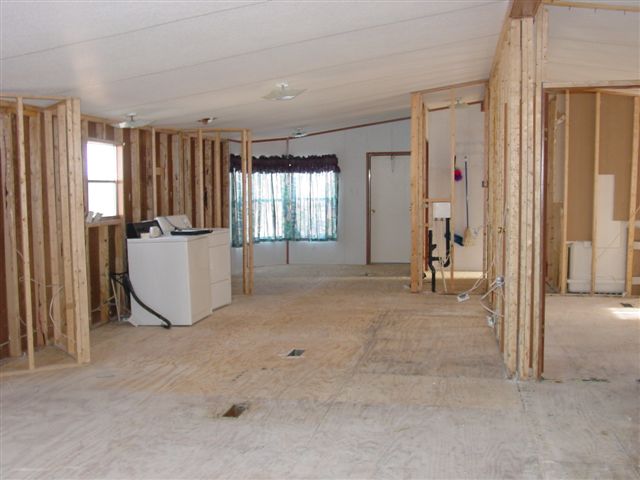
Here’s a photo I found of a double wide that is in the process of being remodeled. It will give you a good idea of what to expect. There will most likely be a horizontal stud on the top but not necessarily on the bottom (it varies with manufacturers) and since this is a double wide, you can see the double studs in the middle that signify a load bearing wall. If you look at the top right, you can see a horizontal stud that looks like some nails are hanging from. That could be where they removed a wall.
FAQ about removing walls in a mobile home
Can you remove the marriage wall in a double wide?
Reader’s question: I have the dreadful marriage wall running right through the center of my house. Family room on one side living room on the other. A real separation in the home. Is there any way I can take out the marriage wall? I’d settle for taking it out and putting in two columns to support the overhead.
Answer: Great question but unfortunately the answer is no. Your marriage line is always load bearing. That doesn’t mean removing it is impossible, but it would be an expensive and delicate job that would require an engineer with proper knowledge of load and shear bearing construction techniques in manufactured homes. Even when the experts are brought in there will usually always be some kind of issue that arises in the future.
If you have any questions or if you’ve removed walls yourself, please comment about your experience. Every little bit we can share can help someone out there get one step closer to their dream home and that’s a pretty awesome thing to help someone do.
As always, thank you for reading Mobile and Manufactured Home Living!


You talk about removing interior closets. I want to remove the interior clothes and kitchen pantry closets that are separated by a common wall and also remove the wall in the kitchen that connects them. Can I do that without touching the marriage wall? Removing the closets will obviously enlarge the kitchen. I should also mention that I removed the old cabinets and want to install new flooring that continues from the living room. Is there any way to remove part of the marriage wall and replace it with a post or beam?
Hi Barbara,
It all depends on the layout of your home. Are these closet walls a part of the marriage line? If so, you should leave it alone – the cost and the future issues you would incur is just not worth it. The new cabinets and flooring are a great way to update your home so def go with that. I’m just not a fan of anyone touching the marriage wall regardless of reason – you’ll never be able to move the home again and you’re essentially disrupting the entire structural integrity of the home.
I like to remove a section of my marriage wall that separates the living room from dining room. It has a 8” or so header in the opening lid like to leave that and install a column under it. Is this feasible?
Hi Carrie,
Good question! To be honest, I’m dead against any kind of modification to a marriage line. It’s absolutely possible to do what you want but every time I’ve seen a home with any kind of mod to the marriage wall an issue of some sort eventually happens (sagging roofs, leaks, etc.). It’s just to big a chance to take in my opinion. Sorry to be the Debbie-downer!
I have a 16 x 80 single wide (93) i think.its a 4 bedroom 2 bathroom. In the 2 small rooms in the back i removed wall and made into one big room.wall studs were 3×1, no load. Hard part was relocate of 2 wall outlets. But all in all took about 1 day
Hi Billy!
I’d love to see pictures of your process. You wouldn’t happen to have any would you? I love to see people make their homes better suit their needs! Thanks for reading!
Hi,
We have a double-wide in the Harvey disaster area, it was built in ’98, we are having a hard time finding VOG suppliers, I asked about rebuilding with traditional paper faced gypsum but it was suggested cost might be higher, I don’t mind a little higher, since walls would look much better. Even Googling for answers has not turned up much and our interior has been demolished and ceiling and walls are ready to go up. Do you have any supplier options for VOG, and you mentioned XRoc but when I search all I find is some junk sites and can’t find that manufacturer or a supplier for XRoc, is XRoc thin like VOG 5/8″? Any help would be greatly appreciated, we are trying to get my elderly mother back in her home after being in hospital for over 6 months including having been evacuated 3 times during the hurricane. Thanks again from Victoria TX
yes my husband and I are looking to take out a counter top in kitchen to open it up it is between the livingroom and kitchen will that be diffacult to do and are they attached to the floor it is what I call a wrap around counter that devides the kitchen living room we want to open that up but we have to do that ourself cause we definetly cant pay to have contractor come in and do the work please if anyone is familiar with that let us know send an e-mail ty so very much for your help
Hi Gena,
Removing counters isn’t as difficult as a wall but it’s not as easy as most think. You need to consider electrical and plumbing first. Subfloors and joists will also need to be considered (patching any holes, etc). You will probably have scars on your flooring and any connecting walls, too. A big open floor plan is a great thing to have these days – everyone wants them so it may make selling your home easier in the future.
Best of luck!
When remodeling, can regular gypsum board be used to replace the vinyl wall material? (This is a big remodel that will affect all the interior walls.)
Second question: You mentioned carpet, laminate and a ‘floating floor’ <— what is that? Also, when it comes to upgrading insulation, what have you found most effective?
Third question: I have a collection of favorite books; while planning my remodel, built in shelves are an item I want to discuss with my designer and contractor. Have you seen this done nicely anywhere? Got any photos to share?
Thank you for answering my questions! I am brand new here, and I am so glad I found mobilehomeliving.org. I appreciate the diagrams, photos and lists. This is clearly a work of love.
Hi Cynthia,
It’s a great idea to replace VOG with sheetrock or XRoc, or whatever brand you choose. You can rid of the strips that cover the seams of the VOG.
The different terms is a common problem because different parts of the country use different names for products. In WV, laminate flooring is also called floating floor and I use both terms interchangeably. It’s the flooring that interlocks together to create a single plane and the perimeter is covered with trim. It’s a good DIY product.
As far as built-ins, I’m kinda against them. You never know when you’ll want to change the space around and built-ins are pretty expensive. I’d go with bookshelves or braces and boards or floating shelves.
So glad you found us! Please take photos of your project!
We would like to add a framed room to the back of our double wide and then take the wall of the mobile down. Can this be done. Bruce
Hi Bruce, you can absolutely build an addition to your home. You will just need to build the foundation separately. Then you’ll just seal the roof, siding, and door between the addition and the home. Here’s an article called Building Mobile Home Additions that may help.
Best of luck!
Hi Crystal , great site! My husband and I are remodeling and wanted to open up the kitchen by removing the center and connecting wall. We figured it might have to stay there or maybe do an Arch or Columns ( spread a little farther apart) Can I email you a picture? Any thoughts of what we can do ? Greatly appreciate!
Hi Mr. and Mrs. Guzman!
I sent ya’ll an email yesterday – Best of luck!
I’d love to know this answer as well! Would like to remove one create an archway for a load bearing wall or “marriage” line wall. Any advice? It divides the kitchen and living room
Hi Teresa,
I’m not a big fan of doing anything to a marriage line but I’ve seen some gorgeous archways done. As long as pro is involved and you remove the absolute least amount of framing while reinforcing it back you’d probably be OK. I still get nervous just thinking about it, though. Thanks for reading!
Hello. Excited to find this site. My husband and I just bought a four seasons 2000 16×60 mobile home. 3 bedroom 2 bath the bedrooms are small and we would like to take off the wall between the back bedroom and the bedroom next to it to make a master bedroom any suggestions please
Hi, Peggy!
Congratulations! I would love to have a 16′ wide home! In most single wides all your integrity is derived from the perimeter walls. That means most interior walls are not load-bearing. I can’t give tell you for sure if your wall is load-bearing but in most cases, single wides can be modified fairly easily.
Hope that helps a little! Best of luck!
Hi,
I have a 2002 26×80 Clayton. I was wanting to replace the sliding glass door with a patio door white one of the door opening not both. Floor to ceiling I only have 84 inches and the door is 79.5 inches tall. Could I use a 4 inch steel I-beam as a header?
Hi Billy,
You will usually need to frame out new doors because the sizes are not standard industry sizes. I’m not really familiar with steel beams but I’ve seen a ton of regular ole lumber used to frame-out doors and windows. Sorry!
I am planning to move our bedroom wall back about 2ft and taking out those 2ft in our walk in closet we live in a double wide skyline 2004 we need to do this to make room for my husbens wheel chair how hard will this be for me to do this and can I just move it back and use the same wall if I am carefull or what do you say about it after the wall is up how do I paint the room thank you Agnes Thomas
Hi Agnes,
You’ll want to use new sheetrock for the new wall. Removing the panels without damage is difficult. Plus, sheetrock is a lot easier to deal with over the VOG panels (you can patch the seams better because sheetrock has a slant edge that helps to smooth the mud. VOG mobile home panels are just straight edge so it’s more difficult to smooth the seams and paint).
Best of luck!
Hi Crystal,
I removed the carpet in some of my rooms in a 1998 Palm Harbor double wide mobile home and put down self stick vinyl tiles on the wood floor. Some of the tiles have separated and have a small line between them, other spaces are okay. What causes this problem. In 2 other rooms I purchased a more expensive tile and there does not seem to be a problem there. Thank you for your help.
Hi Betty,
If I had to guess, it was probably the glue. The more affordable brands don’t use the best adhesive. It just didn’t make a good bond to the surface. You can find a vinyl tile adhesive and put them back pretty easily.
Best of luck!
Peel and stick vinyl tile should not be applied to sob subfloor
Just so everyone knows that may not know, an early 90s model Palm Harbor 16’x80′ has 2″x8″ floor hoist! I was really surprised!
Can a window on the end of a single wide mobile home be removed and the opening enlarged to add an exterior door?
Yep! All you need is the proper framing.
Hi Crystal,
My husband & I are downsizing from a 1750 sq ft frame home possibly to an older mobile home located near (500’) from a lake. The date on the real estate listing says the single wide home was built in 1981. We would like to re-configure the floor plan. I have been reading on your site about moving walls on a mobile home. The statement was made in the article, “In a single wide, with recent construction methods, there are no load bearing interior walls.” What classifies a recent construction method? Unfortunately, I do not know the manufacturer. We have not been inside the home yet, but are considering buying the home & renovating it to our specifications. We are not ‘flippers’, but have renovated several large projects over the years- restaurants, B&B, condo, our own home that was built in 1933, so we feel somewhat qualified to make the changes, even though we have never taken on a mobile home project. What should we know going in?
Hi Susan,
You should be fine as there are rarely any load-bearing walls in a single wide home. The way they are designed and constructed is amazing – the integrity is derived completely different from a site built home so all the load goes to the exterior walls.
Best of luck!
we have a 1978 Fuqua double wide with 1 half having vaulted ceilings. we are remodeling, and removed all the fake wood paneling to install drywall. interior framework is 2×3, and exterior framework is 2×4. we also decided to frame in a new window where there isn’t one. If I frame it in as a load bearing wall (supporting it during the re-framing, and installing 2×6 header, king and jack studs, etc), should I expect to see problems in the future? I am following tutorials online about framing in a window in a load bearing wall. I haven’t cut any of the walls framework out yet.
Hi Will,
It sounds like you know what you are doing and have a good handle on the research. As long as you create a path for the structure to continue its load bearing capabilities you should be fine.
Best of luck!
Is it possible to remove the chassis of a 1972 14 x 68 General mobile home and replace with manufactured wood joists . I realize that this is a huge project but can it be done and any suggestions would be appreciated.
Hi Paul!
I suppose anything is possible but I wouldn’t recommend it. Mobile homes are built on cambered chassis and get their structural integrity differently from a site-built home (top down instead of bottom up). The chassis is slightly curved to properly hold the weight for that model’s design and weight distribution. By modifying it you are risking some serious structural integrity.
You can do just about anything you want with the chassis in place- raise the home, add a basement under it, etc. I’d leave it and work it into your plans – it’ll be a lot less trouble.
Best of luck!
We have a 1973 Festival double wide 2 bedroom 2 bath. My question is what is the interior and exterior construction? We were told it was 1×2 and i thought all walls were 2×4 wall construction.
Thank you,
Steve
Hi Steve,
I’m pretty sure some homes were built with 2×4’s on the exterior walls, where all the load is held, and 1×2’s for the interior walls. And this doesn’t mean your home is inferior to any others – it simply means it has thinner walls. Back in the early 1970’s homes weren’t ‘green’ and weight and cost were the main issues. Thinner walls helped both cost and weight.
Thanks for reading MHL!
Crystal,
You really seem to know your stuff, glad to have found your site.
I have an old ’73 double wide that I’m tearing apart and I’m thinking about using the old 10″ i-beams that run underneath the frame to use as a long beam on the outside edge of a porch cover that I want to build for my new double wide. Less posts!! The guys at the permitting office are giving me grief, saying I need to know what the grade is on that before they’ll approve my plans. Any ideas? Should I be looking for a stamp on it that’ll declare the grade? Or was there a standard grade used for all U.S. made double wides from ’73? Any help you could provide would be greatly appreciated. Thanks!
Hi Julian.
YOU are the one that sounds like they know their stuff!
Here’s what I think I know: All those steel beams under a manufactured home are cambered, meaning they are formed specifically to distribute and hold the weight for that home’s specific design or layout. They each have slight bows, none are stick straight. The inspector could have been talking about that. Then again, when I hear the words grade I think of the grade of the land (or maybe the pitch of a roof? I’ve heard grade used instead of pitch).
Sorry, I can’t be much help! Let me know how it goes – I’m interested in the results.
Hello. I have a 3bed 2bath1970s Tidwell manufactured home. My husband and I are looking to do some remodeling. As we are on a budget we are starting with kitchen and bathroom. My question lies in the kitchen, there is this weird console bar area, with mirrors. We want to remove this area to open the kitchen up to the living room. Any tips? There is an electrical outlet attached. Another question, we would like to remove the Intertherm furnace in the kitchen/ hall area for more space, as we do not heat or cool with it. Is this possible?
Hi Tashianna!
I have a love-hate relationship with those mirrored walls! On one hand, mirrors really do make a room seem larger but on the other hand, some styles of mirrors date the home terribly.
Removing the walls with the mirrors all depends on whether the wall is load-bearing or not. If it’s a single wide and the wall is not an exterior wall you should be fine, it’s likely not a load bearing wall (single wides do not have many load-bearing interior walls). If it’s a double wide and the wall is not on the marriage line or an exterior wall you should be able to remove it assuming it’s not a load-bearing wall. Of course, I’m no expert. You will need to have an electrician deal with the wiring but it shouldn’t take them long to do it.
The furnace can be removed but it’s a little more complex than just taking the unit out. The walls you want to remove cannot be on the marriage line or load-bearing and you will need to properly seal/remove the vents, the electrical, etc. The ceiling is usually a bit complicated because you will have to repair the ceiling after the walls are removed (especially if you remove a couple of walls in a small space). Plan on replacing the whole ceiling panel instead of just a small section. I’ve seen furnaces removed a few times and every time the job ended up taking a lot longer than planned. Sealing the vents is a big job, too.
Hope that helps a little. I don’t want to scare you but there’s a bit more to the removal of a heating/cooling unit than just removing the unit itself. Best of luck – let me know how it goes and if you have any more questions please feel free to ask!
This is a wonderful site! I do have a question. I have a wall in my double-wide that runs in between my living room and kitchen- approx. 13 ft. At the end of the wall, on either side, the wall “doubles” where the two halves of the double-wide come together; however, in that 13 foot section it is just one half of the house. Would this still be a load bearing wall? I can send pictures if that would help.
Thanks!
Hi Corrie,
Yes, most likely. If it’s running down the middle of your home it’s probably your marriage line. You can send me a picture if you want (my email is [email protected]).
Thanks so much!
I also have a question about a well that is the “marriage line” mine is a small section of wall that has a window type opening so you can see through from the livingroom to the dining room. I am wondering if I can put to support post since it would be a very large area to only put 1 post (I am assuming) and remove this marriage wall? Or is there a way to remove the marriage wall completely in my living room?
Hi Crystal!
Let me say that you really should consult an engineer. With that said, you’ll want to add a support beam when doing any kind of modification to a marriage line. There’s a lot of engineering involved in marriage lines (seals, connectors, etc). so I’m not a real big fan of doing anything that doesn’t absolutely have to be done. Perhaps you could leave the studs in and just update the middle of the wall with shelving where the windows are? That would be a lot easier and cheaper and no structural mods will be needed.
Best of luck! Let me know how you decide to go!
I have a 2001 Four Seasons double wide. We had it put onto a basement when we moved it in. The house was not built with basement access (obviously) but I would love to have access to my basement from inside. I’ve had some tell me it could be done and others say no. As far as I can figure, the company has gone out of business, so I can’t contact them to ask. We did have our new furnace put downstairs instead of the little closet room off the laundry, and when my water heater goes the new one will hopefully go downstairs too, and free up some more space in the utility room for storage.
Do you think it is feasible to have basement access from inside the house? I hate having to go outside around to the side of the house to get into the basement.
Hi Diana,
It’s been done many times!
Here’s a single wide that has done it: https://mobilehomeliving.org/the-whim-a-single-wide-exterior-remodel/
Here’s a double wide: https://mobilehomeliving.org/total-double-wide-manufactured-home-remodel/
and here’s an article about basements and manufactured homes: https://mobilehomeliving.org/basements-under-mobile-homes/
Because manufactured homes derive the structural integrity from the roof opening a hole is not a huge problem though it does need to be well-planned; the floor joists will need reinforced around your opening and you cannot modify the chassis so placement is important. Check your local codes and regulations first – there may be laws in your state/county that could complicate the project.
Best of luck!Let us know how it goes (take pics of the process please!)
I have just bought a mobile home exactly the same set up except my basement access is a beautiful wrought iron staircase located within the living rooms.
Hi Emily, thank you for your information. I was wondering I have a 1973, 12 X 50, mobile home. From what I read there isn’t any load bearing walls in a home this size. Am I correct? I have 2 small bedrooms and a small family room, I would like to take out the wall between family room and 1st bedroom so I can have a larger family room. Thank you for your time.
Hi Cheryl,
In most situations, a single wide will only have exterior load-bearing walls but every home is different so I can’t just to tell you there is none. I can only tell you that your chances are good in my experience.
Best of luck!
What about taking a portion of a wall out on the marriage line, but not ruining the integrity of the groups of studs. The first of said groupings, is just after a cutout from den to kitchen. Its spanning 35 inches, so you can imagin a relatively small window. Id still like to remove as many single studs as possible, just not let my kitchen ceiling collapse!
Hi Josh,
Any mods to the marriage line is asking for trouble unless you have an engineer and a highly experienced contractor involved. Manufactured homes derive 100% of their structural integrity from the roof (the very opposite of a site built home) so any changes to exterior walls of single wides (marriage line of a double wide) is a huge project. Just about every home I’ve seen with marriage line modifications suffered issues a couple of years down the line.
Sorry!
We have a 1973 double wide (24 x 60), we want to remove a wall that runs from the marriage line toward the exterior wall (perpendicular to the marriage line). It stops 2 ft from the exterior wall and set 13 ft back from the front of the house. Is that typically load bearing? There is a bedroom and bathroom wall that runs on the marriage line, it is around 17 ft long (we are not touching this wall as we know it is load bearing).
It’s hard to tell MJ. Typically, all perimeter walls for a single wide and the two sections of a double wide will be load bearing. If it’s not a perimeter wall there’s a good chance it’s not load bearing.
best of luck!
HEY, I HAVE A 1998 MOBILE HOME IT HAS A SOLID FOUNDATION FLOORING AND ROOFING WISE, BUT I WOULD LOVE TO TAKE THOSE HOME WALLS AND GIVE IT THE NEW HOUSING LOOK THE WHOLE WALL WITH NO STRIPPING, I’M DOING EVERYTHING MYSELF CAUSE I CAN’T AFFORD TO PAY ANYBODY RIGHT NOW AND I DONT KNOW WERE TO START PLEASE HELP.
Hi Annie,
Here’s the article you need: https://mobilehomeliving.org/how-to-update-vinyl-coated-drywall-in-mobile-homes/
Best of luck!
quick question in general. Do I need HCD or city permit to replace the outside wall of my mobile home?
Hi Martha!
It varies depending on city, county, and state. Call your local courthouse or townhall and ask them about remodeling inspections and permitting. Chances are you will need to pay the government something, especially if you are in city limits (at least that’s how it works in the states I’ve dealt with).
Best of luck! Take photos for me!
I’m glad I stumbled across your website! Great information! I was wondering if you could answer a question.. We are considering buying a double wide that is used, the Windows seem to have 2 in one spot.. Like if you were to open 1 window, you would have to open another..(1 on the inside, 1 on the outside) if that makes sense.. I’ve never seen this before and was wondering if you know the purpose of this. Thank you!
Hi Tabetha,
I think you may be seeing the storm windows. They can come out in the summer but add an extra layer of thermal protection in the winter.
Best of luck!
Hi, I have a 1999 solitaire, the carpet is time to go, trying to find ab inexpensive way to put down a new floor, can I put a concrete floor in the kitchen and dinning room?
Hi Traci,
Concrete is not an idea flooring material. You’re best (and cheapest) option will be the .89 cent per square foot laminate flooring at Lowe’s/Home Depot. We were able to install it in our entire home for $400. It’s simple to install, no special knowledge needed and it stands up really well against scratches.
Buy 10% more than you need – the quality control is a little lax on the cheapest option. They just snap together. Leave 1/2 inch space between the flooring and the wall to allow flooring to expand and contract.
Best of luck!
I am trying to find a site about with suggestions for handicap modifications, Hallways, doors, bathrooms etc. Any suggestions?
Thank you for your time.
Hello;)
I am so glad I found you. I just purchased my 1st home – a 1973 doublewide Silvercrest 24×56 and I am going to renovate quite a bit.
Since it is filled everywhere with vinyl paneling – I have the following questions:
1. Is it worth it to insulate? If so – can I drill holes and spray it in?
2. Do I need to remove the paneling to insulate?
3. I actually hate that stuff and will cover it but not sure about the best way (fill in holes? paint/ wainscott and texturize top half? etc).
ALSO – i have had 3 different contractors give me different info about whether I can remove that yucky long wall that has the kitchen / wall oven/ cook top on one side and a bookcase on the other. IS IT ONLY A ” STRUCTURAL ENGINEER” THAT WILL KNOW?
I will be reviewing my email every day waiting forward to hear from you.
Hi Emily!
It is worth it too insulate but I would start by adding insulation under the home first. I wouldn’t worry too much about the side walls but if you are replacing the paneling with sheet-rock (if that’s within your budget) I would definitely spend the money on a few rolls of insulation and install it. If you are not removing the paneling I think you may want to go from the outside of the home with a spray insulation. At least, that’s how the government did it in WV while helping improve mobile homes (it was a federal grant program to increase energy efficiency in old homes and I got to watch them work a bit).
If your wall is right in the center of the double wide (longways), at the marriage line, it is very likely a load bearing wall (it is) and cannot be removed. You may be able to remove the paneling and leave the studs (make them into decorative columns), to open the space up a bit but that’s about all you can do without getting the expensive guys involved (still, I have to suggest that you have a professional look over it before you do anything).
Hope that helps a bit! I’m here if you have any more questions! Best of luck!
Hi Crystal, we did not know and we removed the bearing wall few years ago, we ask the gay was doing the job and he said that was not a problem, instead we install a bean made with engineering wood of 22 foot long with postes on each end.
But since than the house made so many noises and we don’t know what else to do.
Do we have any other options, please I need your advise.
Hi Ana,
After looking at your photo I received I sent you an email but I’ll answer here as well in case someone one else is interested.
To be honest this is really over my head but I’m going to send it to a framing/structural contractor and see what they say.
You may just need to add a post in the middle to distribute the weight better. Right now, it looks as if the weight isn’t being equally distributed – there’s too much space between the posts.
Can you tell me how many feet that opening is (between the posts)?
Also, could you tell me more about the noises?
Have you noticed any settling (under the home)? Any piers sinking or not touching the chassis anymore?
I’m thinking this wasn’t done completely wrong – at least, whoever did it understood that the beam and posts were needed – but perhaps the home has settled on one side and that’s stressing everything.
How to add an interior wall to an existing older mobile home? Specifically connecting to the ceiling.
Hi Jim,
You would just frame it out (depending on where your ceiling joists are), cover it with sheet rock, and trim it. It’s all looks in this situation since it won’t be a load bearing wall (or can’t be a load bearing wall).
This video explains it very well: https://youtu.be/HAD2-ubd42g
Best of luck!
Hello Crystal, I love reading your MHL. My husband are retiring, we have single wide mobile home 86 miles outside of St. Louis, Missouri. It is stationary on six acres. It will never be moved. We are in the process of selling our home. We want to remodel the mobile home. Make a bigger living room/kitchen, take down a wall, add one for two bedrooms.
We were wondering if you know of any contractors who work on mobile homes in the Missouri area? We are first time mobile home owners and we get so many different comments about how to remodel.
Please help us? thank you again.
Theresa Solari – Rosebud Mo.
Hi Theresa!
Unfortunately, I’m not familiar with any contractors outside of West Virginia. I Google searched for St. Louis mobile home supply stores and found quite a few of them (I’ll add the link below). Call them and ask for recommendations for contractors. A regular contractor that understands the state and local laws for mobile homes and knows the different construction rules is what you need. If the supply stores don’t help try your local mobile home dealers (Clayton, Skyline, Freedom, etc). Just give them a call and ask if they could refer or recommend a contractor that works on manufactured homes.
Here’s the list of supply stores: https://www.google.com/search?q=st+loius+mobile+home+supply+stores&rlz=1C1CHFX_enUS589US589&oq=st+loius+mobile+home+supply+stores&aqs=chrome..69i57.8618j0j4&sourceid=chrome&es_sm=0&ie=UTF-8
Best of luck! Make sure to click on Repair on the top menu and look over the articles about hiring contractors. There’s a lot of good information there.
Thanks so much!
Hey I haven’t seen any post since September so I’m not sure if this is a current thread, however if it is I have a 14×76 singlewide imperial brand from what I was told there are no labels left where they should be. I inherited the mobile home and did some work and remodeled the kitchen. There was a short wall between the living room and kitchen maybe 2′ at most I removed. At the time I figured it was just a divider wall and a place for the original cabinets to end since they were built to the wall. I was hoping to get some feedback on whether someone thinks that was a load or shear wall or just a divider. The mobile home has vaulted ceilings throughout if it makes a difference any help would be appreciated.
Hi Mike,
There’s definetely a ton of new articles since Sept 20, you may want to clear your browser’s cache if you’re not seeing them. You should be able to go here to see them all: https://mobilehomeliving.org
Single wides typically do not have any load bearing interior walls. All of the exterior walls are the load bearers. You should be fine! Thanks so much!
I have a 2007 triplewide fuqua man home we have been in it for 2 years now(we bought it two yrs ago as a lot model) My question is i would love to take a wall down in my kitchen so I can have site lines out our front, do you think its load bearing ?? We would like to leave the beam going across, my concern if it is load bearing, how does it tie into the floor joists ect…. Scary if i was in a house i would rip that sucker out, also we have 4 ft above our cabinets so im taking them all the way up and painting them and I would be glad to share, HELP !!!!! Would share a picture if I could
Hi Rowdiro!
I would really need to see the layout of your home to give you any kind of answer. Typically, on double wides and triple wides it will be the exterior walls (on each section) that are load bearing. If you can send a photo to me at [email protected] I can take a look.
Raising your cabinets is a great idea and will give the kitchen a lot more room. Would love to see your kitchen before and after the change!
Hi Nancy,
My wife and I are about to take in her handicapped nephew and I need to put a door into a room through the marriage wall. The home is a 2004 Clayton and my question is: is the marriage wall built with simply 2×4’s typically or are they doubled up? Can I install a door by double studding the door frame and installing my own header? Will that support the necessary weight?
Thanks
Craig
Husband and I just recently bought a 1997 single wide 14×70 mobile home. We don’t want to go too expensive. We have to replace all of the subfloor due to previous tenant having dogs that peed and pooped all over :/ What subflooring would be best to use?
We also have to replace all of the drywall. Any suggestions there?
Previous tenant had exterior wall removed and put in one of those windows and then door on the side of the window. The frame is rotting, also noticed part of what looks like the underneath of the mobile home board is rotting. How would I go about removing the window/door combo, or just fixing the frame around it?
There is an original back door already, but they covered the inside of it up. If I want to use that one instead, how would I build a new exterior wall where the “new” door combo is?
Hope I didn’t confuse too much.
Hi Nancy,
You can use the 4×8 OSB tongue and groove sub-flooring, that’s what we used and it’s worked great so far. You’ll need to decide on the thickness depending on your home’s construction. The drywall will probably just be a standard demo and install job. The rotting will need to be completely removed and replaced, just take the window and door out and carefully check for damage. Once you know exactly what needs to be replaced you’ll use supports and cut out the damage and frame it all back. Most of these jobs are the kind where you don’t know what you have till you’re in there but it sounds like you are taking the opportunity to get it done correctly so that you won’t have to worry about it again – that’s the way to do it!
Best of luck!
We have a 2006 Indies manufacture home, it’s 28X80 and we are wanting to redo the whole roof. We are having problems finding any information on how to do it and wonder if anyone could help us on this matter. Thanks
Hi April,
There’s a couple different ways to re-roof a manufactured home. These days, most people go with metal roofing because you don’t have to remove the existing shingles so it’s more affordable. You simply build a frame and attach the metal roof (there’s much more to it but that’s the simple explanation).
You could also remove the old shingles and install new shingles.
Best of luck!
Hello. I am moving into a retirement mobile home community that only accepts single wide homes. My current site-built home has lots of windows and views of trees and mountains from all windows. My new home will be on a lot where the only chance I have to see a tree is behind the mobile home. Yet every used or new MH that I look at seems to have no windows at the end (opposite the hitch end). Of course, this would be a load-bearing wall, so I’m wondering if I could have a large window installed there? I really am disappointed that so many MHs have a bathroom or a large closet on that wall. I want to be able to look out at trees! Thanks for your reply :-)
Hi Kathleen!
Congratulations on your new home!
It is odd that most single wides seem to have a lack of end windows but luckily you can have windows installed just about anywhere you want! All it takes is the proper framing (king headers above the window and double headers beside them) to allow the load to be distributed properly.
We were really lucking in finding a single wide with a kitchen on one end and a master bedroom on the other. Each room has windows on all 3 sides. I love it and windows really does help a smaller home seem larger.
Best of luck in your new home! I’m sure you’ll get it exactly how you want it.
Hi there! You suggested doing your homework (which I agree is a great idea) but all I’m coming up with is that the company who made our mobile home we just recently purchased sued a lot of people for not paying for them, and that’s about it. We have a 1973 Geer 14×70 that we’d like to take out a closet/bar/partial wall between the living room and kitchen in. Any suggestions for where I might find more information?
Hi Jessica,
It’s really hard to find information on mobile homes. Even the best research often comes up empty. Companies buy each other out, go bankrupt, and become part of larger companies all the time.
Since your home is a single wide and you want to remove a partial wall, you should be fine. Single wides rarely have load bearing walls – all their structural integrity is derived from the exterior walls and roof. Of course, I’m no engineer but I’ve seen lots of single wides get new layouts over the years with little issue.
Good luck and thanks so much for reading MHL!
I’m looking to frame an interior, non-load-bearing wall with a door to close off our 19×13 Great Room in the front of our manufactured home. To do that, though, I’ll need to put that wall directly across the marriage line. I have no problem doing so, but I want to make sure that it won’t present any structural issues, other than the obvious one of making the wall so that it can be split in two if the trailer ever needs to be moved (which is not a problem). I’ve looked all over and have found no info, so I was wondering if you had any tips or suggestions. Thanks for a great site!
Hi Jim!
I’m not an expert in construction but I don’t see that it would pose any issue since you’re not going to be manipulating any load bearing walls. However, you will need to take into account settling issues between the 2 sides. Should one side of the home settle further or move separately from the other side, you’ll probably have to repair cracks in the drywall and perhaps repair framing.
I tried to Google search information on the issue but came up empty. The wall you’ll be adding will essentially only be a cosmetic addition, not structural, and that shouldn’t pose any extreme issues other than the 2 already mentioned. I would feel comfortable doing it in my own home if the home had been there for a few years (to account for any settling).
Good luck!
my home was built in 1998, half the home has vaulted ceilings and the other half have flat low ceilings. Okay my questions, why aren’t all the ceilings the same through the entire house? And I want to remove the flat ceiling in the bedroom and peak it, can I do that?
I have the same question,,,,half the home has vaulted ceilings and the other half have flat low ceilings. Okay my questions, why aren’t all the ceilings the same through the entire house? And I want to remove the flat ceiling in the bedroom and peak it, can I do that?
I’m not exactly sure why the designers/builders chose to vault only the living spaces and not the sleeping spaces. I want to say it’s to reduce heating and cooling costs and to give the home additional bracing and structural stability (especially during transport).
This is where it gets tricky. I recommend you have an engineer inspect the home before you attempt any modifications. I’ve seen that low ceilings can signify a load-bearing wall and if that’s the case, it’s best to leave it alone – things get too complicated when trying to remove load-bearing walls in a manufactured home because their structural integrity is derived differently than a site-built home (from the roof down instead of the foundation up).
Thanks so much for reading MHL and asking good questions!
Having just purchased a mobile home i wish to perform some alterations i.e. removing walls etc. Are there any guides which may be obtained to help in such projects. Regards
Hi John! I have written a few articles that could come in handy for you. Here ya go:
https://mobilehomeliving.org/removing-walls-in-a-mobile-home/
https://mobilehomeliving.org/how-to-update-vinyl-coated-drywall-in-mobile-homes/
You can use the search button on the top right (it looks like a spy glass) and type in whatever it is your interested in and it should pull all the articles up for you. We have over 300 so I think you’ll find something helpful! Good luck – if you have any specific questions I’m glad to help.
I am trying to find out how to go about putting my mobile home on a slab vs leaving it on the blocks and possibly blocking around the house.. I don’t know pros and cons and was kind of looking for advise.. thanks so much
Hello! That’s a hard question for me to answer since your location has a lot to do with it. Each state and climate zone has their own regulations. Here’s an article about installation and setup of a manufactured home that may help you make a decision. https://mobilehomeliving.org/the-ultimate-manufactured-home-installation-and-setup-guide/
To be honest, I’ve never been involved with or seen anyone install a new slab under a home that’s already been setup. I’ve only seen re-leveling and slab/tier repair. If you are having issues with leveling you should be able to find a workaround that follows code.
Adding a block foundation around your home is a great way to update the appearance, but it has to be done correctly in order for the home to qualify as a permanently installed home. Just adding brick or cinder block under a home does very little for the support itself.
You’ll probably want to contact a couple different installation companies and have them give you an estimate. Just make sure to get a couple different estimates and check their references before hiring anyone. If you have any more questions just let me know. Good luck and thanks so much for reading Mobile Home Living!
Just take it easy on the ceiling above the wall that is coming out, it may need minor repairs anyway.
I'm wanting to take down a wall in my kitchen to make one of my bedrooms a dining room I have a dining room already which I want to extend my kitchen, however the dining room is right there at the laundry and bathroom who wants to eat while being next to those rooms.
Hi Emily,
I'm a big fan of the laminate flooring (floating floors) or tile. They seem to be the easiest to install and keep clean. There's a lot of choices out there though. Good luck!
Hi!
Sounds like you've been busy! I'm a bookshelf junkie (probably cause I'm a book junkie, too) and I would lOVE to have a 10ft bookshelf. Lucky you!
Mobile homes can be a bit naked when it comes to insulation. Small additions can really make a huge impact, too. I'd love to share your home on MMHL, I'm always looking for remodels and updates!
We removed the wall between the bathroom and the guest room and are building it into one very nice bathroom.
Also, in order to accommodate a wheel chair, we knocked out the interior hall walls and significantly widened the hall, building a 10 ft bookcase on the wall that encloses the bathroom.
We are tearing into all the exterior walls to repair any structural damages and over-insulate like crazy. My elec bill tells me, it's working.
My recent post Removing Walls in a Mobile Home
Thank you sooo much for sharing your experience, I am planning the same project and am a wee bit frightened I might mess something up. Knowing someone else has done it gives me peace of mind. Ty, Tena!
We removed the wall between the bathroom and the guest room and are building it into one very nice bathroom.
Also, in order to accommodate a wheel chair, we knocked out the interior hall walls and significantly widened the hall, building a 10 ft bookcase on the wall that encloses the bathroom.
We are tearing into all the exterior walls to repair any structural damages and over-insulate like crazy. My elec bill tells me, it's working.
My recent post Removing Walls in a Mobile Home
We removed the wall between the bathroom and the guest room and are building it into one very nice bathroom.
Also, in order to accommodate a wheel chair, we knocked out the interior hall walls and significantly widened the hall, building a 10 ft bookcase on the wall that encloses the bathroom.
We are tearing into all the exterior walls to repair any structural damages and over-insulate like crazy. My elec bill tells me, it's working.
My recent post Removing Walls in a Mobile Home
We removed the wall between the bathroom and the guest room and are building it into one very nice bathroom.
Also, in order to accommodate a wheel chair, we knocked out the interior hall walls and significantly widened the hall, building a 10 ft bookcase on the wall that encloses the bathroom.
We are tearing into all the exterior walls to repair any structural damages and over-insulate like crazy. My elec bill tells me, it's working.
My recent post Removing Walls in a Mobile Home
We removed the wall between the bathroom and the guest room and are building it into one very nice bathroom.
Also, in order to accommodate a wheel chair, we knocked out the interior hall walls and significantly widened the hall, building a 10 ft bookcase on the wall that encloses the bathroom.
We are tearing into all the exterior walls to repair any structural damages and over-insulate like crazy. My elec bill tells me, it's working.
My recent post Removing Walls in a Mobile Home
We removed the wall between the bathroom and the guest room and are building it into one very nice bathroom.
Also, in order to accommodate a wheel chair, we knocked out the interior hall walls and significantly widened the hall, building a 10 ft bookcase on the wall that encloses the bathroom.
We are tearing into all the exterior walls to repair any structural damages and over-insulate like crazy. My elec bill tells me, it's working.
My recent post Removing Walls in a Mobile Home
We removed the wall between the bathroom and the guest room and are building it into one very nice bathroom.
Also, in order to accommodate a wheel chair, we knocked out the interior hall walls and significantly widened the hall, building a 10 ft bookcase on the wall that encloses the bathroom.
We are tearing into all the exterior walls to repair any structural damages and over-insulate like crazy. My elec bill tells me, it's working.
My recent post Removing Walls in a Mobile Home
We removed the wall between the bathroom and the guest room and are building it into one very nice bathroom.
Also, in order to accommodate a wheel chair, we knocked out the interior hall walls and significantly widened the hall, building a 10 ft bookcase on the wall that encloses the bathroom.
We are tearing into all the exterior walls to repair any structural damages and over-insulate like crazy. My elec bill tells me, it's working.
My recent post Removing Walls in a Mobile Home
Nice article! What would you recommend to cover my floors?
This is great to know! We have torn out some of those silly short walls that form "hallways" by bathrooms and such…a real waste of space if you ask me. And we tore out a wall that enclosed a walk in closet. But knowing we could rip them all out is a pretty liberating feeling! Excuse me…I have some projects to line up :-)