Diagnose and Repair Mobile Home Plumbing Ventilation Issues

Learn how to diagnose and repair poor drainage and other mobile home plumbing ventilation issues in your home with this very in-depth article. Issues such as foul odor, gurgling, and slow drainage can be repaired quickly and easily by the average homeowner.
Since plumbers are expensive it pays to learn how to fix plumbing issues yourself. At the very least, understanding more about your home’s plumbing system can help you save money when hiring a professional.This article covers the most common mobile home plumbing ventilation issues and how to repair them.
Before we get started, let’s cover an important fact: Factory-built home have a standard 3 part plumbing system just like a traditional home but it’s designed a bit different in order to work within the home’s unique construction. Different doesn’t mean inferior – it just means different.
Major Differences Between Site-Built and Manufactured Home Plumbing
Manufactured homes use the same basics and logistics as a site-built home. The main differences are the location of the pipes, the size of the pipes used, and the ‘simplification’ of the system due to the amazing factory-built system that has been perfected by the industry over the decades.
Supply Line Location
The location of the plumbing pipes is different in manufactured homes simply because the homes are built differently.
Supply lines are what the water travels through to reach each fixture. In site-built homes, they are typically running inside the walls. In manufactured homes, they are almost always buried under the floor as the image below shows.
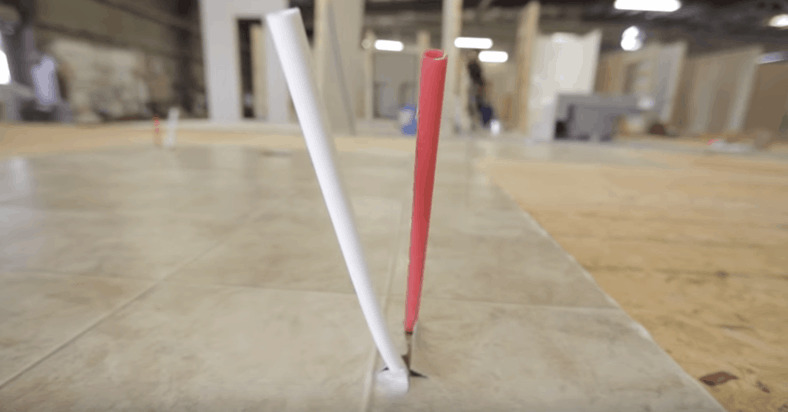
In manufactured homes, plumbing supply lines run under the home either in the middle alongside your heating ducts or on the side, depending on the layout and location of your water heater.
The image above is a photo of a home being built in a factory. Notice how both the hot and cold PEX water lines are stubbed up through the floor before a single wall is even placed. The construction system, along with the plumbing system, of a manufactured home is simplified for easy transport and installation but that doesn’t mean it’s inferior in any way.
Cleanouts and Cut-Off Valves
Another big difference between plumbing in a site-built home and a mobile home is the lack of cleanouts and cut-off valves in the home though newer manufactured homes have those now. There will be a cleanout where the home’s waste drain line meets the sewer or septic trunk outside.
It’s smart to have cut off valves at every water source (faucet, tubs, and toilet). However, if you have to repair or replace anything on a manufactured home plumbing system you have to cut the main valve off anyway because there’s a lot of pressure in those lines and it needs to be reduced before you start cutting into them.
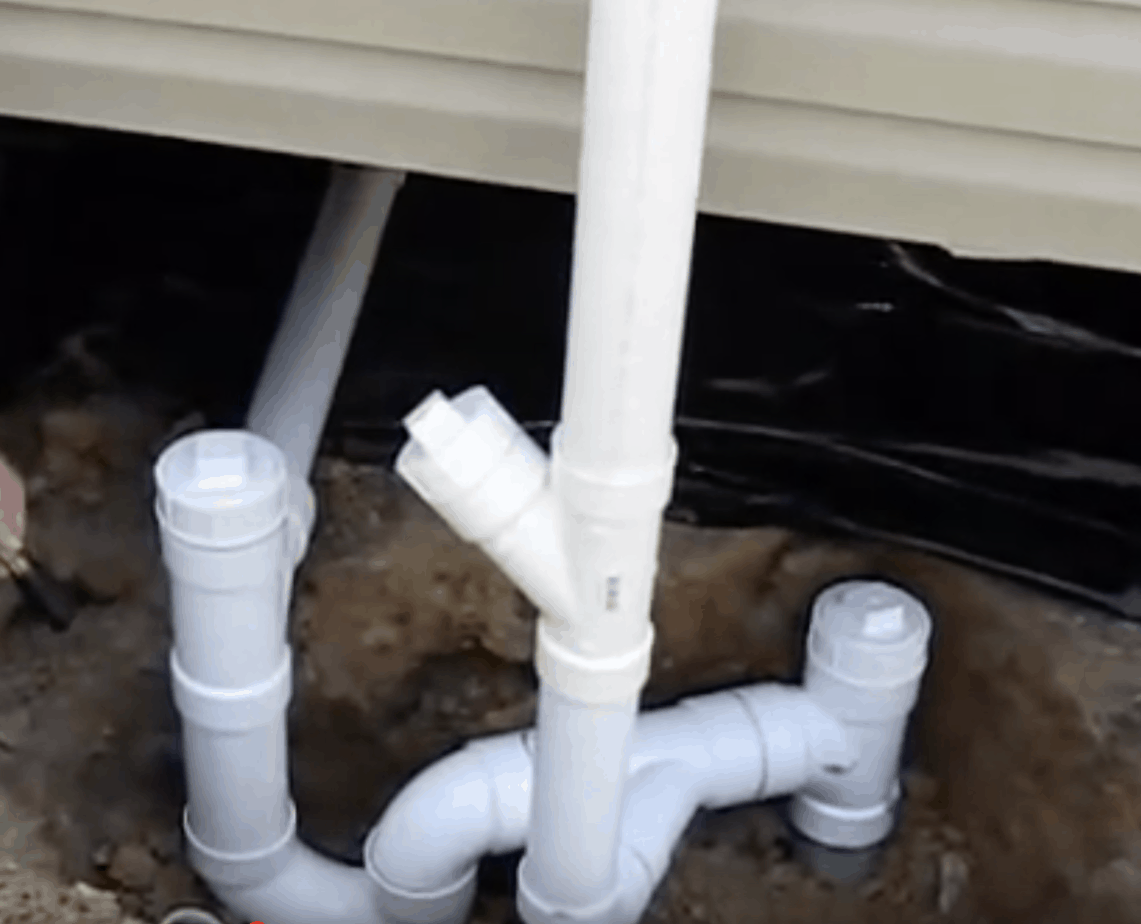
The 3 Parts of a Mobile Home Plumbing System
Every home plumbing system is made up of 3 elements, or systems. All three of these systems work together so a homeowner must understand all three before they can attempt to diagnose any issue.
Water Supply System
Supply lines carry water into and throughout your home. The supply lines, or water lines, need healthy pipes with tight connections (called fittings) that must handle high-pressure water. You turn the handle on a sink and the pressure forces the water out. The more you open the faucet the more water you get. For the hot water, supply lines go through a water heater first. Leaks, pressure, and the water heater cause the most common issues for supply lines.
Leaks around connections is a common concern with supply lines. Frozen water lines is another big problem that manufactured homeowners face. Our article about heat tape will help keep your supply lines from freezing.
Drain – Waste System
A Drain-Waste System flushes away the used wastewater. Drain lines also need healthy pipe and tight fittings that can carry wastewater to the sewer lines or septic tank. It needs the help of gravity and vent lines to keep the correct pressure in the pipe and push sewer smells up and away from the home.
Drain lines are the big (usually white) pipes under a mobile home that go from the water fixtures to the sewer or septic. The pipes are installed at a slope so gravity can push the waste away.
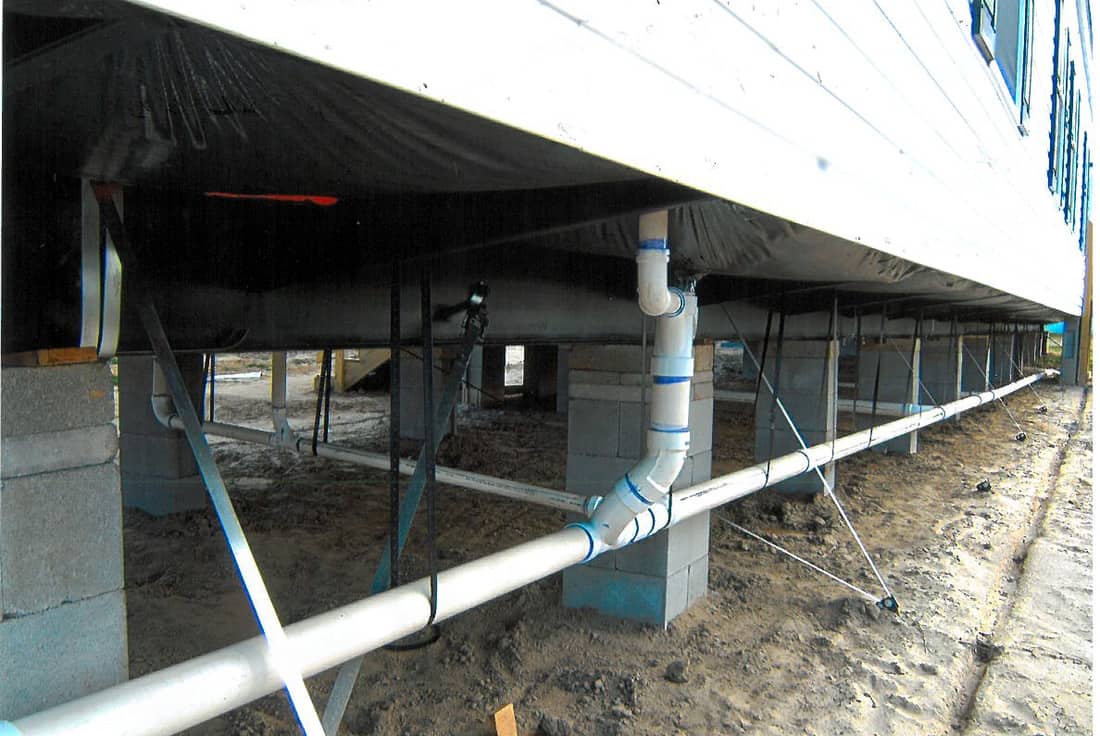
Ventilation System
I’ve seen some articles claim mobile homes didn’t have vents but it’s just another mobile home myth. All homes have ventilation systems, some just better than others.
The ventilation system may be called ventilation pipes or ventilation lines, or just vents for short. Vent lines or drain-waste-vents (or DWV) are also used but they all mean the same thing. While the ventilation system is technically part of the drain-waste line system it’s a separate system.
Ventilation systems, vents for short, do 2 things:
- maintain pressure in the drain lines and help wastewater to drain smoothly
- act as a planned route for sewer smells to follow so no one smells the foul odors in the drain waste pipe.
A healthy plumbing system must be able to breathe and it does that via the vents.
The ventilation system allows air to enter your drain lines so it can keep the right atmospheric pressure in the pipe. Without the ability to breath, draining water would create a vacuum or suction that pulls all the water out of the P-traps (at all fixtures and before sewer line connections).
2 Common Vents Used in Mobile Home Plumbing Systems
Mobile and manufactured homes typically use 2 kinds of vents in their ventilation system: the direct or stack vent and the auto vent.
Direct Vents or Vent Stack
The most common kind of vent is called a direct vent but is often called the vent stack, soil stack, or VTR which is short for ‘vent through the roof.’
A vent stack is the pipe coming out of your home’s roof or running up the side of your home. It connects to the drain line and allows air flow. The
These vents tend to get clogged with leaves, bird or bee nests, or any other debris that can find its way into a pipe sticking out of a roof.
Wet Vent
When one pipe serves as both drain pipe and vent pipe it’s called a wet vent. They can save a lot of pipe and money. Plumbing codes vary with these and there are a lot of restrictions.
Wet vents can consist of a toilet and sink or a toilet, sink, and tub (right image below). It could also be the kitchen sink and the laundry sink, whichever is closest.
Auto Vents or Air Admittance Valves
An auto-vent is a small device that is usually placed under sinks to let air into the drain waste line so it can keep the right vacuum or pressure when draining. Auto-vents do not let the air out, only in. We’ll cover them more below.
A lot of plumbers will use auto vents instead of running a wet vent or a direct vent in new home construction and remodels. It’s cheaper because it uses less pipe and quicker because you don’t have to anything but screw an auto vent.
P – Traps
A trap is a curved pipe under your fixtures but you usually only see the traps under your sink. Traps are a part of your ventilation system and they are called a trap because it actually traps water.
There are two main kinds of traps used in a mobile home: P-traps and running traps. There used to be S-traps but those aren’t used anymore.
Traps use water to close, or seal, the drainage-waste pipe so sewer smells in mobile homes don’t occur. The water seal forces the sewer smells to exit out of the roof vent instead of the fixture. Every time you run water it flushes the trap but gravity does its magic to keep some water in the lowest part of the traps.
The Reason Manufactured Homes Have so Many Vent Issues (and Why Plumbers Don’t Like Working on Mobile Homes)
Below you’ll see a photo of some plumbing that has been installed in a new manufactured home being built in a factory. It’s a brand new home with brand new plumbing and seeing it will make a master plumber with 22 years experience chuckle and walk away shaking his head.
Let me make it clear that manufactured homes only have to meet HUD code – no local codes at all. I’m sure everything in the image passes HUD code but sometimes HUD codes need to be, umm, fixed.
In the photo below, you are looking at the backside of the utility room where the washer will go in the manufactured home.
The white box is the washer box. That’s the control center for your washing machine – it’s how you connect the washer to your home’s plumbing system. You tie in the washing machine drain hose into the home’s drain system and attach the water supply lines from there. The water will flow through the p-trap and then down into the drain line. The small black thing on top of the right pipe (to the right of the P-trap) is an auto vent.
In traditional home plumbing, the air vent should always be above the washer box and the washing machine drain lines would be larger to accommodate the very powerful new-age washers we have nowadays. Also, it’s always smart to use a real stack vent for your washing machine because that’s a lot of water leaving a large appliance very quickly.
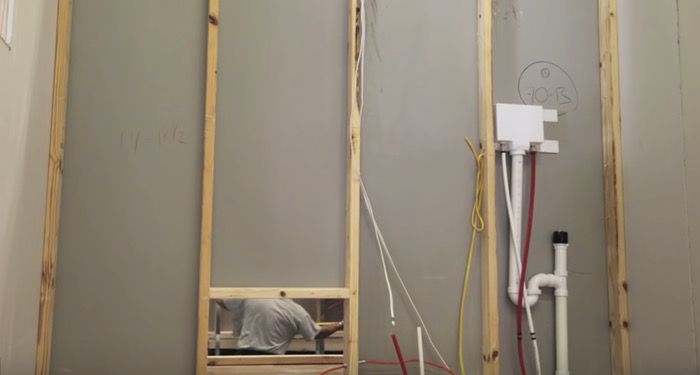
Yes, this design will work. It has worked in millions of manufactured homes for many years. However, it’s things like this that ultimately cause an issue and make master plumbers across the nation not want to work on our homes. There’s no easy fix to this once the walls are installed.
It’s things like this that give manufactured homes a stigma they just can’t seem to shake. There are 3 systems that should never be cheaped out on: plumbing, electrical, and HVAC (mobile home heating systems and ACs). Manufactured home builders are well-known to go cheap on all three.
With all that said, let’s learn about the common cause of venting issues issues in mobile homes, how to diagnose a vent problem, and how to repair it.
5 Common Causes of Mobile Home Venting Issues
Venting issues in mobile homes are usually caused by four things and we’ll cover them all in-depth:
- The venting pipe sticking out of your roof can get clogged fairly easily
- Ventilation pipes can become disconnected during transport or settling
- Auto vents wear out
- Poor initial design from the factory
- Many homeowners don’t even realize that plumbing systems have ventilation lines, or pipes, in the first place.
Clogged Vent Stacks
Vent stacks can get clogged by leaves, birds, rodents, and countless other things. To repair this you will need an auger or drain king or a snake. A snake is just a coiled metal rod that twists through the vent lines and either pushes the clogs away of pulls them out. An auger is a high-pressure water hose that pushes the clog down through the drain lines.
You can buy toppers that allow good air flow but keeps things from falling into the pipes. Vents can also get crushed or bent so a regular checkup is recommended to ensure there are no leaks around the seal and that nothing is blocking air flow.
Disconnected Vent Lines
Vent pipes can get damaged by a slew of things. Mostly, though, it’s either transportation or poor installation. Accidental cutting is also common. There are three ways to fix disconnected vent lines: find where the disconnection has occurred (which is difficult), run new vent lines to tie-in to the main stack, or hope it can be cured by an auto vent.
Worn-Out Auto Air-Admittance Valves
Auto vents, or air-admittance valves are mechanical as in they open and close every time you use water. The cheap brands (used by a lot of manufactured home builders) aren’t so great and wear out quickly. Luckily, replacing auto vents is pretty easy.
Poor Design
The fourth most common reason for venting issues in mobile homes is poor design from the factory. See the image above.
The Unknown
Lastly, but not less important, is the fact that many homeowners have no idea there is such a thing as ventilation in a plumbing system. You can’t repair something if you don’t even know it exists.
Learn How to Winterize your Mobile Home Like a Professional
Troubleshooting 6 Common Ventilation Issues in a Mobile Home
These are the most common signs that will clue you into drainage or ventilation issues.
Problem 1: Foul Odors
Smelling foul odors will be a big sign that something is wrong. You shouldn’t smell anything from your plumbing system. It’s designed to keep that very thing from happening. A foul odor can be caused by poor drainage or ventilation issues or septic tank issues. There’s a few things that can cause foul smells but it’s a sure sign that your plumbing system isn’t working properly.
Problem 2: Slow Drainage
Slow waste water drainage is one of the first signs of ventilation issues. It’s also one of the first signs that you have a clog.
Snakes and augers work if you can find the clog.
If you have an auto vent installed and that drain is slow unscrew the auto vent and see if the water drains correctly. If it does, replace the auto-vent. If it’s still draining slow it’s likely a clog or blockage and you can try a snake or auger. If those don’t work you’ll need to call a plumber to use their industrial strength snake. Those things can get a clog out of just about any pipe (except grease).
Problem 3: Gurgling
If you hear gurgling come from your drains you likely have poor drainage caused by ventilation issues. Don’t confuse there noises with noises that occur when you are running water. That’s a whole different animal.
Problem 4: Water Heater Odors
Of course, not all foul odors are caused by venting problems. Foul water odor could be coming from your water heater.
Problem 5: Missing Water in your Toilet
Nope, the dog probably isn’t drinking all the toilet water! If you find your toilet is missing its water you may have either a drainage leak or a ventilation problem.
Problem 6: Air Bubbles in Your Toilet Water
Seeing or hearing bubbles rise from the toilet bowl is another sign that your drainage system isn’t getting enough ventilation.
Read about 5 more common plumbing problems in mobile homes.
Air Admittance Valves
An air admittance valve is used in cases where connecting a drain pipe to a stack vent is difficult or impossible. They ensure that waste goes down to the sewer and gases stay out of your home.
Look under your sinks and see if you see something like this (it could be black or white, straight or domed).
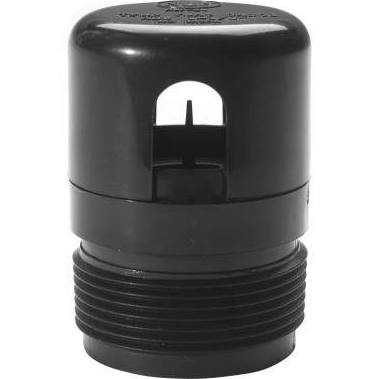
Essentially, an air admittance valve acts as a set of lungs for a weakly ventilated drainage system. It allows the pipe to suck in air when needed and closes off when it’s not needed.
How do Air Admittance Valves Work?
Air admittance open and close by gravity. When anything moves along a pipe it essentially seals it and causes a negative air pressure. That negative pressure pushes the valve open so that air can enter the pipe. As the negative pressure eases the valve slowly falls back into place.
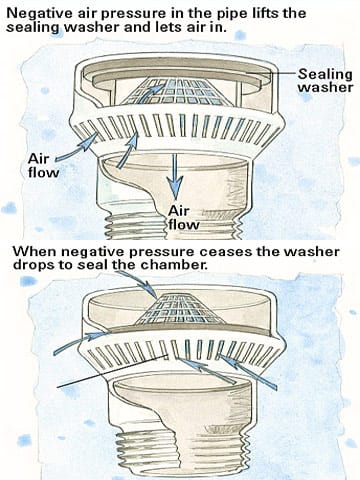
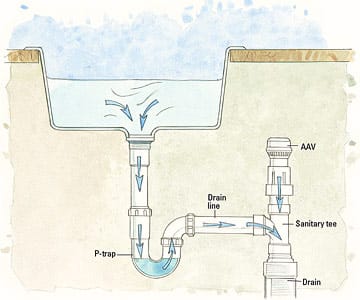
Studor Air Admittance Valves
We highly recommend the Studor brand air admittance vents.
Studor is most plumber’s favorite brand for auto vents or air admittance valves. Joe, the master plumber of the family, always recommends that homeowners replace their original manufactured home’s generic air admittance valve with a Studor brand as soon as you notice signs of failure. He says there is a huge difference between a $5 item and a $35 valve.
(Note: Studor does not pay us for this recommendation. After 22 years as a plumber you tend to learn what works and what doesn’t.)
This video from Studor explains how their air admittance valves work:
How to Install an Air Admittance Valve Under Your Sink
If you notice any of the above signs of drainage or ventilation issues you may want to install or replace an air admittance valve. All you do is unscrew the old one and screw in the new one. If you are installing one where there has never been one it’s a little more work.
The white pipe is drain lines and it is sloped though you may not notice it.
Q & A for Common Mobile Home Plumbing Venting Issues
Question 1 – Backups, Odors, Overflows
I live in a 1987 mobile home. When the washer drains, water will back up into the kitchen sink and the fumes are horrible. Sometimes the water even overflows from the drain onto the laundry room floor. I see no vent stack thru the roof nor do I see any under sink venting devices. What do you suggest to correct this problem?
Answer – 3 Common Issues
You are experiencing three very common plumbing issues but it’s likely caused by one thing – poor or failed venting. It’s kind of a double whammy of not enough (or failed) ventilation and possibly too small of a drain line from the washer.
First, try adding a Studor auto vent under the kitchen sink. That should help the smell. Studor is the best name brand and well worth spending the extra money over the other auto vents.
If your washer drain line is only an inch and a half pipe you may want to consider re-piping it with a two-inch pipe. While doing that, tie it in under the house directly to the main drain/trunk line itself, separate from the kitchen drain. That will definitely fix your problem! Those 1.5″ pipes just aren’t meant to handle a lot of water, especially high-pressure water being released from a newer washer.
Try the auto vent first, especially if there is no stack connected to the immediate system (though there could be one in the walls that has failed – the cheaper vents seem to fail after only a few years)
Question 2: Drainage Issues in a Mobile Home
I have a 1981 Hallmark 2 bedroom trailer. Our bathroom and kitchen sink won’t drain. The tub and toilet are fine. I’ve taken apart the plumbing under the sinks and ran a snake as far as I could, and still nothing. I’ve crawled all under the trailer, and the only lines I see coming down and connecting to the waste/septic is for the washer (also fine). The trailer is insulated very well underneath, and I’ve cut a couple of spots looking for pipes under the sinks but for the life of me, I can’t find anything lol. I’ve even googled various phrases relating to the plumbing plan, to no avail. Any ideas?
Answer: Blockage or Ventilation Issues
It’s most likely a blockage or ventilation issues. Try a true professional plumber’s snake (those they sell at Lowe’s or Home Depot are not that great and are mostly for sinks, not drainage line blockages. You should be able to rent one. Poor ventilation could be air locking the system as well.
Question 3 – Noises and Sewer Smells in Mobile Homes
I have running water, but I have this horrible stench in the kitchen and it sounds like scratching in my walls first it was on the repair side of the house now alternate on both sides. The odor became so bad 4 days after we had water we left the house after raising 5 windows in the house. I returned the odor comes and goes and I haven’t heard the scratching noises. Please help. Asap
Answer: Open Sewer or Venting Issue
It sounds like you have an open sewer pipe or a ventilation issue. When you had your dishwasher uninstalled did the drain to the dishwasher get capped? Maybe the dishwasher’s drain was accidentally left open. All you’ll need to do is find that and cap it like you did the water lines.
If it’s not an open waste line from the dishwasher it’s possibly a ventilation issue. The noise could be your pipes and that usually means the system isn’t able to breathe properly. You can either look for a broken vent line (poor glue jobs, settling, or accidental cutting are the usual culprits when it comes to disconnected ventilation lines) or you can try installing an under-the-sink Studor vent to act as a mini-vent and help rid your home of the odor but my money is on the dishwasher drain assuming you had none of these issues until the dishwasher was disconnected.
Plumbing is a Complex Topic
It’s difficult to explain venting issues in mobile homes. Plumbing seems simple but it isn’t. Keep in mind that a licensed plumber is absolutely necessary for your more complex drainage issues in mobile homes. You should call them if you have a serious issue or can’t find a leak (water is one of a mobile home’s biggest enemies). They have ways of testing a system and narrowing down a problem in minutes.
Thank you so much for reading Mobile Home Living!
Please Note: Your state and local plumbing codes will always determine the exact requirements for your manufactured home’s plumbing system. This article should be used as a reference only. Mobile home venting issues is a problem that requires an on-site inspection and testing most of the time.
This article was first published on Feb 11, 2016. It was completely updated on May 9, 2019.



161 Comments
Jessica Marie · 10/22/2023 at 1:54 am
Purchased a 10-year old double-wide on a permanent foundation, approximately 10 years ago. Within the first year of occupying our home… leaky faucets, water lines, and drains rotted bathroom walls, studs, subfloor, and floor joists in both bathrooms – before any major issue was noticed and observed.
Both bathrooms were completely gutted, leaving plumbing fixtures, water lines, and drainage pipes “capped off” below the subfloor and floor joists for over a year. Everything was removed from the bathrooms to properly repair damages including vent pipes – due to additional leaks occurring around roof vents.
Several years later, new plumbing fixtures have been installed in different locations and running into multiple issues with each install.
I desperately need to find an easy understanding guide/resource for basic plumbing installation and drainage for a double-wide because hiring a plumber is not an option. I’m a single mother on a tight budget.
Peter Zabriskie · 05/21/2022 at 10:37 am
Thank you very very much. We have retired to an older 1972 doublewide mobile home that is wonderful except for the occasional oders. I thought venting was the issue and this insightful article is a huge help to get our home sweet home smelling.
Cheryl · 11/04/2021 at 8:42 am
Simple: maybe and maybe not. WHERE IS AND WHAT DOES THE CUTOFF VALVE LOOK LIKE. I NEED TO CUT OFF AT MOBILE HOME BUT I DON’T KNOW WHAT I AM LOOKING FOR.
William Lade · 11/01/2021 at 12:53 pm
i have a 1998 skyline manufactured home sewer drain from far est shower and toilet fill up and drain very slow ran a power snake as far as can nothing going into tank where would it go not under house or any where that we can see plummer does not know either where water and sewer was going any ideas?
Julia Allen · 10/23/2021 at 12:44 pm
Thank you so much for your help.
deborah d · 06/22/2021 at 3:26 pm
I have the smell of sewer inside and outside my mobile home. When I put baking soda down the pipe of my washing machine the smell insides goes away. I think this is the problem area.
Several years ago right before I purchased the home, pipes broke and had to be repaired due to no heat and freezing weather. Maybe they did not repair the pipes correctly? However the first year I was I lived here there was no sewer smell.
I have a large vent system that supposedly pipes smell out of the roof of the home so I thought maybe this was clogged.
I have no slow drainage of sinks, and no air bubbles from toilet. What is your take on it? Thanks.
Debbie
Rich · 05/28/2021 at 4:49 pm
Do you need separate roof vent for washing machine. We installed a washing machine, attaches to main drain line, but no separate vent for washing machine drain line.
Clifford · 05/28/2021 at 7:05 am
I live in an 09 lexington mobile home. Ive been experiencing this issue for quite some time, but im not really there too often, so ive just been dealing with it. In the bathroom furthest from the sewage drain, my toilet backs up and takes a few hours to drain. If i plunge, the water backs up into the sink. If i dont use that bathroom for a few weeks, then everything drains normal, and then after normal use for a day or 2, sometimes even a week, it starts back with the same issue. Havent noticed any smells, but shortly after this first started, it stopped and i found out one of the sewer lines disconnected and i had it fixed, only for it to start up again. Occasionally, i will have an issue elsewhere in the house, for instance, a couple years ago, my dishwasher backed up and flooded my kitchen as a result. Im torn between replacing lines and, after reading your article, installing air admittance valves throughout the house. Which would you advice for the most cost effective option that would fix my problem?
Lynn M Carl · 06/05/2020 at 9:13 pm
Hi Mobile Home Living,
We just put a new insulated roof on an older 1974 mobile home and now we are getting a strong sewage odor inside, but only when it get up to 100 degrees outside! The problem is compounded when we run our new air conditioner unit. Any thoughts?
Crystal Adkins · 12/27/2019 at 8:58 pm
Hi Roger,
In 90% of manufactured homes, there will be a straight duct ran right down the middle of the home with branches off of it. For double wides, there will be 2 trunks, one down the middle of each section. There would be no papers or schematics available – builders didn’t release that kind of stuff very often. Heck, even the manuals are just made per size of the home (one for single wides, one for double wides), and not models.
These articles may help you: How to Seal Heating Ducts in a Mobile Home to Save Money
Mobile Home Heating Guide to Furnaces and Heat Pumps
How to Repair a Mobile Home Belly Board
Best of luck!
roger peck · 12/23/2019 at 12:57 pm
i need to work on a 1963 HILTON 12 x 60, mobile home 3 bdr. i am looking for the heat ducting plans
Crystal Adkins · 10/20/2019 at 10:46 pm
Hi Bernadette,
Your washing machine drain pipe can be moved. It will take a little crawling under the home and drilling a new hole for the pipe to come up through your floor. I’d get estimates from at least 3 plumbers and if you have other plumbing issues have them do it all at once. Best of luck!
BernadetteConrad · 10/10/2019 at 1:16 pm
I have a 79 Emperor what I want to know is can a drain pipe be moved for the washing machine right now it’s in my bathroom and would like to relocate it where the washer is.
Crystal Adkins · 09/27/2019 at 12:26 pm
Hi Alisa,
It’s most likely grease that’s closing right back up after the snake is removed. You’ll want to replace the P-trap (and all other pipe with grease in it). You should be able to remove the P-trap and see the grease if it’s in the rest of the line. You can always clean out the p-trap but it’s a messy smelly job and can’t be done at any sink or toilet. It’s well worth $15 to not have to deal with the mess.
Let me know how it goes!
ALISA STALKER · 09/24/2019 at 3:44 pm
I have the same issue with my kitchen sink. And we had a professional plumber snake it twice with no luck. Last night we plunged it forever and it finally worked, ran hot water and boiled water for over 20 minutes. This morning is it clogged again. Any suggestions??
Crystal Adkins · 08/21/2019 at 12:18 pm
Hi Arlene,
You should be able to install a boot around the roof vent. Height for the vent pipe is important as it helps push the smell up and away from the home but you can work with a shorter one as long as the vent itself is clear of debris. If there are no issues in your tub or sink in the bathroom with the toilet issue it’s probably not the vent and just a regular ole clog in the line. Try using a snake to clear it and see if that works. If not, you may need to call in a pro that has an industrial snake. Best of luck!
Arlene Perea · 08/18/2019 at 9:59 am
Hi. My name is Arlene. I live in a 1993 (I believe) Solitaire. I believe I have a venting issue. My master bedroom toilet will not flush properly. Both vents, master and guest, were broken at the roofline last year after snowstorm. Not sure how to repair since breaks are just below (about an inch) propanel roof. Will I have to remove propanel sheets to repair? I also have extremely hard water so that doesn’t help the toilet and fixture issues. Any guidance?
Crystal Adkins · 06/24/2019 at 1:12 pm
Hi Lisa!
I’m so sorry you’re having so much trouble. It sounds like you have a partial blockage under the guest bathroom and those estimates are way too high in our opinion. If you have an auto vent under your sink in that bathroom take it off and see if the drain is faster. If it is, you’ll know it’s the vent. If not, it’s a blockage. A snake can fix the blockage (industrial strength) in no time.
Beast of luck!
Crystal Adkins · 06/22/2019 at 10:37 pm
Hi Melissa,
My husband and I lived in FL for a couple of years and he worked as a master plumber. FL does allow vent stacks. The vent that is sealed could possibly be for a gas furnace but since you live in FL many people don’t install heating units at all and they would just seal the vent. Think that could be what you’re looking at? Is there another vent that isn’t sealed? See if that one is clogged…
Let me know!
Crystal Adkins · 06/03/2019 at 6:27 am
Hi Angie,
They do the same thing but Studor is made better and have less failure rates.
Every time you use water it has to open and then close, that’s lot of mechanical action so it needs a smooth actuator that Is easily triggered by air fluctuation/suction in the lines (I’m not sure that’s the right name for the part inside).
I should be a Studor salesperson (or at least an affiliate, huh?) I swear I don’t get a penny! They really are just better.
Angie · 06/02/2019 at 7:59 pm
I’m curious to know: what exactly is meant in this article with “there is a huge difference” between the Studor Air Admittance Vents and the cheap black ones? Are they just superior as far as the material goes? Or do they work differently and lead to better ventilation?
Melissa Nichols · 03/31/2019 at 10:42 am
I couldn’t find a way to start my own comment, so I am hoping you get this in a reply to one of your answers.
I live in Florida & I believe I have a problem with venting. I had a guy go up on the roof to see if the vent pipe was clogged & to flush & clean it.
I can’t afford a plumber, so he was just a neighborhood handyman.
He reported that the stack located between the bathrooms seems to be completely sealed with an aluminum piece that resembled an upside down soup bowl.
He could find no way to open it, as if it were a cap – that it seemed to be all one piece. He also said there were no holes or slits to allow for air to get in.
I do have an AAV on one bathroom sink & one on the kitchen sink.
I was able to remove the cap off the AAV under the bathroom sink. My next goal is to buy a wrench big enough to get the part out that is screwed in & replace it with a new one.
From searching, I believe that Florida allows for there to be no roof ventilation and that I could possibly just have AAVs under a couple of sinks.
A friend suggested putting Sure Shot Drain Opener in it, once I get it off.
I am not sure about that, though.
I don’t want to go up on the roof myself. The guy said that all the pipes on the roof were similar, so I am not sure what else to try, besides replacing the AAV & hope it starts flushing again.
Is there a way to test the system, by holding down the spring to let air in & then flushing? Or is it going to be replace & see?
Or do you have another suggestion for why the roof vents don’t seem to be vents?
Crystal Adkins · 02/11/2019 at 11:58 am
Hi Fatima,
When its a kitchen sink that is clogged its usually just grease and food. Have you tried a liquid plumber product? If that doesn’t work, try plunging it: Seal up the one side of the sink (assuming it’s a double) with a rag and make sure it’s air tight, then use a sink plunger on the other side. The suction should loosen up your clog a bit.
You can also buy a cheap snake and try that. The problem with grease is that a snake won’t necessarily cut it because the grease just seals back up as soon as the snake is pulled out.
In the worse cases you’ll need to pull the p-trap and clean it out. Make sure you install it back properly so there’s no leak.
Best of luck! Let me know how it goes.
Fatima · 02/11/2019 at 12:58 am
I Own 1996 Mobil home
Bought it a few months ago.
I hadn’t had a problem with the pipes until today I noticed that the water in the kitchen sink clogged.
I’m concern bc I was informed that it can be expensive and that the system is not the same as a regular home. Please help!
Is there anything I can try or do b4 calling a professional?
Thanks
Crystal Adkins · 02/09/2019 at 7:24 pm
Hi Janel,
You’ll need to find your cut off valve at your meter but there should be one outside under your home, usually at the corner where the garden hose goes.
Call you water company and a plumber immediately. You have to stop the water from soaking into your wood. You’ll def need a new toilet ring on that one toilet.
Best of luck! Let me know how it goes.
Janel · 02/02/2019 at 1:26 pm
Artic freeze, two bathroom mobile home , one on each end. One bathroom and kitchen works great, one bathroom is you flush toilet or run bathtub or sink water will poor out of the bottom of the toilet. Shealth was cut under bathroom and water came pooring out. Pipes are thawed and no water running but should I call a plumber, have no shut off valve on anythink.. Help 69 year old retired women in tears.
Lisa · 01/22/2019 at 2:01 pm
Crystal,
I am at a loss. I have had 3 plumbers out for a slow drain in our guest bathroom. 1st plumber says it is my P-Trap, The 2cnd plumber says that our mobile home has a cast iron pipe that is rusted and causing a bad drainage.
Our mobile home is about 20 years old and our guest bathroom tub is acting up and slowly drains.
Now the 3rd plumber says it is the air flow and that a part under the house needs to be replaced with a new pipe since it is leaking under the house. This has been stressful and time consuming. I do know that I have been given 2 estimates with 2 different repairs from 2 plumbers. To make a long story short I found out my 2cnd plumber didn’t tell the truth and it is all black pvc pipe under the house. So if it is the air flow system is it best to just replace the air flow vent or do a total repair of the tub, pipes and to add a access door behind the tub to prevent this from happening again? I have a repair estimate at 1600 or total tub , pipe repair at 3600 🙁
Lost and confused!
Crystal Adkins · 01/21/2019 at 7:38 pm
Hi Betty!!
You need a bigger drain line. Mobile homes are notorious for only having 1.5” drain lines from washing machines to trunk. New machines are powerful and higher-efficiency and needs at least 2” drain lines.
That will fix you right up! Best of luck!
Crystal Adkins · 01/10/2019 at 11:27 am
Hey Emily,
Assuming there is no leaks under the home, I’d suggest changing out your aerator (the screen at the tip of your faucet). When you moved the lines around You probably loosened up some gunk and it’s closed off your faucet. Just unscrew it from the faucet and see if you have water. You can buy a new one for a couple of dollars or just clean the old one.
If that doesn’t work let me know (but def make sure you don’t have any water under your home).
Best of luck!
BETTY INFINGER · 01/08/2019 at 10:17 am
Hi. I guess I was asking about this washing machine drain line–it overflows constantly–no other areas back up..when washing clothes it gurgles–when water going down drain–I have used several chemical drain openers–doesn’t help…what do i need to do?? It seems like other things like the sink or bathtubs would be having draining back up problems but we don’t..Does the drain line under trailor need cleaning out? Can you recommend a drain opener that might work??
Emily Chaney · 01/06/2019 at 3:03 pm
I live in a 1997 double wide 3 BDRM 2 bath Palm Harbor home. Everything works great except the bathroom sink that is the farthest away from the water supply. We have no water at the sink. Tub & toilet are fine. I had to repair the line which required pulling the pipe up about 1″ from under the house. I though the problem might be from the water having to go “uphill” a little more than before, so I added a small amount of pipe & dropped the line back down to where it was. Still no water. There is a vent under the sink & like I said, the tub & toilet ( & rest of the house) get water & drain water fine. Any ideas of what to do or try?
Crystal Adkins · 11/13/2018 at 12:55 am
Yes! It’s probably a good idea. No sense in taking the chance of leaks until you get there.
diane bynum · 11/05/2018 at 9:12 am
Hi! I just bought a singlewide 1979 Liberty mobile home in Florida. The bathroom floor is soft in front of the sink. We live in N.J. and won’t be able to even visit this home for a few months. Should we have the water shut off until we get there? Thank You!!!
Crystal Adkins · 10/28/2018 at 3:30 pm
Hi Wendy,
Absolutely!
Crystal Adkins · 10/28/2018 at 3:23 pm
Hi Betty,
I know I’ve answered this comment before but my commenting system in on the fritz so I’m answering it again, sorry. You can open-site your washer line in many areas but it is illegal in many areas, too. You can drain it into a flower bed (and use friendly detergents) you have the prettiest flower bed in the area!
Best of luck!
Crystal Adkins · 10/28/2018 at 3:20 pm
Hi Sue,
I sent you an email. Please let me know if you didn’t get it. Thanks!
Crystal Adkins · 10/28/2018 at 3:13 pm
Hi Laura,
I know I’ve answered this comment before but my commenting system in on the fritz so I’m answering it again, sorry. So, it sounds like sediment from the construction has caused a stoppage somewhere. You’ll need to find it and get snaked out to open flow again. Pipes have a lot of gunk and movement will stir it up.
Best of luck!
Crystal Adkins · 10/28/2018 at 1:13 pm
Hi Alisha,
This sounds like the washer is having issues, not a plumbing issues. Is it filing up slowly or gurgling?
Wendy · 09/22/2018 at 6:40 pm
I have an AAV under the kitchen sink and would like to know if the pipe can be cleaned out? I can see gunk in the line. We also hear gurgling from the kitchen sink while doing laundry.
Crystal Adkins · 09/05/2018 at 2:23 pm
Hi Kay,
Yeah, your trunk line is clogged and needs to be jetted out. It would only affect the one bathroom because the other connects to the main trunk at a different place. You could try snaking your line out yourself before calling a plumber but to be honest, paying a plumber for an hour to use their jet and make sure nothing gets blown out is worth that added expense. Best of luck!
Crystal Adkins · 09/05/2018 at 1:54 pm
Hi Frank,
This sounds like the trunk line is clogged and holding water so the sinks drain fine because it’s not a whole lot of water at once. When you flush, it puts out 1.6 gallons at once which fills everything up and closes off the vents. You’re gonna need a plumber to go in and jet the line. The plumber would know where to go in without blowing out your connections. You could try snaking it yourself but this is pretty big since it’s sucking both traps dry.
Best of luck!
Crystal Adkins · 09/05/2018 at 1:38 pm
Hi Kimberly,
So, what you are experiencing is due to weir on your P-trap (I don’t know how to explain this so bare with me). It’s normal for the situation you have – the water you see is the same level as your drain. Only way to fix it would be to lower where your t ties into the drain but it’s not a big deal at all.
Thanks!
Crystal Adkins · 09/05/2018 at 1:22 pm
Hi Pat,
You’ve done just about everything you can so at this point, you really need to call a plumber. You have a clog somewhere but it’s probably going to require a professional snake (RT66). Best of luck!
Frank Mendoza · 08/27/2018 at 12:08 pm
I live in an early ’80s mobile home and all the sinks and the tub drain fine. When flushing the toilet, it drains very slow and there’s a gurgling sound coming from the tub and well as horrible gas smells from both the tub and the kitchen. Since all the other sinks drains fine, if the toilet the only one suffering from poor ventilation?
Kay · 07/13/2018 at 10:10 pm
I have a 1997 (I think) Heartland double wide. The problem we are having is the master bathroom toilet doesn’t flush. At first it would fill up very slow and we could flush maybe 2 times a day. Then it wouldn’t fill up at all. To top it off the master stall shower fills up. It actually clogged up pretty bad yesterday that after showering (5am) the next day (5am) the water was still in the shower. Now, to my knowledge the tub is fine. (We hardly use it) Are we having a main pipe line issue or is it something greater? The 2nd bathroom toilet is fine. It was having the same problem at first but I think now it flushes every time. I just want to know if there is anything we can do to prevent damage and save money. Thank you
Crystal Adkins · 07/04/2018 at 2:49 pm
Hi Beth,
Yes, you will want to do whatever you can to get the water away from the home as quickly as possible. You can always tape over the holes you make in the plastic. You will definitely want to get that leak fixed. The longer it goes the more damage you will need to repair, especially with the subfloor and cabinetry. If it were me I would cut the water off to the kitchen (assuming there’s a cutoff valve) and only turn it on when absolutely necessary until it gets repaired.
Best of luck!
Beth Bishop · 07/01/2018 at 9:14 am
I have a minor to moderate leak that I believe is coming from the kitchen drain, which is located at about the center of my mobile home (island sink, dishwasher, etc.). I first noticed creaking sounds through the floor in front of the sink area, then recently noticed a wet area of ground at the back of the home. Looking underneath the home, the underbelly appears to be bulging only at the most rear area and feels real heavy. My home slants in that direction, so I’m thinking the leak is running there and gathering until reaching a certain point or pressure. My question is, should I create a small drain hole of sorts where the water seems to be gathering until I can get an inspection and repairs done?
betty infinger · 06/05/2018 at 9:27 am
I have a 1994 mobile home–my washing machine always overflows when washing clothes..Could my septic tank be full or is it clogged up..I have used several drain openers –sometimes helps.. can we separate the washing water hose and let it drain outside in the yard instead of going into septic tank..We live in country..
Jimmie Janel Wright · 05/30/2018 at 6:25 pm
great info thanks
Sue · 05/29/2018 at 10:54 am
We live in a double wide mobile and recently had a plumbing issue where the water backed up to the tub and toilet and onto the floor. We called a plumber and they unclogged it, saying the water was not draining out to the septic but draining backwards because the pipes in the back end of the mobile were lower than the front of the house. How are these pipes strapped up to get proper drainage. The plumbers want 1700.00 to do it. How can we do it ourselves?
Crystal Adkins · 05/11/2018 at 10:26 am
Hi Stanley,
Probably not. The industry doesn’t seem to want to make their schematics available from older models. You may luck up and find an owner that has scanned in their manual or brochures but that’s about all. I’ve never heard of a single success story of any owners getting help from a builder regarding older models, unfortunately.
best of luck!
Crystal Adkins · 05/11/2018 at 10:14 am
HA! I’ve seen those composting toilets in action and they are pretty cool. Plumbing isn’t too bad – it kinda amazes me how it works together.
Thanks for reading MHL!
Dave · 05/07/2018 at 11:44 pm
Reading this article and the comments makes me want to install a composting toilet. This is nasty stuff. Like, umm, literally.
Laura · 05/06/2018 at 7:43 am
Hi we had water leaking from under our mobile home outside that has a bit of a sewer smell to it. It stopped leaking after about an hour and was leaking out from the area where our washer is located just inside but we cant figure out what is going on. We had to plunge both of our toilets a week before this but other wise we have no pluming issues inside, no leaking inside and no odor inside. We do have city sewer and we had workers from our gas company out working throughout our mobile home park cutting large holes in our roads and cleaning out pipes etc. Our issues all started happening around the same time so we just cant figure this out any input would be greatly appreciated! Thank You!
stanley robinson · 05/02/2018 at 4:49 pm
we are re-plumbing our fortune home manuf. #02fo ve 286405s, ser no.fhin101559ra-8. is it possible to obtain a plumbing diagram for this home.
Alisha · 04/15/2018 at 4:35 pm
I am having issues with my washer not filling right or spinning and draining. Its brand new washer. We live in an trailer park. My mom lives in the same one has the same issues. Also theres has been an lot of rain here.
Kimberly · 03/26/2018 at 1:50 pm
We have a 1975 double wide. Just fully renovated the only bathroom. The new bathtub is lower than the old tub which seemed to sit up higher and the plumber put in an overflow which the previous tub didn’t have. Tub drains fine when showering, if dumping a bunch of water, it is slightly slower to drain. I used draino thinking maybe there was a clog but like i said seems to drain fine. When you shut the water off after a shower, the water stops and sits in the drain right at the cross piece the stopper screws into. Soap suds also. I have never seen water sit in any drain like that before. The plumber had mentioned the stack behind the wall is higher than i should be but left it and now is saying the drain is fine with water sitting there. Am i crazy thinking that is NOT normal?
pat · 03/05/2018 at 10:07 pm
I have a problem with the main bathroom. I have repaired the commode with a new wax ring because the water was running out the bottom in the front. Before this our shower was not draining and the commode would not flush well also we have a bathtub in the same room. I checked the sink in this bathroom and it seemed to be about half stopped up as well. We have a vent underneath the sink and I was going to check the air vent for a clog but they have glued the plug. I have also run snakes and to no avail. Lowes said to put ridx down it and that only made it worse, now the ridx is clumped as well any suggestions.
Crystal Adkins · 02/16/2018 at 12:45 pm
Hi Johnny,
Usually, with kitchen sinks, it will always be a grease problem. When you use a ‘regular’ snake the grease just closes right back together as soon as the snake is pulled out (I don’t know the scientific term but the snake goes through the grease easily, but it doesn’t break it up). A professional water snake may be needed to break up the grease and push it down the drain to the tank.
Best of luck!
Crystal Adkins · 02/11/2018 at 3:49 pm
Hi Angela,
It really sounds like your problem is in the ground or the area between the ground and the home. Most manufactured home builders will only cover the pipes from the home’s connection point so I’m impressed with them moving the line from the beam as it’s outside the home. You will need to make sure your water supply line or trunk is below the frost line from the meter to the home and then the vertical line entering the home is very well insulated. Using heat tape in that area is common in your state, too. You may want to call a plumber and have them make sure that trunk is at the right depth and that the area from trunk to home is properly insulated.
Best of luck!
Crystal Adkins · 02/11/2018 at 3:23 pm
Hi Kathy,
Vibrating could be either partially clogged vent or a loose water line vibrating. This is probably best handled by a licensed plumber.
Best of luck!
Crystal Adkins · 02/11/2018 at 3:22 pm
Hi Judy,
If you’ve changed your auto vent and did the bag trick then you probably have something dead somewhere or a sewer leak somewhere close. Throwing lime under the home may help.
Best of luck!
Johnny Applewhite · 01/25/2018 at 9:34 am
I have an 80′ double wide. The sinks, tub, shower, toilets and washer on the east end drain perfect. The kitchen sink is in the middle of the house. When you run water into it, it backs up into the tub in the west end of the house. Sometimes the kitchen sink will back up for a few hours. Nothing in the bathroom on the west end will drain. When it drains, it might take days. I have ran a snake from the kitchen sink vent over 50′ east towards the septic tank and i found nothing. The snake stopped but it probably hit the tank wall as the tank is only 10′ from the east end of the house. you would think that the problem was between the kitchen sink and the septic tank but I have found nothing. My next guess is to pull the toilet in the west end and run a snake towards the kitchen sink. Any suggestions?I
Angela Serocki · 01/14/2018 at 3:59 pm
Good Afternoon we have a 2007 Manor Hill 4428-21 Select, 54MAH28443BH07A home. We’ve had numerous issues with the home. We were promised that the homes are constructed so we would not have to worry about water pipes freezing in our MN winters. We are on frost piers. The first winter and every winter since, the pipes have froze. Year one Harvest Homes did come out and determine that the water line was touching a beam which they said was causing the pipes to freeze. They said the moved it. It did not fix the issue. The second year, we purchased and added additional insulation behind the skirting to help eliminate the cold from especially the south wind, but completely around the home. This also yielded no results. Sometimes we can get up in the morning run the water for 5 minutes and 15 minutes later the lines are frozen. The only relief we have found is if we can bank snow up to the bottom of the window seals then the pipes stay thawed. What can we do to fix this issue…we are stumped.
Kathy · 12/30/2017 at 10:48 am
I have a 1991 Victorian mobile home, and just recently started to hear a vibrating noise right behind the wall that encloses the shower plumbing after flushing the toilet. By the way, this started during the cold weather, Dec. of 2017. Could you please advise? Thanks so much!
Judy · 12/22/2017 at 4:49 pm
About a week ago we started smelling a foul odor in our spare bathroom The smell was definitely coming from under the sink. We have a 1996 manufactured home & it has the black air admittance valve under the sink. My husband cut the cabinet floor out to see if something dead was in there. No such luck. He sealed the floor area with foam sealant to plug the obvious holes where the pipes came in. A plumber friend recommended removing the valve & attaching a bag on the pipe to see if the smell stayed. It did. We purchased a new valve but not the Studor one. Still no change. The room is closed with window opened in hopes that whatever will cease. Any suggestions ?
Crystal Adkins · 12/21/2017 at 12:52 pm
Hi Buffie,
A house needs at least one vent through the roof and then all the other fixtures can be auto vents though most inspectors want vent stacks (coming out of the roof) whenever possible. It sounds to me like the sewer is leaking under your house, maybe the new plumbing came apart somewhere? Get someone to go under your home and watch the plumbing as someone else flushes and uses all the fixtures one by one. A drainage leak should be visible.
Your skirting or underpinning absolutely needs vents, and this may be your biggest issue if you don’t have any vents. There is a ratio used for skirting vents and I think it’s 1 square foot of vent for every 150 square feet of area. You will need to make sure there are vents with 3′ of your corners so dead air pockets aren’t created.
I think if you do both these things you will be all set. Please let me know how it goes! Best of luck!
Crystal Adkins · 12/20/2017 at 2:51 pm
Hi Tammy,
You wax ring was leaking and that’s why your insulation was saturated. I’m assuming you removed the toilet when you replaced the subfloor and used a new wax ring when you replaced it so there probably wouldn’t be any more leaking. Insulation is always recommended on your water lines. If you don’t want to use the pink stuff you can at least wrap it with a foam sleeve?
Best of luck!
Crystal Adkins · 12/20/2017 at 2:46 pm
Hi Kristy,
You may have a vent issue. Try installing an auto vent under your kitchen sink and maybe add one under bath lav. It wouldn’t hurt to have a plumber check the vent off the drain system. It could be damaged or clogged. This definitely sounds like a vent issue – We just don’t know where.
Best of luck!
Crystal Adkins · 12/20/2017 at 2:43 pm
Hi Beverly,
You sure can!
Crystal Adkins · 12/20/2017 at 2:42 pm
Hi Robert,
So, if I had to guess I would say you have a sag in the drain system and it’s holding water and freezing, which clogs the whole system. A simple strap will probably fix you right up.
Best of luck!
Tammy · 12/20/2017 at 2:27 pm
I replaced the subfloor underneath and around the toilet. We pulled out the insulation underneath the toilet out as it was saturated with urine. If I don’t replace the insulation do I run the risk of frozen pipes?
Crystal Adkins · 12/20/2017 at 2:09 pm
Hi Jeremy,
If it’s not coming from seepage lines of your septic tank system then yes, it’s probably the vents on the roof. I’d give the septic system a good look.
Best of luck!
Crystal Adkins · 12/20/2017 at 12:14 pm
Hi Aaron,
Your water heater is probably clogged. Turn everything off and follow the directions on this link.
Best of luck!
aaron · 12/20/2017 at 8:27 am
I live in a 1985 single-wide moble home. Im losing hot water pressure but my cold water is completely fine. the hot water I do have is nice and hot just super low pressure and has gotten worse.
What can I do? Is this an expensive fix? I have no money at all and getting serious anxiety. thanks for the help!
Crystal Adkins · 11/27/2017 at 1:56 pm
Hi Eva,
You can find the proper couplings and pipe at Lowe’s. Be sure to use the right cleaner and glue for the pipe material. Good luck!
Crystal Adkins · 11/27/2017 at 1:30 pm
Hi Jeff,
You’ll probably just need to remove the fan to find out. Most manufacturers don’t release much information or schematics for each model, only an annual manual for single wides or double wides. Luckily, the hoods are not too difficult to remove. This will give you a good opportunity to determine if you need to do any vent repair.
Sorry. Best of luck!
Jeff · 11/26/2017 at 1:49 pm
I have a 2005 double wide champion model 775 need to replace kitchen stove hood and know its 30 inch wide but need to know the size of pipe it hooks to seen 7 inch in books also states mobile homes could be 5 inch need to know what I have before buying new one
Thanks Jeff
robert carr · 11/26/2017 at 12:09 pm
I have a 1990’s mobile home.every winter for some reasons my drains stop going down and both toilets the tub and the other shower all back up and overflow..have called plumbers and roto rooter and they didn’t know what the problem was.
Beverly Summers · 11/25/2017 at 11:10 pm
Can I snake out the trunk line between access cap and septic tank 10 feet away.
Jeremy · 11/24/2017 at 2:22 pm
We have a new 2016 mobile home.
Everything appears to drain well but outside we can smell sewage.
We crawled under the home and you can’t smell it under there and it’s dry and all plumping looks ok.
I was thinking it may be coming from the vents on the roof but I’m not sure.
How can I make it stop?
Crystal Adkins · 11/21/2017 at 1:33 pm
Hi Karen,
It’s a good idea. Professionals will have the right equipment to snake clogs out and test the vent lines. You can always go up and see if there is a problem that you can handle like a bird’s nest (you can rent the professional equipment if you’re comfortable with that kind of thing but it often ends up costing as much as a plumber anyway).
Best of luck!
Karen Curry · 11/21/2017 at 11:15 am
Do I need a plumber to go on the roof and look at the vent?
Crystal Adkins · 11/21/2017 at 8:30 am
Hi Carla,
Kinda sounds like your ventilation lines are clogged which is allowing the smell to come into your home. Snake your vent pipes on your roof first – make sure there are no obstructions. Then, replace the auto vents. (your problem is the exact reason I wrote this article).
best of luck!
Crystal Adkins · 11/21/2017 at 8:28 am
Hi Michelle,
Sounds like you have a serious drainage issue in your trunk line (and will require professional equipment). Couple hundred dollars should get a pro out to snake your lines with the heavy duty snake (assuming your drainage lines are all properly installed). Best of luck!
Michelle Vance · 11/19/2017 at 12:49 pm
We are new to mobile homes and we are having a problem. We can not take a shower and flush a toilet, everything that went into the toilet and the shower goes back to the back bdrm shower stall and floods.All the while both toilets gurgle and drain away.. We have did the drano thing tried to snake but we have a cross in each drain sink and tub. What could be our problem
Carla Moser · 11/18/2017 at 3:42 am
We have lived in a mobile home for over 8 yrs. For the past going on 2 yrs there has been a poopy smell that starts in my bathroom and moves through my house. I really need help on how to fix this problem. It is the master bedroom side. Our hot water heater is on opposite side of the mobile home.
If it is the traps where are they located and what needs done.
Please I’m soo sick of this smell. It happens often.
Kristy Smith · 11/16/2017 at 3:05 pm
Hi I own a mobile home 1987 I believe. Anyways we have lived here a year. All year we hear gurgling from the toilet if we drain the tub and gurglingvin the kitchen sink when we use our dishwasher. But when the temperatures start to get cold there is an awful odor that arrises when we use our hot water for the most part but also cold sometimes too. The smell is only in the bathroom. But its bad please help if possible.
Thank you,
Kristy
Buffie Taylor · 11/15/2017 at 1:54 am
Hi Crystal!
Firstly, thank you so very much for all this info! After reading nearly everything on your site, I’m convinced I either have some kind of ventilation issue or a drain leak (ok that narrows it down).
Back in June we had our 2013 double wide moved. We then hired highly recommended plumbers to re-plumb the home. Around August we began noticing horrible smells. This occurs any time we wash clothes or use dishwasher BUT not always. It comes sometimes when NOTHING has been running all day, like I get home from work and it knocks me down when I enter the front door. The smell comes not only from drain under kitchen sink. It also knocks you down when you open the kitchen sink cabinet. This smell comes and goes within minutes. Sometimes it lasts for hours though. It seems worse at night, but it happens in the middle of the day sometimes too.
Kitchen auto vent has been tested and works fine. No slow drains anywhere in house. No gurgling or any other noises. I’m making sure all P traps get filled regularly on any infrequently used faucets etc. like guest bathroom.
We had a reputable plumber come out and charge 65 bucks to tell us we have a dead rodent somewhere between the floor and the bottom cabinet under sink. He stuffed walmart sacks around the pipes coming in to kitchensink to block the smell. It did help some. The dead rodent thing may be true and we’ve put out some high potency poison that I believe has resolved that issue. That still doesn’t explain the raw sewage smell inside AND outside our home. The smell, when you’re outside, seems to be coming from the end of the home where the dishwasher/kitchen, washing machine and master bathroom are. I’m a social worker, not a plumber. Haha! Please please please, I need help before December 3 when we’re planning a family get together.
Oh and…. I did add some soil for grass growing purposes to the backside right against underpinning back around July, which I’ve now removed because the ground in back where I had added it wasn’t draining off rain water as quickly as it had. THAT actually really helped the smell. I have also opened up some of the underpinning panels (which are tin and don’t breathe enough I don’t think) which also helped.
Ok so…. how many auto vents should I have? Its a 4 br/2 bth. Is that one vent under kitchen sink enough??
Did I create this issue in the first place with the butt load of soil? Or do you think I may have a drain leak? It is definitely staying damp under there and along the whole backside of home. But then again it gets no sunlight and doesn’t drain off that great anyway. I’m driving myself crazy trying to figure this out. No one seems to know what to do or what the problem is. And I KNOW I don’t. Lol no clue what to do. I’m just completely overwhelmed with it at this point.
Eva Seekers · 11/04/2017 at 9:41 pm
Hi, we just purchased a 2014 mobile home and the movers cut off the sewer pipes before moving. There is one pipe that comes from the master bathroom toilet that looks too short now. Is there some kind of coupling we can use to lengthen it before gluing the p trap and the rest of the pipe back on or will we have to take up the whole toilet and replace it? Looks like only a couple of inches sticking down. Thanks for any info.
Crystal Adkins · 10/31/2017 at 10:46 am
Hi Dustin,
Check your main line. Clog is probably further down the main line from where the tub and vent tie in so you snake and drain king needs to go farther down the pipe.
Crystal Adkins · 10/31/2017 at 10:42 am
Hi Adam,
The smell is probably because your system is not vented properly so when you drain the water in the p-traps are getting sucked dry. You’ll want to find the clog in the tub drain (it’s usually always hair).
Best of luck!
D · 10/26/2017 at 9:41 pm
Our toilet won’t flush and the tub backs up. Tried snake and air bladder it shot from the roof air vent. Still stopped up, not sure if it’s in our toilet ..Tub. ..or main line clogg. And Is this our problem or landlord
Adam · 10/15/2017 at 8:39 pm
I have a slow strain in the tub of my trailer bathroom. There’s a smell coming from the sink and the tub after it drains. I was told there’s a valve or something under the trailer to check to make sure it’s draining properly. Any thoughts?
Crystal Adkins · 09/29/2017 at 2:01 pm
Hi Lequutta,
You probably have a dripping water hose that feeds your washer. It always drips but when you turn the feed off it drips a lot less. You’ll need to replace the washer connection hoses and reconnect them to your water supply line. While you’re down there try to move the lines away from the venting.
Best of luck!
Crystal Adkins · 09/29/2017 at 1:49 pm
Hi Lin,
That is probably a clean out but if you have sewage coming out you likely have a stoppage. All waste should be routed away from the home. Your trunk line could be off grade which is allowing this to happen.
You will want to have a professional plumber come out and check the main trunk line for grade and stoppage and then have that ‘clean out’ at your master bath capped off properly. This is a bit of a health hazard and needs to be remedied quickly.
Let me know how it goes.
Lin Dziuk-Whitley · 09/23/2017 at 1:52 am
Off our master bedroom is a plastic pipe, about 3-4 inches wide. It is
( _| )shaped with an end cap at the corner where it both ends meet. The end cap was killed by my lawncare guy & now raw sewage leaks out. I stopped it up with a water bottle.( Dumb, I know) . My landlord is slow to fix things. I was going to try. It stopped leaking for a bit but has started again around the ( _ ) part of pipe
Crystal Adkins · 09/22/2017 at 3:14 pm
Hi David,
You probably have grease build up. If that isn’t it the clog is further than your snake can reach. With the grease build up you can snake it but the grease just closes back off after the snake is pulled out.
Best of luck.
Crystal Adkins · 09/22/2017 at 3:12 pm
It sounds like your washer line is clogged which is causing the water (and soap suds) to back-flow into your ventilation pipe. Check behind your washer and make sure you don’t have water hitting your floors or walls and soaking in. You likely wouldn’t see it during regular day to day activities.
The washer drain lines in manufactured homes are small (1.5-2″), this creates a problem with some washers. Now, you may not have a true leak since water is heavier than the suds it may be traveling exactly where it is supposed to go but the suds, being so light, are getting up into the vent line.
In WV, they actually changed code on washer drainage. It now has to go into a 3″ trunk because soap builds up in the lines so easily.
Find the clog, get that fixed and then make sure water didn’t leak and cause damage to your home.
Best of luck! Let me know how it goes.
Crystal Adkins · 09/19/2017 at 10:50 am
Hi Nicole,
Sorry to hear you are having so many issues. Bypassing old plumbing supply lines is a very common thing in mobile homes that have been re-piped. Instead of having to remove all the old supply lines you just cap the old off and run new because it saves on labor and time. It’s also done on trunk lines sometimes.
Converting gas water heaters to electric is also a fairly common thing. You can buy kits at all the home supply stores. There are many reasons to go from gas to electric but usually cost is the biggest reason.
You really need to hire a plumber to come out and help you. I know money is tight but living without water is not really an option. Perhaps they will let you make payments?
Let me know how it goes.
Rebecca Rhodes · 09/18/2017 at 7:32 pm
We have what looks like soap suds coming out of the pipe on the roof. 2005 mobile home.
Nichole Rodriguez · 09/09/2017 at 11:19 pm
I am a new mobile home owner I bought a trailer as is thinking for some ignorant reason that it just needed to get a little TLC I was sadly mistaken!!!! I went to turn the water on and it was a disaster, apparently the guy before bypassed everything I mean everything except the sink, toilet, and tub/shower in master bedroom. Also tried to convert gas water heater into a electric water heater. I am a single disabled mother of 4 children living on $934 a month, so when this, what I thought was a great opportunity, has turned into a huge mess me and my children are in this home with no running water I am my wit’s end how much estimate I know would a entire plumbing assembly be
Crystal Adkins · 09/03/2017 at 5:08 pm
You need a pressure reducing valve. The high pressure is blowing your tanks and faucets out. I’m sorry, you need a plumber – a plumber could put a pressure reducing valve on your line for what one of your water heaters cost.
You may contact your water company and see if they will put one on and bill you in installments (small water companies have done that in my area).
Best of luck!
Lequutta Rowdy · 09/03/2017 at 3:15 pm
I live in a 2007 manufactured home and when I wash clothes I have to turn the water valves connected to the washer off after washing clothes because water ends up in the vent in my bathroom which is directly behind my laundry room.If I forget to turn the valves connecting to the washing machine off I get a build up of water in my air conditioning vent. Help driving me crazy I wanna know the problem before I call the Plummer.
Denise · 09/01/2017 at 2:01 pm
I own a 1970 single wide mobile home. I am learning to be a DIY. Over the past 2y I have taken out and installed 4 water heaters due to various reasons. we have finally got it all under control except for my water pressure. the water pressure in my bathroom is fine. the hot water presure to the rest of the home sucks. I am a single mother and am hoping i can figure this out without a plumber
David Pellett · 08/31/2017 at 9:13 am
Can’t get water to go down kitchen sink drain.ive plunged,crud comes up,I’ve snaked it.about to try liquid plumber.plumber as last resort
Crystal Adkins · 08/22/2017 at 2:03 pm
Hi Lori,
You can use an auger to get a clog in the toilet. Slow drain is probably hair and you will need to remove the strainer.
Best of luck!
Crystal Adkins · 08/22/2017 at 11:40 am
Hi Robin,
It sounds like the pipe running to your shower head is spraying water up into your ceiling. Probably right behind the shower head or at the connection. It could be a connection or just an old pipe. Pretty sure a new line coming from your cutoff to your shower head (including a new shower head) will fix your problem.
Best of luck!
Robin · 08/08/2017 at 12:29 pm
Hello Crystal,
Thank you so very much for all this great info! Incredibly helpful! wonderful to discover it!
We bought a 2bdrm 2bath 1965 Flamingo in 2008 that had only one owner prior to us. Yesterday we noticed water dripping from the ceiling in the shower/tub bath. Nozzles, spigot, etc. go up the one wall (or down perhaps?). We have a shutoff lever attached to the short adjustable (up or down) pipe right that extends down to the shower head that we engage when shower is off to prevent leaking. While the shower is running with the shutoff not engaged, the dripping immediately starts from the ceiling near the same distance the shower head is from the wall. When shower is off and shutoff engaged, the dripping stops. We are perplexed as to what would cause the dripping in that particular location out of nowhere. Any suggestions, clues etc. are greatly appreciated.
Lori McDaniel · 08/03/2017 at 1:21 pm
Help please. I recently purchased a 1999 mobile home in New Mexico. About a week ago my tub started having a VERY slow drain. (By the time I’m done taking a quick shower, there are several inches of water in the tub.) I had a wet toilet paper in the tub issue (new puppy!), but the drain has a hose with a screen on it, so nothing should be able to get through it? And if something did, and there’s a clog … do I plunge it? Or use Drano? Or how do I get a snake down the drain if there is a screen (filter) on it? Thank you!
Crystal Adkins · 07/19/2017 at 2:21 pm
Hi Jessie,
It could be leaking during drainage – as the tub drains or the toilet flushes or the water goes down the sink drain. Even a slow leak can cause the problems you’ve stated. For the toilet, you can get a dye for the water that can help you locate a leak. For the drains and supply lines, you can have a pressure test done to find any leaks. It’s sometimes pretty hard to find leaks, they aren’t always obvious.
Best of luck!
Crystal Adkins · 07/19/2017 at 1:58 pm
Hi Amanda,
You either have a massive stoppage or some serious airlock. If you have a septic tank it could be full or your trunk lines could be graded improperly (maybe a strap fell?). Not sure why you would lose water supply. If you can get a plumber there and have them check the septic tank (if you have one) and/or run their industrial snake through your trunk lines and vent lines you should be able to find out whats going on pretty easily.
Best of luck!
Crystal Adkins · 07/19/2017 at 1:43 pm
Hi Jennifer,
Sounds like you need to at least put a new wax ring on your toilet. They are $14 and it’s not a hard project at all (lift the toilet, remove the old wax ring and put the new one down, and replace the toilet). It would/could only leak when you flush which absolutely can cause a smell since its waste water.
While replacing the wax ring you may want to go ahead and have that subfloor replaced (it’s a ‘find the leak first’ but while you’re there you might as well do what you can while it’s easy kind of thing).
Best of luck!
Jessie · 07/11/2017 at 2:25 am
We live in a single wide mobile home, in the country. Now, the problem (or so I thought) are the mice leaving an odd smell under our kitchen cabinets, but the smell is also from the master bathroom. Reading further into it, I realized that it might be a plumbing issue.
The smell is “musty” like a wet, dirt smell or something like it. The smell comes from under the kitchen cabinets. There is no leak that I can see from directly under the sink, where all pipes are visible.
Is there an idea of where the leak could be?
Now, in the master bath, we put caulking on all the cracks on the bathtub walls, and even cut a hole in the wall that shows the pipes/hoses that connect to the faucet of the tub. We still can’t find a leak. But there is still a leak on the floor just outside the tub, along the sidewall. The carpet on the other side of the bathroom wall is never wet, but the wall on the inside of the bathroom near the floor by the tub does show water damage. Is there any guess as to where that leak could be coming from?
Amanda · 07/07/2017 at 1:12 pm
We live in a 1981 trailer and have several issues with the water and plumbing. It’s seems as if there is a blockage somewhere. Our waste water is now coming back into the tubs and toilets and will randomly have a slow drain but will fill back up. We now have no water for no explainable reason. What could we do about the water backing up into the tubs and toilets and having no water?
Crystal Adkins · 06/17/2017 at 1:47 pm
Hi Shawn,
Sorry, I overlooked your comment till today. I’ve been told that the new washers require a larger drain line than we’re used to needing as they release the water a lot faster than the old washers did. You may just need to add an auto vent to that ‘branch’ (laundry/kitchen/bath) so that there’s adequate venting. You may also want to change the location that your laundry room drain enters into the main drain trunk (further ‘down’ from the kitchen drain perhaps).
It definitely sounds like a venting issue but without seeing the system I can’t be much help. Sorry – best of luck!
Crystal Adkins · 06/17/2017 at 1:36 pm
Hi Hazel,
It sounds like you have a ventilation issue. Either your vent lines from your tub/bathroom have separated or there is a clog (birds and critters love vent lines). You’re gonna want to check that all the vent lines that go into the roof vent for that side of the house are healthy. This is especially important if your water heater is on the other side of the tub wall (like so many mobile homes are designed). Pressure and age can cause separations.
You’ll also want to go under the tub drain and make sure the P-trap (or S-trap) is healthy (it’s holding water and isn’t separated or damaged) and that the drain lines from the toilet and faucet are properly routed to a vent line.
Luckily, ventilation issues aren’t terribly difficult to repair. A plumber can always reroute if needed.
Best of luck! Thanks for reading MHL and please let me know how it goes!
Hazel w El · 06/12/2017 at 8:57 pm
I have a 1986 doublewide in a trailor park and since moving in there is a horrible poopy smell coming from the master bathtub. It is worse when it’s hot out. I am coming near the rent to own and I love my home so of course I would like to purchase. The park has replaced all the plumbing under the home and the vent under the master bath sink. Now with it being 100 degrees today my whole house smells. Its definitely coming in the tub. What can this be?
Jennifer Mills · 05/31/2017 at 7:02 pm
Hi we woke up to a wet floor in our master closet water close to is washer dryer heatpump and the condenser for the ac i have check for all and all seem to be ok the ac confessor i had to uncolg it wasnt ddraining very well however i also noticed the water level in the toliet master bathroom is low and it rocks when you sit down the floor is still wet and i went under the home and marked the water ring just to be able to tell if it gets better or worse the part i unclogged for the ac had water to the rim of the tray until i unclogged it it seems to be draining fine i just want to ensure that that can cause it it seemed like a awful lot of water could the toliet have anything to do with it there is a faint smell coming from the bathroom as well
Shawn · 05/30/2017 at 3:35 am
I been living in a 97 Fleetwood Mobile home for about 3 years and over the years when the washer is in draining I can hear the backing up sound in my sink never thought it was a big deal. But week ago there was water running into my kitchen coming from the washer. When the washer is draining on rinse/spin cycle it will overflow out of the pipe but as soon as I shut it off the water will drain down the pipe and thats when I hear the gurgle sound in the wall behind the washer and water coming up in my sink. At first I thought it was clogged so I snake out the pipe in which it was clean too using pouring boiling water but it still no results. Iam DYI guy but yet not the best to where Iam looking for suggestions in what it most likely be before I start taking apart pipes and even replacing check vent.
Crystal Adkins · 05/23/2017 at 12:09 pm
Hi Heath,
Sorry, it took so long to reply! I lost your comment. Since you did replace the elbow with the p trap I’m gonna put my money on the previous owner doing something to the venting. If they didn’t know the very basic plumbing rule that a p trap needs to be on every tub and sink (toilets have them built in) then they probably didn’t know there was even such a thing as ventilation.
You’re gonna need to track down your entire venting system and find out where the issue is. You may get a little help by installing an auto vent under your sinks too.
Best of luck!
Crystal Adkins · 05/23/2017 at 11:48 am
Hi Kathy,
It sounds like you are having a ventilation issue. A venting pipe may be open somewhere or clogged. If the venting is not right it can cause the water in your P traps to get sucked out which will cause the odors. You’ll want to have a plumber make sure your P-traps are installed right at every drain (tubs and sinks – a toilet has a p trap made into it) and then you’re gonna want to have the vent lines checked to make sure there are no separations or clogs and that the design is correct (vents have to be placed in the right places to work properly). An auto vent can be used under your sinks but you really need the main vent pipes sticking out of your roof to be healthy and working like it should.
I’m not sure about the washer issue. If it isn’t the water it has to be bacteria growing somewhere. If your washer is a front load you’ll need to clean the rubber gaskets with bleach (get in every crevice with a q-tip) and then keep the door open so it can dry out between loads. The foul smell is a common issue with the front loading machines.
Let me know how it goes! Best of luck!
Crystal Adkins · 05/20/2017 at 2:08 pm
Hi, Anne,
I don’t really understand which warranty company you are speaking about but as far as I know the toilet manufacturer wouldn’t be responsible since this is a plumbing pipe issue and not a toilet defect. The manufactured home builder wouldn’t be responsible if you installed a new toilet. Now, if this home was recently purchased and installed then your installers could be liable for not properly installing/sealing the pipe. However, if you signed off on the paperwork and/or the home has been in place for over a year and has settled any at all and you haven’t had it re-leveled then they won’t be liable either. That’s why so many people have so many horror stories about manufactured homes – there’s a way out for every issue, especially when it comes to installation issues and the majority of issues that homeowners have are due to improper installation. It’s a vicious circle.
You could waste a lot of time trying to get someone to repair this so you’ll probably want to go ahead and get the toilets in working order as soon as possible on your own and then use the professional plumber’s opinion to try to have the cost reimbursed. Reconnecting a waste line would only take a few minutes time.
I’ve seen ‘warranty’ issues take 3 years to be settled. Best of luck!
Crystal Adkins · 05/20/2017 at 1:52 pm
Hi Adam,
I’m going to put my money on this being an airlock/ventilation issue. Whenever someone mentions odor and slow drainage it is almost always a ventilation issue. You need (better/unclogged/working) ventilation off the main trunk line and auto vents under each sink wouldn’t hurt anything. Your main vent stack(s) could be clogged or seperated and if it’s not easily repaired you can run a new vent (just make sure you put it in the right place depending on your plumbing design).
Best of luck!
Anne Baade · 05/17/2017 at 11:18 am
Would improper installation cause a 3″ sewer pipe underneath my home to disconnect at a seam? I have been without commodes for almost a week, due to the warranty company denying the claim. Improper installation is covered, as is normal wear and tear. The warranty company is stating the problem is not caused by either, even though the pipe has come apart, and apparently the installation was done without the proper drop.
Adam · 05/16/2017 at 2:59 pm
Very great article!
I have been battling a plumbing problem for a few weeks now and I cannot get to the root of it. To go in depth here.. I have a 2 bathroom manufactured home. My kitchen sink isn’t draining quickly anymore, and neither is my shower, or bathtub in the other bathroom. When my wife does the dishes in the kitchen sink, water seems to come up in both tubs. When the washing machine drains, water comes up very fast in my shower, and I believe some goes to the back bath as well. My toilets seem to drain fine and go straight to the septic. I have ran an auger through the main drain line completely and so have some hired plumbers. They think I have a clog near the bathroom with my shower, but said it will cost $1000 to dig their way back there to get to it. I can crawl back there myself though. I have also noticed that when looking back towards my back bathroom with the tub, if the toilet back there is flushed, after a few seconds, I will see water dripping off to the side. I am wondering if it is coming from the clean out. I also thought I seen water elsewhere under the house but haven’t crawled all around yet. Also, after running water pretty much anywhere, the sewer smell is god awful! Any ideas? Wasn’t sure if you think ventilation or a clog? Also, I see no vent pipe running out of my roof, but have seen an air admittance valve under my kitchen sink. Thanks in advance!
Kathy Riegler · 05/11/2017 at 5:01 pm
HELP! We have a 2003 double wide mobile home and had the septic tank sucked out for the second time a few weeks ago….we put on those stack things over septic tank also so we won’t have to dig so far next time….now we have a foul smell in the master bathroom ….we replaced all vents in home and the smell is still in MB noticed mostly after taking showers……when septic was full I had to plunge the heck out of the shower drain to try to get it to drain, it didn’t though….(shower and tub are separate in Master Bathroom) ……also our washing machine leaves clothes smelling foul….don’t know if these 2 problems are connected but thought i should mention it….replaced vent in wall next to washing machine also….Please help me to figure out the cause of these smells and how to fix them for as cheap as possible….
Heath · 04/26/2017 at 1:46 pm
Hey Crystal, I really hope you can help. My wife is pregnant and so smells hit her really hard. We have a horrible odor coming from our master bathroom. It fills the whole house sometimes. It smells like a combination of mildew and/or gas. It gets worse when we run a lot of water or when it rains. We bought the mobile home used and put it on some land that we own. Brand new septic tank. We discovered that the previous owners installed an elbow pipe underneath the tub at some point and not a P-trap. We thought that was the issue and replaced it, it helped, but didn’t fix the issue.
Crystal Adkins · 04/14/2017 at 1:43 pm
Hi Paula,
Hmmmm, this sounds like a ventilation issue. Since nothing else has worked, try cutting and capping the original washer line and then running a new washer drain line and tying it into the trunk waste line under the house further downstream than where the kitchen lines are attached. This will allow the system to get the right ventilation route and allow the auto vent under the kitchen sink to be able to work like it should (inhale instead of trying to exhale). Also, most manufactured homes should have a vent going out of the roof for the washing machine (especially if it’s grouped close to the kitchen) instead of an auto vent in the wall. I’m not sure why yours doesn’t have it.
Hope that helps! Let me know how it goes!
Paula Hunter · 03/31/2017 at 10:57 am
I’m hoping you can help direct us in the right direction. We live in a 1996 manufactured home. When the wash cycle goes to rinse, the kitchen sink gurgles and we have a sewer smell. We had the septic pumped and they checked the outside lines and said all was good on their end. We had a plumber come in and replace the vent under the kitchen sink and also the vent in the wall by the washer and snaked the pipe near the washer. It did not correct the problem, still gurgling and sewer smell. I really do not know what to do next or what to tell the next plumber to investigate. I really don’t want to keep spending money and not fixing the problem. I hope you can help with suggestions, etc… Thanks.
jessica artz · 03/27/2017 at 6:03 pm
e had the same problem last week. We used drain liquid and a snake and finally got free. Now my hubby went under the house to make sure we didnt have a leak etc. There is NO water under the house,but there is a huge bubbled out part the plastic lining and full of water! My hubby had us turn all the water in the house on while he was under there and no NEW water is going into this bubble,so that tells us that unblocking the clog is letting the water flow the way it should. My question is,s that water from having the block? Is there an overflow that allowed it to fill up? and how should we go about emptying it ourselves?
Crystal Adkins · 03/27/2017 at 11:22 am
Hi Felicia,
You need to get under that house and fix those pipes somehow. Churches and local charity organizations will sometimes help you work on the home, especially if human waste is just going on the ground (that’s really bad for the environment and for everyone living there).
Pipe isn’t that expensive thankfully.
Felicia Grant · 03/23/2017 at 1:44 am
My family and i lves in a double wide manufacture home since 1996. Ever since my dad past away 8 yrs ago the house has been having some terrible issues, such as the plumbing. Underneathe the house one of the pipes has come loose and everything s running straight down into the ground, toilet does not flush completely, you can gear water running right now. The smell is horrible, we have to wait days at a time just to use the washer. Please help, my mom is a double amputee, senior citizen, and widower on a fixed income.
Crystal Adkins · 03/20/2017 at 3:03 pm
Hi Jeanette,
It sounds like your sewer trunk is clogged a little and is causing the stuff to backup and toilet trash to come up into the shower. You may want to cut and cap where the washer water goes to sewer line.
Best of luck!
Crystal Adkins · 03/20/2017 at 3:00 pm
Hi Laura,
The drain probably dropped when you unhooked it for the sink which caused it to hold water underneath and cut the vent off to the toilet. The drain underneath is basically just a p trap so look under the toilet and make sure that waste pipe is well-attached and that the trap is holding water.
Best of luck!
Crystal Adkins · 03/20/2017 at 2:20 pm
Hi Leslie,
Sorry it took so long to reply but I was waiting on my master plumber friends to reply. Here’s what he says:
“Sounds like it’s a grease clog in the kitchen line underneath.. a snake will go through grease then close back off. Bout need to blow it out either with drain king on end of hose (this kinda takes knowing what to do)… or cutting line underneath that goes to the kitchen and or clean or replace.”
Best of luck – let me know how it goes!
Leslie · 03/06/2017 at 1:41 pm
Hi, my kitchen sink is clogged. I have checked all pipes under the sink and no blockage is there. I went to the store and bought a snake. I snaked it at least 15 times, nothing was found on the tip of the snake and clog was still there. I have done the baking soda and vinager, plunger and chemicals. So far no luck, and thoughts into where I need to check on a double wide?
Laura · 02/28/2017 at 4:38 pm
Hi,
We just installed a new toilet and it was working fine for about 5 flushes. We then unhooked and installed a new sink. Unfortunately our supply lines and drain were too short and we left it all until I could go back to the store. The next morning it flushed right the 1st time, but then started having a very weak flush, slow drain, and gurgling. We have the sink hooked up now, and installed a new vent under the sink. Of course, we’ve plunged it several times, just in case, but no luck. Our mobile home is 17yrs old. Is there anything else we can do? Thanks
Jeanette Hammons · 02/14/2017 at 4:09 pm
I need HELP. I’m 79 and husband is 86, unable to do repairs so I’m healthy as a horse
and I crawl around under our doublewide if a problem happens. Here’s my problem.
In Jan 2016 I paid someone to change my shower drain (bathroom #1)and washing machine to drain out in my yard. (we live way out in the country). All of a sudden the washer water drain is backing up in my commode and also in the 2nd bathroom tub. Along with commode waste. I find the washer drain tee’s into a vertical line going toward the outside drain but also toward the septic line. Do you have any idea what I need to do.
Crystal Adkins · 02/05/2017 at 7:12 pm
Hi James!
Thanks for the kind words. I don’t offer anything but I’m happy to answer questions via comments. It may take me a few days but I get to them eventually!
Thanks!
james safari mwamure · 02/05/2017 at 12:47 am
hi thanks for the knowledge you provide to people.its amazing. i would like to know if you have lessons and certificate courses which one can take for free and online
Crystal Adkins · 01/31/2017 at 1:48 pm
Thank you for the kind words, Sue!
Admittedly, after 5.5 years of blogging, and over 500 articles about mobile and manufactured homes, I do have to put in a little extra effort to get motivated to write new articles! Apparently, that is common for bloggers after many years.
I still love the homes and the people in them, though! My 1978 single wide completely changed my life for the better and I’ll forever be thankful.
I try to publish 2 articles per week but sometimes life gets in the way. While I can’t really provide plumbing help any longer (outside my comfort range), I can at least try to point people in the right direction and I’m happy to do that.
It was a good run while it lasted! Thanks so much for the kind words!
Sue Durst · 01/28/2017 at 6:10 pm
Oops i guess your site is updated, my apologies. But my point is…thank you so much for all you do!
Sue Durst · 01/28/2017 at 6:06 pm
Crystal
I hardly ever do this but felt compelled to write this time. Your website is well organized and well written, especially since you aren’t a master plumber yourself. (my heart sunk when I read your post about not being a team anymore, I am sorry) Regardless, I can tell the website is/was your baby and I bet you wrote most of the extremely informative, easy to understand articles yourself (of course, based upon information provided by the master plumber). I noticed the last Q & A was early 2016 so I am thinking your heart is not in it anymore 🙁 I just want you to know that I have used the information you provided many times for various mobile home issues/projects with great success and your efforts (and master plumbers expertise too), are greatly appreciated.
If you don’t want to continue with this site, I highly recommend doing another website of your choosing. You have a way with words 🙂
Sue
Doug · 01/01/2017 at 11:20 pm
I’m thinking maybe it’s just easier, and less expensive, to just turn on the water, flush the toilet, in that bathroom once a week!
Re-circulating pumps aren’t too expensive. But, then, there’s the cost to put it in. And, then, the water heater runs so much more to keep that water hot all the time.
JoNell · 11/25/2016 at 10:22 pm
Me and my hubby are new to this we just purchased a 1996 single wide home with 2 bed 2 bath and just today the whole plumbing seemed to work fine until I washed the dishes. Never had a issue with drainage till now- the water wouldn’t go down in the sink I removed the drain stopper from the sink I was washing dishes in and neither water to go down we cleaned out the pipe but still having issues…just trying to find some answers
Lauren · 11/08/2016 at 4:47 pm
Hi Crystal,
Thank you for your response!
I’m sorry you and the master plumber are no longer together. (not for answering my question, but for you)
Thank you for the links and I’m going to open up the panel with all the tub valves in it this weekend.
Take Care,
Lauren
Kiani · 11/08/2016 at 2:35 am
We just installed a brand new sprayer for our kitchen sink and now about a month later the water coming from it stinks like a grease trap! The old sprayer never had this issue and nothing in the plumbing has changed. The smell does go away after running it for a few minutes but if you let it sit again for about 20 minutes the stink is back. The smell hasn’t affected any other faucets… I do know that the smell is horrible and whatever it is in the water almost killed one of my plants… Help please! Oh and PS…. I’m on well water. Thank you!
Crystal Adkins · 10/18/2016 at 3:08 pm
Hi Lauren,
I’m so sorry, the master plumber and I are no longer a team so I don’t have a professional to answer questions any more (it was good while it lasted though!). I want to say you need to replace a washer in the faucet or maybe install a strap on your water lines but I’m not a professional and my knowledge only goes as far as helping Mr. plumber on jobs during our 20 year marriage. I was able to find a few articles that may be helpful though (the first one seems dead on):
http://terrylove.com/forums/index.php?threads/help-knocking-pipes-in-shower-only-when-handle-in-in-the-middle.29939/
http://www.womenyoushouldknow.net/fix-friday-quiet-pipes-shake-rattle-roar/
https://dengarden.com/home-improvement/How-To-Fix-Noisy-Shower-Pipes
http://homeguides.sfgate.com/repair-shower-valve-its-making-noise-101846.html
http://homeguides.sfgate.com/banging-noise-water-pipes-shutting-off-shower-87485.html
Sorry I can’t be more help! Best of luck!
Lauren · 10/15/2016 at 10:13 pm
Hello Crystal,
Thank you so much for answering perplexing plumbing problems! I’m a “do it yourself” if at all possible person. I recently purchased a single wide with one bathroom. The tub faucet in that one bathroom makes a “banging” problem when I shower. It happens when I fill the tub with water to take a bath as well. If I turn on the hot water full blast, it does not “bang”. I found the access panel to this tub inside a closet. Do I need to pull the access panel and do something in there?
Thanks again, Lauren
Crystal Adkins · 10/11/2016 at 5:52 pm
Hi Jim,
Unfortunately, this is one of those issues where it would be near impossible to answer without looking at it. Have you checked your elements to make sure they are working properly? If so, you’ll want to make sure you’re water lines aren’t crossed and your wiring and amps are the right size. Other than that, it would be hard for me to guess what else it could be.
Best of luck, let me know how you end up fixing it!
Cindi Eshelman · 09/27/2016 at 3:38 pm
I live in a 70’s mobile home. Just recently, we’ve been having problems with air bubbles coming up in the toilet when we shower, and the toilet not flushing well. I took the toilet off and had it snaked out, which seemed to fix the problem..until yesterday. One plumber I called out said the was a bow in the drainage pipe under the toilet (wanted 4000+ to replace it). We made sure the vent stack was clear (snake came back completely dry). What now? Can I replace the pipes myself?
Matt W. · 09/27/2016 at 7:47 am
We recently had to install a new sewer line connecting 12 RV sites to an existing sewer line that has 4 sites and 1 deluxe cabin (not roof vented). The cabin is the last sewer connection before the line turns, and goes 25 feet to a 2000 gallon tank. Odor complaints began after we did this (could be a coincidence) about 3 weeks ago. It is intermittent, folks check in and it’s fine then 3 hrs later it stinks. We tried to determine the exact odor, sewage, sulfur, rotten eggs, what is it, etc……….We augured the main line from cabin to tank. We put a vent coming out of the cabin in (before the drain) and up and outside of the cabin. This park model is not vented through the roof.
Then after a rotten egg smell I thought of bacteria in the hot water heater, then water sitting in traps and causing odor there. So I throughly flushed the heater with peroxide. Odor returned.
Spoke with my local septic guy and he said a couple things. The pee traps could be cracked, clogged (we’ve dumped plenty of Drano), or just bad. They smell when they dry out. He believes the odor is sewer.
It may be sewer……when someone dumps, or something passes by, intermittently, there is an odor. Then gone. BUT we vented the line coming out of the cabin and drain. Maybe this should not be vented because of creating the wrong pressure. Should we vent before as well? Is it something already in the cabin piping?
I had a galstay in the cabin 2 nights ago. And let me know if an odor returns.
It returned.
We just aired out the cabin and replaced two Studor vents under 2 sinks. Is there one in the shower? We will close it up later and continually check later today, etc…..
I’m now thinking the upward vent we attached to the drain line outside the cabin is creating a pressure problem inside. Or there is a Studor vent under the shower we missed.
Your help is greatly appreciated
Veronica · 09/20/2016 at 1:45 am
I have a double wide mobile home and we have noticed leaking at the p trap. We replaced the washer and it still leaks. I have a bucket under it to catch the leak. Yesterday I noticed that the underside of all the kitchen cabinet fascia are warped and seemed damp. I noticed that when putting the p trap back on you have to lift the drain pipe that runs through the floor because there is a gap where the p trap connects. The pipe that connects through the cabinet floor appears to lift up out of the floor when we lift it to attach the p trap. Is it possible that the straight pipe going through the floor of the cabinet is not connected properly and causing it to leak under the cabinets? How hard would that straight pipe be to fix?
Jim · 09/16/2016 at 5:26 pm
I have a 1999 double wide with a 40gal electric water heater. I cool to warm water coming to my faucets (all brand new) and no hot water.
Also, the WH hot side gets hot to the touch and the cold side gets warm but still only warm water at the taps. If i release the Pressure valve the hot side of the tank gets hotter for a few minutes then it turn cool. I am thinking there is a 3way valve somewhere underneath the home, but i can’t seem to locate it. Any ideas?
Crystal Adkins · 08/30/2016 at 5:20 pm
Hi Ilene,
The answer is going to depend on your location so I can’t give you an exact answer. I can say that you usually can vent off a sidewall as long as it’s an exterior wall and the distance is minimal (a few inches). Vents can get pretty warm from a water heater.
You’ll need to call a plumber to make sure you’re within regulations. Best of luck!
Ilene Reff · 08/30/2016 at 1:37 am
I am interested in purchasing a new park model and would like to transfer the 40 gal water heater from the one I have now the heater will be placed into a dedicated closet and due to a loft above I am not able to vent through the roof can it be vented through a sidewall.
Crystal Adkins · 02/17/2016 at 12:36 pm
Hi Suzanne!
I may know one or two plumbers…lol…Thanks so much for the tip! I’ll put filtration systems on my t-write list! Always good to hear from you!
Crystal Adkins · 02/17/2016 at 12:29 pm
Thanks Jeni!
Jeni · 02/13/2016 at 10:54 am
Thank you Crystal for this very informative article! I had some issues I had questions about and found answers here. Thanks so much!
Suzanne Melton · 02/11/2016 at 8:19 pm
Great article, Crystal…it’s almost as if you have a close, personal friend who is a plumber!
The article doesn’t mention whole-house water filters but, if anyone reading this is considering have one installed, don’t forget to change the filters every six months (April 5 and October 5 here).
If the filters aren’t changed, they will eventually “explode” and tiny little carbon particles will travel all though the system.